
Write something
Pinned

4h •
🏆 HOW COMPETITIONS WORK FROM NOW ON 🏆
Quick update on the competition schedule so everyone knows what to expect. 📅 NEW CADENCE: TWICE A MONTH We're dropping comps on the 15th and the 30th of every month. Two chances to compete, every month, on a set schedule you can plan around. ✍️ WHY THIS SCHEDULE Spacing them out this way means we can give tailored feedback on every single submission. Not just the winners. Everyone who enters gets notes on what worked, where it's weak, and what to do next. 🎁 WHAT WINNERS GET Along with the prize, every winner gets a 15-minute one-on-one with Jake. Use it to talk through your build, ask questions, or bring whatever else is on your mind. Two comps a month. Feedback on every entry. Direct time with Jake for the winners. Mark your calendar for the 15th and let's get to work!
Pinned
4h •
🎆 GOOD NEWS: THE SALE STAYS OPEN. HAPPY 4TH 🎆
We're holding the last sale through the holiday weekend so nobody misses it. 🎉 Premium: $27 → $14/mo 🎉 VIP: $97 → $67/mo This is the cheapest it will ever be. Once it closes, the price is gone for good. ⏰ New deadline: July 5th, 10:00 AM EST. This is the last extension. If you've been on the fence, sign up now. You lock this rate in and keep it every month going forward. 🖥️ ONE MORE REASON TO JOIN The week of July 5th we're dropping the software we've been building for this community. It goes out for beta testing first, and only Premium and VIP members get access. Sign up before the sale closes and you're in from day one.

🔥
23d •
(New to ICM?) ICM, explained with a birthday cake 🎂
This post is not for the ICM pro, there will be no talk of gates, scripts, or orchestration! This is for the person just starting out! @Karli Rosario Yes, I mean you! (And anyone else who may just be starting out with ICM) Seriously, I'm glad you found ICM. Let me give you the simplest version of it I know. ICM is a system of structured folders. Yes, the same folders you have been using on a computer for most of your life. The ones you stored photos in, & pirated music from Napster and LimeWire. That's it. I will take you through the process below. When working with AI, a lot of people are doing this 👇 You take a long prompt, feed the entire thing to AI at the beginning of your interaction, and spend time going back and forth with AI trying to get the outcome you want. (I'm not coming for you Karli, you are exceptionally good at this, but ICM will make your outcomes exceptionally better!) What is different about AI and prompting with ICM 👇 You take that same really long prompt and instead of giving it to the AI all at once in the beginning, you break it into steps, and each step gets its own folder, each folder gets its own piece of your large prompt, just 1 step from it, and you ordered the folders by when the steps happen in the workflow. You got it? Good 😊 ❤️🔥 -------------------Still a bit unclear, let's bake a cake. 💡 Here's an analogy I have success with (I picked this up way back in my VB programming days): Imagine teaching AI to bake a birthday cake. 🎂 The way most people do it: 👇 One giant prompt. "Bake a cake, here's the recipe, the frosting technique, the decorating style, the candle placement..." Then they hit enter and wait. The AI is juggling 40 instructions at once, and by step 30 it's forgotten step 3. The ICM way: 👇 Break the prompt/workflow into steps. Each step gets a folder. The first folder is your first step. Then you point the AI at the first step, and the first step is 00-birthday-cake: (Point the AI just means giving access to the folders to the AI, through uploading or direct local access, don't worry about that now, let's keep building our cake.)


1h •
Broad work, first real build - how do you stay focused enough to ship?
Hey everyone, Paul here. I wanted to share where I'm at and lean on the collective brain in this room. By day I'm a clinical data science lead in pharma - the kind of role where my "job description" is basically a small anthology. I'm across clinical data management, EDC builds, protocol and CRF work, SDTM datasets, sponsor interactions, and a lot of cross-functional fire-fighting. It's a mission-driven organization and I care a lot about the work. On top of that, I'm trying to really learn the sponsor management side of the industry while leveling up on AI/ML and agentic workflows so I can bring more structure and leverage into our development programs. Here's the honest part: I'm genuinely excited about all of it. The possibilities feel huge. I'm also struggling to focus, and I've gotten a bit gun-shy about shipping my first real ICM build. I've been playing with a bunch of ideas, drafting files, sketching workflows, and spinning up partial architectures... but I keep stalling right before I commit to, "this is the first build I'm going to ship and actually use." It's not lack of interest. It's that my world is wide, and every time I pick one use case, ten others raise their hand. Then I start second-guessing whether I chose the "right" one. I see how people here go from foundations to real systems, and it's both inspiring and a little intimidating. So instead of staying in my own head, I'd love to ask directly: Q: What actually keeps you focused when your work covers a lot of ground? (Vote below, and share more in the comments!)
Poll
4 members have voted

21h •
Curtis and Brooke are on to something, but tread carefully
So this one is the ultimate Clief Notes community bringing disparate threads together post. So reader, consider this your warning upfront. @Alyshia Perri and I were talking and she was keen to get feedback on her entry in the coach competition. I tried to do that in DM to begin with, and then realised I was babbling. I asked her permission to fork it and make my edits so I could *show* her what I was trying to describe and she gave me that permission. None of the rest of this happens without her and she also gave me permission to post this. So here’s a brave woman who’s willing to let me link to a repo showing how I messed with her baby because I couldn’t find better words for the teaching. Please tell her how awesome she is, because that is *gutsy*. One of the coaching offerings in this repo was “board mode” which runs an idea past three different perspectives, each with a different agenda and angle of attack to help the user. I’m going to be upfront and say these sorts of mechanics in AI are generally not to my taste for a bunch of reasons. I don’t think they are effective, let’s keep it to that. But on my mind was the recent podcast by @Curtis Hays and @Brooke Hays showing the impact of using Jungian thinking archetypes / Myers-Briggs profiles to genuinely give the way agents approach things different flavours. What I did: - I got the model to do a sub-agent pass first using the roles as written - I took the three roles as stated and identified which profiles applied to these roles from my point of view - the skeptical stakeholder got “ESTJ”, the peer who has been burned got “ISFJ”, future self got “INFJ”. Then we did it again and compared the outputs - I added two new roles that I felt were missing - the logic stress tester (INTP) and the values-holder (INFP) - I felt off the results of these that Amund as the synthesiser was missing a trick. I tried two separate synthesis passes (over the first rounds, the second round, and all five together) - one using an ENFJ synthesiser and another using an INTJ one.
1-30 of 2,165
skool.com/cliefnotes
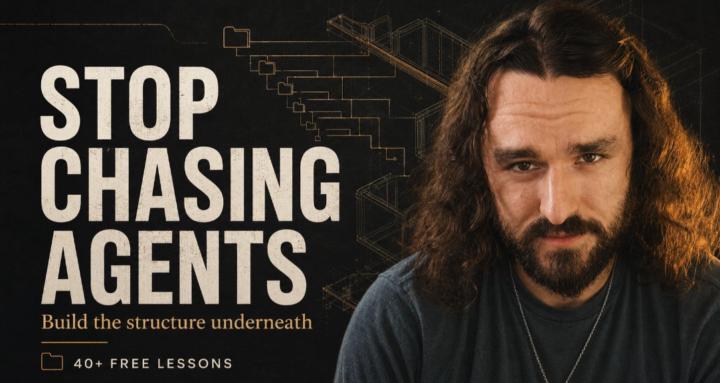
What we give away free beats most paid courses. Build durable AI systems with a Marine vet and Edinburgh researcher. 40+ lessons, growing.
Leaderboard (30-day)
1
🔥
+1774
2

🔥
+1726
3
+1209
4

+1029
5

+614
Powered by