
Write something
Pinned

19h •
🏆 HOW COMPETITIONS WORK FROM NOW ON 🏆
Quick update on the competition schedule so everyone knows what to expect. 📅 NEW CADENCE: TWICE A MONTH We're dropping comps on the 15th and the 30th of every month. Two chances to compete, every month, on a set schedule you can plan around. ✍️ WHY THIS SCHEDULE Spacing them out this way means we can give tailored feedback on every single submission. Not just the winners. Everyone who enters gets notes on what worked, where it's weak, and what to do next. 🎁 WHAT WINNERS GET Along with the prize, every winner gets a 15-minute one-on-one with Jake. Use it to talk through your build, ask questions, or bring whatever else is on your mind. Two comps a month. Feedback on every entry. Direct time with Jake for the winners. Mark your calendar for the 15th and let's get to work!
Pinned
19h •
🎆 GOOD NEWS: THE SALE STAYS OPEN. HAPPY 4TH 🎆
We're holding the last sale through the holiday weekend so nobody misses it. 🎉 Premium: $27 → $14/mo 🎉 VIP: $97 → $67/mo This is the cheapest it will ever be. Once it closes, the price is gone for good. ⏰ New deadline: July 5th, 10:00 AM EST. This is the last extension. If you've been on the fence, sign up now. You lock this rate in and keep it every month going forward. 🖥️ ONE MORE REASON TO JOIN The week of July 5th we're dropping the software we've been building for this community. It goes out for beta testing first, and only Premium and VIP members get access. Sign up before the sale closes and you're in from day one.

👑
⭐
Mar 10 •
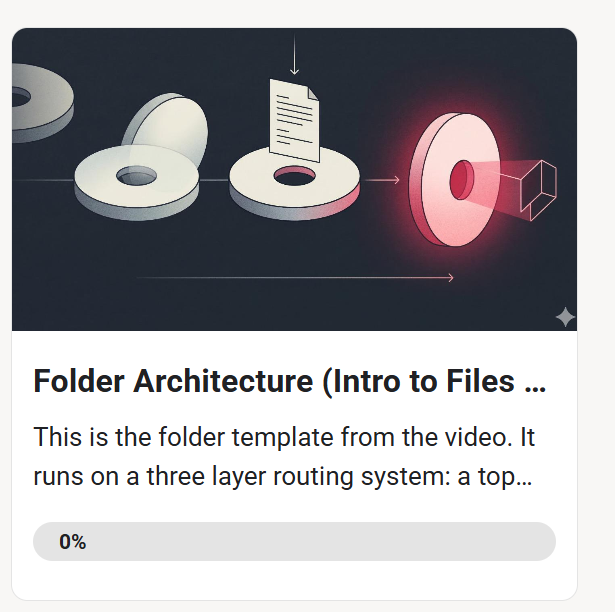
New Video: How I Structure Folders to Replace AI Agents
Just dropped a 23 minute deep dive on the folder architecture I keep showing snippets of. This time I actually walk through the whole thing from scratch and explain every layer. Covers: what tokens are and why they matter, what markdown is, the three layer routing system I use, how CLAUDE.md works, how skills plug into the system, and how naming conventions replace databases. I also built a template you can download and start using today. If you're on Premium or VIP the template files are already in The Vault. If you're on free, the video covers everything conceptually so you can build your own version no need to upgrade! Just want to add more value to my early supporters before the full paid content is done being recorded. Drop your questions in the comments. I want to know where I moved too fast or what needs a deeper dive so I can make the next one better.

2d •
Open Model Beats Opus 4.7 - Runs on your laptop
Ornith-1.0: the open-source coding LLM that matches Claude Opus 4.7 — and runs on your laptop. This open-weights agentic-coding model hits 77.5 on Terminal-Bench and 82.4 on SWE-bench Verified, beating Claude Opus on both, then ships a 9B size you can `ollama run` locally. MIT licensed, four sizes, and it taught itself the harness.

21d •
ICM on enterprise level - introducing Taurus
Folders, not frameworks: how Taurus makes Claude repeatable for a whole team Giving an AI agent the right context at the right moment is still the hardest part of using coding agents like Claude Code in real, daily work. We've all felt it: the agent is brilliant when it knows where it is, and frustrating when it doesn't. So how do you give it that context — reliably, for more than one person? A small team will work but what happens when you try to on-board 100+ people? The popular answers don't scale. Elaborate memory systems help a single power user, but in an enterprise they become a liability: they're hard to curate, easy to pollute, and brittle the moment you add more people and more projects. And anything built around one person's bespoke setup — their servers, their wiring, their mental model — is expensive to onboard a whole team onto. Honestly, the wheel hasn't been invented yet. Nobody has a clean, proven answer for how context should work at enterprise scale. This is where the Interpreted Context Methodology (ICM) changes the conversation. Its core idea is deceptively simple: folder structure as agent architecture. Instead of orchestration code or a sprawling memory store, the context lives in the folders themselves. A workspace is just numbered folders for each stage, with markdown files (CLAUDE.md, conventions, reference material, working artifacts) that load in layers when an agent starts there. The agent reads downward and stops when it has enough — typically 2–8k tokens instead of 30–50k. You "configure the factory, not the product": set the workspace up once, then every run reuses it with new inputs. Outputs are plain text, editable, reviewable at every step. ICM is elegant because it's filesystem-native and human-readable — a non-developer can reshape a workflow by moving files. But it has one practical dependency that's easy to overlook: When you add more and more folders agents begin to skip information. Guidelines are missed, rules are overlooked. What worked for one person doesn't work for another because the model scans economically and thinks it knows enough. The solution is again simple, the agent has to actually start in the right folder. Start in a central place and the layered context never loads; start in the right place and the agent is instantly grounded. In a team, "just cd to the correct directory" is exactly the kind of invisible, error-prone step that breaks repeatability.
1-30 of 2,180

skool.com/cliefnotes
What we give away free beats most paid courses. Build durable AI systems with a Marine vet and Edinburgh researcher. 40+ lessons, growing.
Leaderboard (30-day)
1

🔥
+1756
2

🔥
+1682
3

+1231
4

+981
5

+619
Powered by