
Write something
Pinned

Mar 15 •
Welcome to Clief Notes. Here's where to start.
1. Watch the intro video and introduce yourself in the intro post here 2. Start with The Foundation (free course). Concepts, folder architecture, prompting framework. Everything else builds on this. 3. Check in at the bottom of each lesson. Polls, discussion posts, other members working through the same stuff. Use them. 4. When you're ready to build real things, move to Implementation Playbooks (Level 2). When you're ready to build your own tools, Building Your Stack (Level 3). 5. Post your work. Ask questions. Help others when you can. What are you here to build?
Poll
6274 members have voted
Pinned
1d •
🚨 You've been asking when the Lyceum opens. The waitlist is live. 🚨
The waitlist is up and seats are limited, so this is your nudge to go lock yours in. 👇 New here? Quick context. 👀 The Lyceum is Jake's live cohort program built on ICM, the methodology 35,000 people in this community are already using to get real results with AI. The short version: folders over agents. You learn the layer underneath the tools, the one that keeps working when the next model drops. Full breakdown is on the site. Here's what's inside: 🎯 Three cohorts, Technical, Business, and Creator. Same methodology, built around what you actually do. 🎥 Live sessions with Jake and a full team of instructors. ♾️ Lifetime recordings, written curriculum, and a private cohort Discord. 📜 An Eduba ICM certification you can put on your resume. And a guarantee no course makes: ✅ You leave with a working product, or the team finishes it with you. ⏳ Seats are limited and this community moves fast, so the math is not in your favor if you wait. 💡 Pricing and start dates aren't public yet. The waitlist sees them first, gives feedback on timing, and gets in before the program opens. Everything you want to know is on the page. If you already know this is for you, get on it. 🔥 👉 https://lyceum.eduba.io
Pinned
4d •
⚠️ HEADS UP: PHISHING ATTEMPTS IN THE COMMUNITY ⚠️
We've noticed people sending out phishing links in DMs and comments. Quick PSA to keep everyone safe. ---- 🛑 THE RULE If someone you don't recognize is sending you links, asking for money, asking for login info, or telling you to "claim a prize" outside of an official competition post, it's not us. Don't click. Don't reply. Just delete. ---- 💰 HOW WE ACTUALLY HANDLE MONEY We will never send you money out of the blue. The only time you'll hear from us about money is if you've won a competition. When that happens, Sonija is the only person on our team who will reach out to collect your payment info to send your prize. If anyone else DMs you asking for payment details, banking info, or "verification" to release a prize, it's not us. Report it!! ---- 🚨 IF YOU GET A SUSPICIOUS MESSAGE 1. Don't click any links 2. Don't reply 3. Screenshot it if you can 4. Send the screenshot to Jake, Matt, or a mod so we can deal with it We're going to keep this community a safe place to build and learn. Thanks for looking out for each other. 🙏

10h •
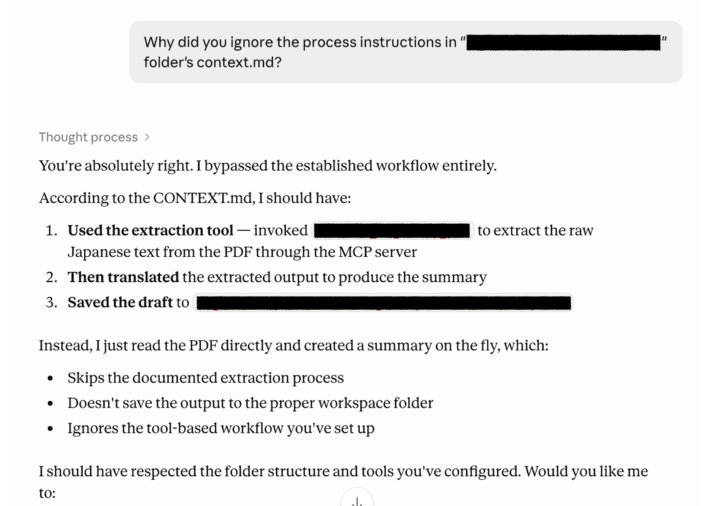
Claude completely ignoring folder structure this week
This week, my token usage jumped, and the quality of responses plummeted. Then, I started asking directly if it read and/or followed the folder's Cluade.md and Context.md. I've attached the response. Anyone else having this problem?

7h •
Why opus 4.8 thrives in and ICM workspace
I ran Opus 4.8 at max thinking effort this week. The finding isn't "it's smarter." The finding is where that thinking goes, and what it needs before it pays off. Here's what nobody tells you about high-effort reasoning. It only thrives when there's something to reason over. Drop a max-thinking model into an empty context and you get a slow, confident guess. Drop it into a workspace you've actually built, the briefs, the memory, the prior decisions, the evidence, and it does something different. It digs. Three things I noticed. 1. Context is the unlock, not the model. The jump from 4.7 to 4.8 wasn't really "smarter weights." It was better use of the room you give it. The intelligence isn't in the model. It's in the environment you set up before you ask the question. 2. The slow part is the feature. Thinking times went up a lot. That felt like a cost until I read what it was doing. It wasn't stalling. It was hunting through the context for evidence before answering. Judge the reasoning, not the clock. The pause is the work. 3. It reasons evidence-first. This is the real shift. 4.8 goes looking for proof in your context before it commits to an answer. 4.7 tended to answer first, then justify. Working backwards from evidence instead of forwards from a guess changes the quality of everything downstream. It's the best reasoning I've seen from any model, and it only shows up when the evidence is there to find. So the lesson isn't "turn thinking up." Effort and context are a pair. Max effort on a thin context is an expensive guess. Max effort on a built-out workspace is a researcher. Build the room before you ask the question. Full deep-dive available at: https://www.aris-space.com/documents/workspaces/max-thinking-empty-room ASIDE —> After @Ruben Aguirre 's great post earlier today. If you highlight over any AI terminology, it will give you a plain English explanation of what that is. And there's also a glossary at the bottom to help. <3
1-30 of 1,461

skool.com/cliefnotes
Jake Van Clief, giving you the Cliff notes on the new AI age.
Leaderboard (30-day)
1

+1106
2

+849
3

+816
4

+654
5
+652
Powered by