
Pinned

👑
⭐
15d •
Welcome to Clief Notes. Here's where to start.
1. Go check out 📚Navigating The Course to see how to get around and what's here. 2. Start with The Foundation. Concepts, folder architecture, prompting framework. Everything else builds on this. 3. Check in at the bottom of each lesson. Polls, discussion posts, other members working through the same stuff. Use them. 4. When you're ready to build real things join in on our Biweekly competitions and win some real cash. ⭐ Competitions Mega Thread 5. If you are wanting to dive into the masterminds, grab all the past templates, artifacts and resources. Upgrade and head into the The Vault for Premium and The Drawing Room (VIP) for VIP 6. Post your work. Ask questions. Help others when you can. What are you here to build?
Pinned
👑
⭐
8h •
🚀 Ledger is live — alpha, go kick the tires
We just shipped the alpha of Ledger 📋 —https://ledger.eduba.io the talent platform we've been building on top of this community. Free for VIP and Premium Members. Here's the idea, plain: every other job board matches on a resume. Ledger matches on ICM. Every candidate in there has been through the methodology you're already using here — that's the whole point. Companies aren't guessing whether someone "gets it." They know it going in. 🎯 It works kind of like a job board, but more anonymous — right? 🕶️ Employers see an anonymized profile: skills, bio, portfolio, a short video intro if you want one. No last name, no email, no current employer. Every conversation runs through the platform's relay instead of real inboxes, so nobody's exposing contact info before they're ready. Two doors in: - 🏢 Company hiring — freelance or full-time — sign up and get access to a pool of people who already speak ICM fluently. - - 🙋 Candidate looking for work — freelance or full-time — list yourself. Takes a few minutes: profile, skills, a short video if you've got one. We're vetting both sides before anyone gets full access — companies and candidates — so the quality holds up on both ends. ✅ That means it's not instant approval; you might wait a beat while we look at it. Bear with us there. It's alpha 🧪, so: things might be rough around the edges, we're watching it closely, and if something breaks or feels off, tell us — that's exactly what this stage is for. Be nice to us and we'll be fast about fixing it. 🙏 Sign up: https://ledger.eduba.io 👇
Pinned

14h •
🏆 WEEKLY COMP #9: THE EDITOR 🏆
🎟️ PRIZE: FREE SEAT IN THE LYCEUM 🎟️ Pick your cohort. Technical, Business, or Creator. Your call. 🎯 PICK YOUR DOMAIN The domain is yours. Pick something specific. Pick something you'd actually use. A few sparks to get you thinking: - 💻 Code review editor for a specific language and level (junior TypeScript, senior Python) - 📊 Pitch deck editor for pre-seed founders - 🎨 Grant application editor for arts nonprofits - 📄 Resume editor for career switchers into tech - 📰 Op-ed editor for policy publications - 🎙️ Podcast script editor for interview shows - ⚖️ Legal brief editor for civil litigation - 📋 Product spec editor for early-stage PMs - 🎓 Academic paper editor for one specific field The more specific, the better. "Writing editor" is too broad. "Op-ed editor for tech policy publications targeting a policy audience" is right. 🗂️ THE METHODOLOGY If this is your first comp, welcome. Here's what you need to know: This week (and every week) you're learning interpretable context methodology. Folders as architecture. Each file does one job well. Your editor is a folder with five things: - 📄 identity.md (who the editor is, what work they review) - 📐 rules.md (how they critique) - 💬 examples.md (what good critique looks like) - 📚 reference/ (style guides, checklists, frameworks the editor uses) - 📖 README.md (how to use it) Drop the folder into a Claude project. Claude becomes the editor. Reusable. Shareable. Portable. 🔥 THE ANGLE THIS WEEK An editor is NOT a rewriter. An editor doesn't do the work for you. An editor surfaces what's weak and pushes you to fix it. That distinction is the whole assignment this week. When someone hands the editor a draft, the editor shouldn't produce a "fixed" version. The editor should point at the three lines that don't work, explain why, and hand it back to the writer to solve. ✍️ Generic feedback like "consider strengthening your intro" is a fail. Specific feedback like "your intro assumes the reader already knows what a Series A is, but this pub is read by generalists, so lead with the stakes instead of the jargon" is what a real editor does.

2d •
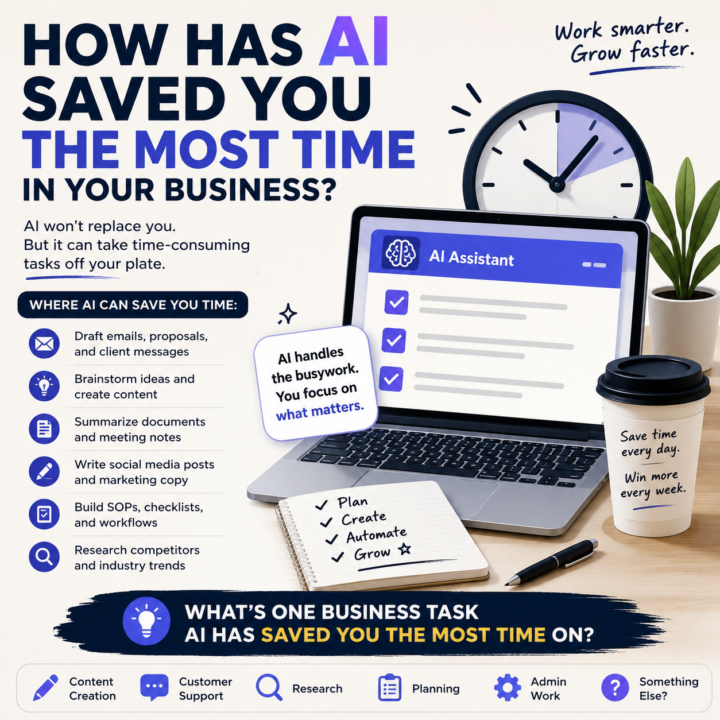
How has AI saved you the most time in your business?
When I first started using AI, I thought it was mainly for writing content. But the more I explored, the more I realized it's like having an extra team member that can help with brainstorming, research, planning, organizing ideas, drafting emails, creating marketing content, analyzing information, and much more. The biggest mistake I see new business owners make is expecting AI to do everything perfectly on the first try. Instead, treat it like a collaborator. Give it context, explain your goals, and refine the conversation. The quality of the output usually improves with the quality of your input. A few ways AI can save time every week: - Draft emails, proposals, and client messages. - Brainstorm content ideas when you're stuck. - Summarize long documents or meeting notes. - Create social media captions and marketing copy. - Build SOPs, checklists, and workflows. - Research competitors or industry trends faster. Even saving 30–60 minutes a day adds up to dozens of hours over the course of a year time you can spend serving customers, improving your products, or growing your business. What's one business task AI has saved you the most time on?

2d •
You're Probably Missing A Key Part of Model Agnostic Structure
If your main files still sit under ~/.claude or ~/.codex, you're still not quite there yet, or more importantly, safe. Think: if the Claude app decided to nuke itself tomorrow, wiped the whole application folder and everything inside it, how cooked are you? With what Grok AI pulled off recently (downloading whole Repos of information without permission), you can never be too safe. <- PLEASE read up on this if you're not caught up. Now, however ridiculous the idea you might think, the proposition still stands. If your instructions, context routing, and memory all live inside ~/.claude (or wherever your app stores its files), you don't have a model-agnostic structure. You have an app-dependent one. If Claude suddenly decides to stop supporting certain file customizability and directly, it'll be an immense and frustrating headache to fix. While it likely won't happen soon, or at all tbh, the simple fix is decoupling. My whole global system, I personally named it "BABEL," lives in its own folder directly, version-controlled, completely separate from any app folder. What sits inside the Claude and Codex apps is just a thin layer of symlinks and shims pointing back to my global ICM structure. If my Claude wiped its own folder right now: - My instructions, memory, registries, skills, docs are completely fine. - Restoring is one simple prompt for me. Re-point the symlinks, and I'm good. - Want to move to a different client entirely? Same source files, new shim layer. The brain doesn't move at all, and even a fresh, completely new LLM harness is good enough to wire itself in with symlinks. Was inspired to post this after the recent Grok incident; happy to break down how the symlink layer works if anyone wants it.
1-30 of 2,538

skool.com/cliefnotes
What we give away free beats most paid courses. Build durable AI systems with a Marine vet and Edinburgh researcher. 40+ lessons, growing.
Leaderboard (30-day)
1

🔥
+1753
2

+1203
3

+1041
4

+832
5

+768
Powered by