
Write something

May 22 •
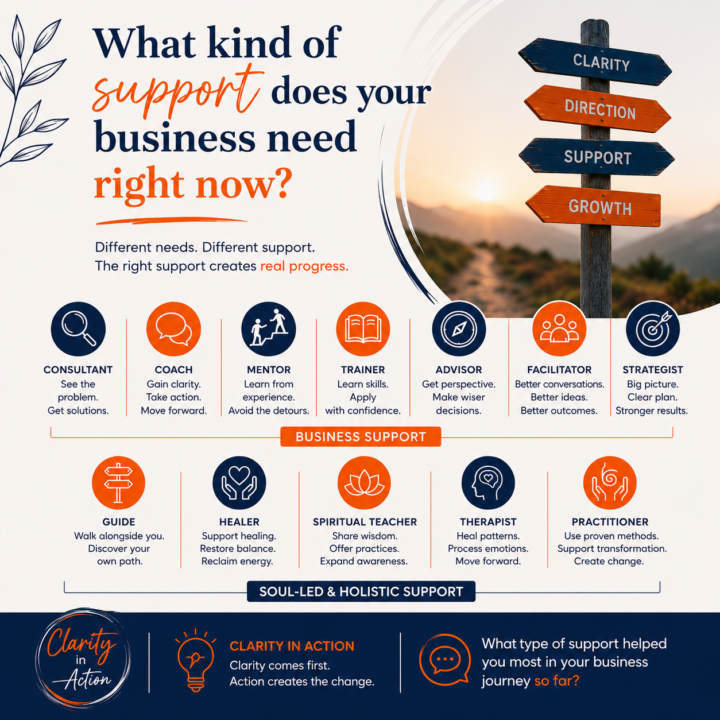
What kind of support does your business need right now?
I made this post on my socials yesterday. I am resharing it here because I believe it is important to understand the roles and functions of different experts. At one of our 4N meetings recently, I had a conversation about getting the right support in business. It got me thinking because very often we say things like: “I need help growing my business.” But help with what exactly? More clients? Better decisions? Strategy? Accountability? Knowledge? Direction? Healing? Guidance? Depending on what you need, the type of support matters. Here is a simple reference point: 📌 Consultant Identifies problems and gives solutions. “Here is what I see and what I recommend.” 📌 Coach Helps you think, gain clarity and move forward through questions and accountability. “What do you think is the right next step?” 📌 Mentor Shares personal experience and guidance. “I have walked this road before.” 📌 Teacher or Trainer Transfers knowledge and skills. “Let me show you how this works.” 📌 Advisor Provides guidance based on expertise and experience. “If I were in your position, this is what I would consider.” 📌 Facilitator Guides a process, discussion or group experience and helps people move towards an outcome. “Let me guide the process and help create clarity.” 📌 Strategist Looks at the bigger picture and creates direction, priorities and a plan. “Where are you now, where do you want to go, and what is the best path forward?” And for those in the soul-led and holistic space, there are a few more: 📌 Guide Walks alongside you during a personal or spiritual journey. “I will walk with you while you discover your own path.” 📌 Healer Supports emotional, energetic, physical or spiritual wellbeing. “Let us look at what may need attention, balance or restoration.” 📌 Spiritual Teacher Shares wisdom, practices and perspectives for growth and awareness. “Here is a teaching or practice to explore.” 📌 Therapist Helps people process emotions, patterns, trauma or challenges through evidence-based methods.
1
0
May 4 •
Monday check-in for the Fleet
Let’s keep this simple and real. A question I often get is: "Do you need more clients?" Most people say yes straight away. But in business, that answer, without context, means little. Before thinking about more clients, pause and look at this: What is your target this month? What have you already achieved? What is the gap? Now bring it into today. How many clients do you realistically need this week? And more importantly, what needs to happen today to move that forward? Forget ten things and a long list. One or two clear actions. It could be: reaching out to 3 people following up on conversations sharing something valuable making an offer Keep it simple. Keep it focused. Clarity removes noise. And when the noise is gone, action becomes much easier. Clarity in Action step: Write down your number. How many clients do you need right now? Then decide: What is the one action you will take today to move closer to that number? If you are in, share your number and your action below. Let the Fleet support you. Make it so.

Mar 28 •
What do you want?
Such a simple question. Surprisingly, many business owners do not know what they actually want. And when we don't know what we want, external noise can disrupt our operations. It also influences how we make decisions. Or not. How we price our services. Yes, knowing what you want is a part of your business planning. It must be. And it's not fun. I mean, who loves planning all the time? No need to be that extreme. So today I want to invite us to find time and reflect on the following: When my business is ideal and aligned, this is what happens….. Go and describe your perfect business in one day, one week, one month, one lightyear… See it and feel it in your soul. Blessings to all 🖖🙌

Feb 24 •
Avoid Decision Drift
I was LIVE this late morning on LinkedIn and other platforms. I covered a few topics, but the one that is worth your attention is about making decisions and avoiding decision drift. When you're caught in the paralysis of overthinking, waiting for perfect timing, or second-guessing every move, you're experiencing Decision Drift. It's the silent killer of business momentum. ➢ Overthinking turns simple choices into complex problems ➢ Waiting for perfect timing means missing good timing ➢ Second-guessing yourself erodes confidence with every delay "It is possible to commit no mistakes and still lose. That is not a weakness; that is life." – Captain Picard Even Starfleet captains need clarity before they act. The key isn't avoiding mistakes – it's making decisions with intention.

Feb 10 •
The Pomodoro Technique
Hi, Crew! I am currently looking into productivity techniques, as some of my clients experience challenges in this area. So today, I am sharing the Pomodoro Technique and what it is all about. The Pomodoro Technique is a time management method designed to improve focus, reduce procrastination, and prevent mental fatigue. It was created by Francesco Cirillo in the late 1980s. The name comes from the tomato-shaped kitchen timer he used as a student. Pomodoro means tomato in Italian. Here is how it works in its simplest form. Choose one task. Be specific. Set a timer for 25 minutes. Work on that task only and avoid distractions or multitasking. When the timer rings, stop. Take a 5-minute break. After four cycles, take a longer break of 15 to 30 minutes. One 25-minute work session is called a Pomodoro. Why it works This technique leverages time-constrained psychology. When you know you only have 25 minutes, resistance drops. The brain perceives the effort as manageable. It also reduces cognitive switching costs because you commit to one task only. Regular breaks prevent cognitive fatigue and help maintain productivity over longer periods. When to use it ☞ When you feel overwhelmed ☞ When you are procrastinating ☞ When a task feels too big ☞ When you need structure ☞ When you want measurable progress You can adapt it. Some people work for 50 minutes and rest for 10. The principle is not the exact timing, but focused sprints combined with deliberate rest. If this resonates, adapt it to your needs and use it. Make it so 🚀

1-11 of 11
powered by

skool.com/clarity-in-action-fleet-7930
Together, we build a working business plan for clarity, structure, and confident decisions.
Suggested communities
Powered by