
Write something

4d •
🌱 The Monday Pulse | Belonging Is a Basic · Part 3
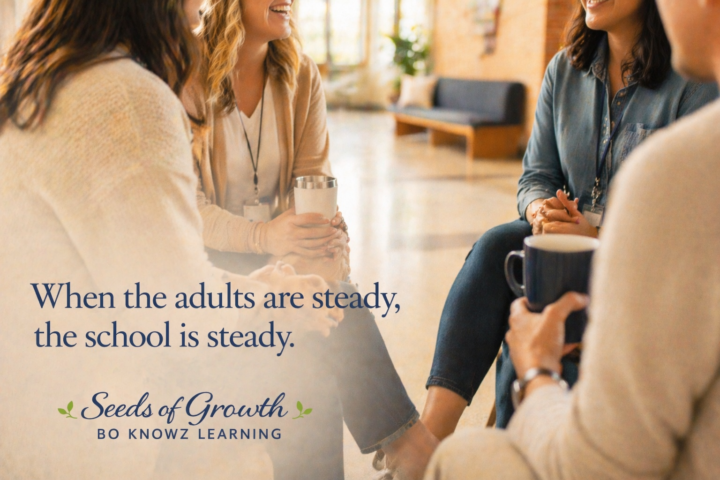
This week we're shifting the lens. We've talked about what belonging means for students. We've talked about what happens in the brain when it's missing. This week, we're talking about YOU. And your staff. Because here's the truth I've seen play out in school after school across 34 years: Adult culture mirrors student culture. Always. When teachers feel unseen, undervalued, and unsafe to take risks — students feel it. Not because anyone says a word. But because nervous systems are contagious. A leader's steadiness becomes the school's steadiness. 💬 This week's question: How steady do your adults feel right now? Not your programs — your people. What's one signal you've noticed lately — positive or concerning — about the emotional climate your staff is living in? Drop it below. This is a safe space to be honest. (This week's Seeds of Growth post goes deep on this 👉 https://www.boknowzlearning.com/post/adults-feel-first) — Dr. Kim
0
0
7d •
Friday Wins!
Happy Friday, Steady Schools community. This week we talked about brains. About biology. About what's really happening when a student shuts down — and what it means for how we lead. Heavy stuff. Important stuff. So today I want to bring it back to you. Because here's what the research also tells us: it's not just students whose nervous systems need safety. Leaders do too. You do too. A regulated leader builds regulated classrooms. A steady school starts with a steady leader. 💬 This week's Friday Win question: What's one moment from this week — big or small — where you responded to a person rather than a behavior? Where you looked underneath and led from there? It might have been with a student, a staff member, a parent — or even yourself. Share it below. These are the wins that don't make it into data reports. But they are the ones that change schools. I'll be reading every single one. 💛 — Dr. Kim
0
0

7d •
From the Steady Schools Framework | When the Brain Feels Safe
I want to share something with you that reframes everything. Chronic absenteeism. Rising behavior referrals. Disengagement. We tend to respond to these as discipline problems. But neuroscience tells a different story: these are neurological responses to environments that don't yet feel safe enough to learn in. Here's the biology in plain language: When a student feels safe, seen, and connected, their brain releases the chemistry that makes learning possible. Motivation. Focus. Emotional stability. When are those conditions missing? The stress response takes over. And a brain in survival mode has one job: to protect itself. Not learn. Not grow. Survive. This is why the Steady Schools Framework puts culture before curriculum. Always. You can have the strongest lesson plan in the building — and if the nervous systems in that room don't feel safe, it won't matter. ✨ Try this in your building this week: Walk your hallways with a different lens. Don't look at behavior. Look for signals. What is that student's nervous system trying to communicate? When we respond to the need underneath rather than the behavior on top — everything changes. That's not soft leadership. That's the most rigorous work we can do. — Dr. Kim
0
0

9d •
🌱 The Monday Pulse | Belonging Is a Basic · Part 2
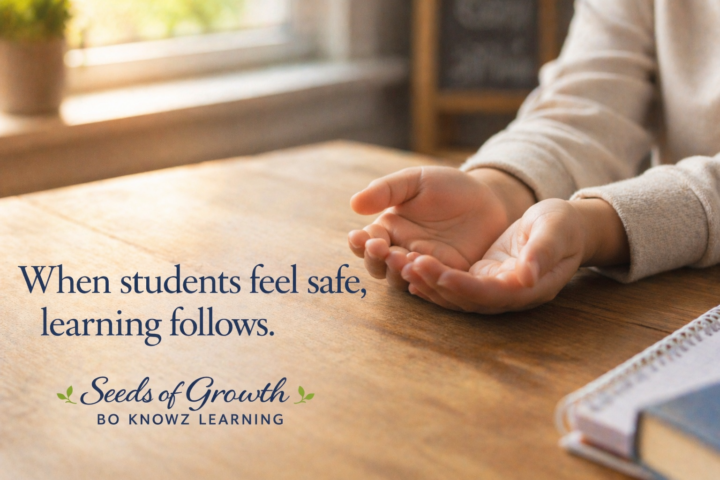
This week we're going deeper on Belonging — and we're taking it to the brain. Here's something I want every leader in this community to sit with: When a student shuts down, goes quiet, or checks out — that's not defiance. That's biology. A brain that doesn't feel safe cannot learn. Full stop. It can only protect itself. And here's the part that stops leaders in their tracks when I share it in schools: we are always building something in our students. The question is what. 💬 This week's question: Think about a student whose behavior has puzzled or frustrated you — or one you remember from your career. Looking back, what do you think their nervous system was actually trying to tell you? Drop your reflection below. There's no right answer — just honest ones. (And if you want to go deeper on the neuroscience behind this, this week's Seeds of Growth blog is worth a read 👉 https://www.boknowzlearning.com/post/brain-safe) — Dr. Kim
0
0
16d •
Building Belonging in Schools
Here's something I've seen over and over in 34 years of school leadership: Belonging is not a feeling you can manufacture with a program. You can hang every banner, launch every initiative, train every staff member on inclusion — and students will still walk your hallways feeling invisible. Because belonging isn't created by what's on the walls. It's created by what happens in the moments between the announcements. The look a teacher gives when a kid walks in late. The way a leader responds when someone brings bad news. The culture of a staff meeting — who speaks, who stays quiet, and why. In the Steady Schools Framework, Belonging is one of the foundational pillars of school culture — and it lives in the micro-moments, not the macro-programs. One question to sit with today: ✨ If a brand new student walked into your school tomorrow with no context at all — no one to guide them, no welcome buddy — what would they feel within the first 10 minutes? That answer tells you everything about where your culture actually is. Read more on this in this week's Seeds of Growth blog at boknowzlearning.com →
0
0

1-30 of 54
powered by

skool.com/bo-knowz-learning-7950
Your home for practical, uplifting, and evidence-based tools in Social-Emotional Learning, Emotional Intelligence, leadership, and family engagement.
Suggested communities
Powered by