
24h • Lobby
So Your Back Hurts, So What?
So many of us start our fitness journey worried about our backs.
I had aches in my back throughout my teens, and always thought it was from school chairs.
And then one day I was hyperextending on a glute-ham extension. Basically, I was popping up like a dolphin because my body could do it.
Then I felt a brruurrrrrp! in my back.
I stopped, got off the machine, and then couldn't put socks on without collapsing for a year and a half.
"Heavy lifting seems dangerous", we think, "because I tend to hurt my back when I pick up heavy things!"
On the surface that makes so much sense, right? It's simple logic, "when I picked up that lawnmower I hurt my back."
So picking up heavy things is what hurts your back, thus heavy lifting is dangerous. Right? Wrong.
There's the truth: Heavy lifting can be dangerous, if you aren't conditioned to it in a structured environment. That means you have to train your body to be able to handle heavy lifting. How do you do that? By lifting slightly less heavy things with a coach!
But let's dive a little deeper into what's going on here, because I want to break some beliefs, not just preach to you. The logic behind "I get hurt when I pick up heavy things means that lifting heavy things is dangerous" is flawed. It is an inaccurate view of what is happening. So let's go on a little tangent. Say you have an old crane and you want to pick up something heavy with it. No problem, the crane was made to pick up heavy things. So you turn the crane, lower the hook, grab the object, pick it up, and then the crane tips with you in it. Afterwards you conclude, this heavy object ruined my crane! So cranes must not be built to pick up heavy objects!
That is what you're doing when you're saying heavy lifting is dangerous, by the way. You're ignoring that several things need to be in place before you can operate properly or safely. What's missing in the crane's case? A foundation or a support. Nothing fastened the crane to the ground, so when it picked up the object it tipped over. The same could be said for trying to lift the object with a hemp wench instead of a steel one. Or with a crane arm welded by a carpenter, or with an inebriated driver.
All of these things interrupt the function of the system and cause it to fail. The failure for your back can feel catastrophic. After all, the back is one of the most interconnected muscle groups in your body. Any system with too many moving parts has a lot of opportunities for failure.
But here's the thing about bodies, they adapt. And even injured backs recover and adapt to the demands you put on them.
Chronic nonspecific low back pain sufferers, I have a solution for your pain: A recent meta analysis looked at people who've had back pain for 12 weeks or longer from a series of medical databases. Their pain was without a clear cause, so they couldn't remember the original injury. Also, all the participants were aged 30-60, so in the average adventurer age group.
I've linked to it below for the nerds among you.
What they found was that lifting heavy things improves:
- pain intensity
- quality of life
- disability metrics
Your back should not be babied. It should be guided through into strength in a structured environment.
I'm a perfect example of this. I have struggled with back pain for the vast majority of my life. The pain has generally reduced in duration and intensity as I've gotten stronger. I am quite careful with my programming to prevent pain. But whenever I do "throw my back out" recovery time has gone from months to weeks to even days. This has all come from a structured, dynamic workout environment.
Oh and the exercise I was doing when I got hurt? I was holding 25 lbs. The problem was that I was a beginner and didn't know what I was doing. I can now do that exercise with no pain. And we've isolated the cause to a much earlier injury when I was a child.
Weight training finds injuries we already had more than it creates new ones. A good coach catches and works around these issues.
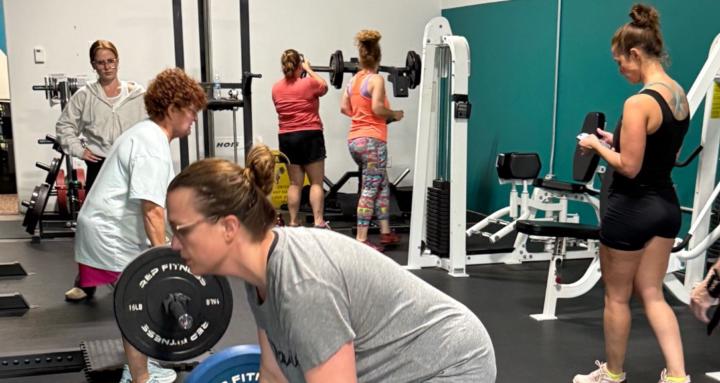
I see it over and over again here. Clients come in afraid of movement patterns because they got hurt doing it once. Then over months or years they tend to forget they even had the fear once careful training was a part of the picture.
These clients all followed the instructions of their trainers, in structured programs for months to build their new foundation. Their backs become well-maintained cranes. Good as new, sorta.
Do we get it perfectly every time? No.
We've lost some good adventurers to overeagerness. Sometimes we get excited when we try new things, or sometimes coaches get excited with new clients. The emotion overtakes the structure and the structure is lost.
And then that adventurer loses trust in the coach's ability because they got hurt too early in the game. And this happens at the exact moment that they stand to benefit most from continuing training.
That is a shame, and thankfully it doesn't happen often.
But the next time you're at the Forge, ask around. I'm certain one in every 3 among you has back pain that has steadily improved since you started working out.
I know mine has!
For the mega nerds and Shapesmiths among you, another great resource on this topic is Stuart McGill. He has made an entire career out of the mechanics of your back.
4
2 comments
So Your Back Hurts, So What?
skool.com/bjorns-lobby-4142
Bjorn Fitness's FREE group, tons of fitness content, regular lives, and more!
Leaderboard (30-day)
1

+18
2

+12
3

+10
4

+8
5

+7
Powered by