
Write something
Pinned

May 19 •
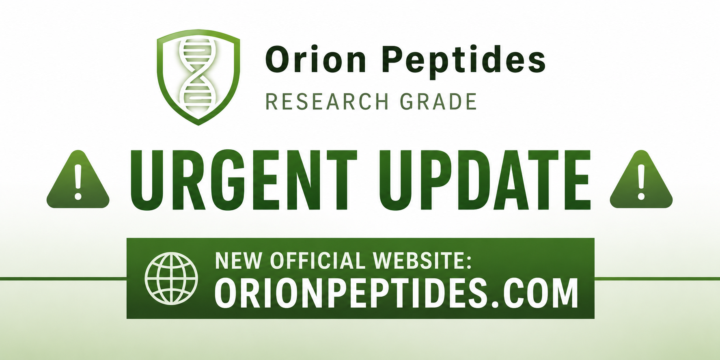
🚨 ORION PEPTIDES SERVICE UPDATE 🚨
Firstly, we want to sincerely apologize for the recent downtime and temporary interruption to our services. As Orion continues to grow, we needed to implement major backend and infrastructure changes to help us provide a faster, more secure, and more reliable experience moving forward. We’re happy to confirm that services have now been restored and we are officially back online under our new domain: Orion Peptides ✅ Ordering systems are operational ✅ Existing orders and support requests are still being handled normally ✅ Customer accounts and data remain secure ✅ Future updates and communications will come from our new domain These upgrades were necessary to help prepare Orion for future growth, improved security, and a smoother overall experience for our customers and research community. We truly appreciate everyone’s patience and continued support during this transition. For support or assistance: [email protected] — Orion Peptides
Pinned
Jan 6 •
🛑 Community Rules: Read Before Posting 🛑
Welcome to the team! To keep this space free, educational, and safe for everyone, please read and respect the following guidelines. We are here to research and learn, not to spam or endanger others. 1. NO Selling or Solicitation (Zero Tolerance)🚫 : - Do not use this group to sell your own products, promote your own affiliate links, or push "Underground Lab" (UGL) items. - Any member caught sliding into DMs to sell substances or unverified services will be banned immediately. 2. This is NOT Medical Advice ⚠️ - While I am a professional Biohacking Coach and Trainer, I am not a doctor, and neither are most members here. - Everything shared here is for informational, educational, and research purposes only. - Do not prescribe protocols to others as absolute medical fact. - Always consult with a qualified medical professional (like our partners at Optimal Clinic) before starting any new therapy. 3. Research & "Bro-Science" 🧪 - We love new experiments, but please distinguish between anecdotal experience (what worked for you) and scientific fact. - If you make a bold claim, try to back it up with a source or clearly state that it is just your personal experience. - Help us fight misinformation by calling out bad data respectfully. 4. Respect & Professionalism 🤝 - We are navigating a complex industry together. Treat fellow researchers with respect. - No flaming, harassment, or bullying. - Disagreements are fine; disrespect is not. 5. Privacy Matters 🔒 - Do not post private personal information (addresses, phone numbers, etc.) or sensitive payment details regarding vendors publicly. Keep the feed clean and safe. 🔒
1h •
Can Elamipretide Delay Ovarian Aging? New Research in Mice and Human Oocytes
A new study found that the mitochondria-targeting peptide improved age-related declines in oocyte quality and fertility in mice. But how close are we to doing the same in humans? Female reproductive aging remains one of the most difficult problems in modern medicine. As reproductive age increases, the quantity and quality of available oocytes can decline. This decline is associated with lower fertility and an increased risk of certain adverse reproductive outcomes. Scientists have spent years searching for ways to slow, prevent, or potentially reverse parts of this process. A new study has now put an unexpected candidate back into the spotlight: Elamipretide. Also known as SS-31 or MTP-131, elamipretide is a short, four amino acid peptide designed to target mitochondria. In a 2026 study published in Aging Cell, researchers reported that elamipretide improved several measures of age-related ovarian and oocyte decline in mice. The treatment was also associated with improved fertility outcomes in aged mice. The researchers then examined human oocytes in laboratory culture. They found that elamipretide improved several measures of oocyte maturation and developmental competence in vitro, particularly in oocytes from women aged 35 and older. That sounds enormous. And scientifically, it is certainly interesting. But it is also important not to jump from: “Elamipretide improved fertility related outcomes in mice and laboratory cultured human oocytes” to: “Elamipretide reverses ovarian aging in women.” Those are very different claims. Here is what the researchers actually found. What Is Elamipretide? Elamipretide is a small peptide consisting of four amino acid components. It is also known by several names, including: - SS-31 - MTP-131 - Bendavia - Elamipretide Its molecular weight is approximately 639.8 g/mol. What makes elamipretide particularly interesting is its interaction with mitochondria. Mitochondria are often described as the powerhouses of cells because of their central role in cellular energy production.
1
0

24h •
The New FDA GLP-1 Eye Warning: What Do the Numbers Actually Show About NAION?
A closer look at rare NAION events and the difference between relative and absolute risk If you've been online over the past day, you've probably seen some version of the headline: “GLP-1 drugs linked to vision loss.” Or perhaps: “Ozempic and Zepbound now carry a blindness warning.” The headlines are alarming. And the underlying condition is serious. But the numbers matter. On November 9, 2026, the U.S. Food and Drug Administration issued a Drug Safety Communication requiring warnings about a potential increased risk of non-arteritic anterior ischemic optic neuropathy, or NAION, across GLP-1 receptor agonist medications. NAION is rare, but it can cause sudden and sometimes permanent vision loss. That absolutely deserves attention. However, there is a major difference between saying that a relative risk may be increased and saying that large numbers of people taking GLP-1 medications are losing their vision. Those are not the same thing. And when we look closely at the FDA's own analysis, the story becomes much more nuanced. What Exactly Is NAION? NAION stands for non-arteritic anterior ischemic optic neuropathy. It occurs when blood flow to the front part of the optic nerve is disrupted or reduced. The optic nerve carries visual information from the eye to the brain. Damage to this structure can therefore cause significant visual problems. The FDA describes NAION as a rare condition that can cause: - Sudden vision loss or decreased vision - Usually painless symptoms - Symptoms affecting one eye - Blurred or missing areas of vision - Visual field defects, including blind spots or tunnel vision - Changes in colour perception - Reduced central sharpness In some cases, the visual impairment can be permanent. This is important: Sudden or unexplained changes in vision are not something to wait and see about. Anyone experiencing sudden, painless vision loss or significant new visual changes should seek prompt medical evaluation. What Did the FDA Actually Announce?
1
0

2d •
David Sinclair’s Peptide Picks: What the Research Actually Shows About GHK-Cu, Epitalon, and Apelin
Peptides have gone from a relatively niche topic in laboratories and biohacking communities to something people now discuss at the gym, on podcasts, and even at dinner parties. The problem is that public interest has grown faster than the evidence. That makes a recent episode of Lifespan, featuring Harvard aging researcher Dr. David Sinclair and co host Matthew LaPlante, particularly interesting. Rather than simply presenting peptides as the next miracle in longevity, the discussion explored both the biological potential and the enormous gaps in the research. Sinclair highlighted three compounds that he finds particularly interesting: 1. GHK Cu 2. Epitalon 3. Apelin All three have legitimate scientific literature behind them. But they do not have equivalent levels of evidence, and none should be confused with a proven anti aging treatment. That distinction matters. The Peptide Boom Has Changed the Conversation One of the most important points raised during the discussion is that peptide medicines have already transformed public attitudes toward injectable therapies. GLP 1 based medicines helped move peptide biology into mainstream culture. Many people who would never previously have considered a peptide injection are now familiar with medications based on naturally occurring signaling molecules that have been modified to improve stability and duration of action. That scientific principle is important. Natural peptides are often broken down rapidly in the body. Researchers can sometimes alter a molecule in ways that improve its stability while preserving or modifying its biological activity. A small chemical or structural change can dramatically affect how long a peptide remains active. But that success story has also created a problem. The public can easily assume that because some peptide medicines have been extensively tested and approved, other peptides sold online must have similar levels of evidence. They do not. A pharmaceutical peptide that has completed large controlled clinical trials is fundamentally different from an experimental compound supported primarily by cell studies, animal experiments, or small early studies.

1-30 of 1,217
powered by
skool.com/biohacking-and-longevity-group-3757
All-in-one peptide education community. 🧪
Dosing guides, storage protocols, stacking frameworks, vendor intel, GLP-1 research, and expert support.🧬
Suggested communities
Powered by