
Write something
Pinned

May 19 •
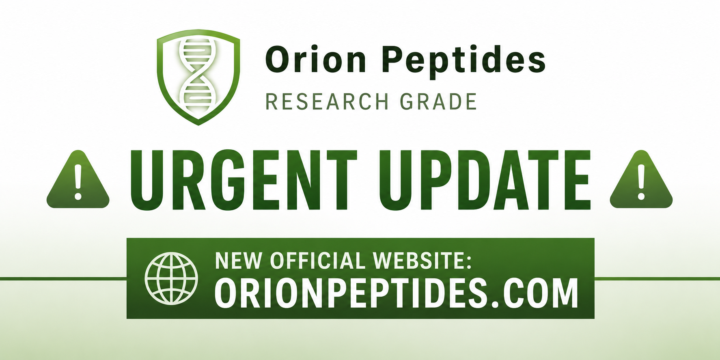
🚨 ORION PEPTIDES SERVICE UPDATE 🚨
Firstly, we want to sincerely apologize for the recent downtime and temporary interruption to our services. As Orion continues to grow, we needed to implement major backend and infrastructure changes to help us provide a faster, more secure, and more reliable experience moving forward. We’re happy to confirm that services have now been restored and we are officially back online under our new domain: Orion Peptides ✅ Ordering systems are operational ✅ Existing orders and support requests are still being handled normally ✅ Customer accounts and data remain secure ✅ Future updates and communications will come from our new domain These upgrades were necessary to help prepare Orion for future growth, improved security, and a smoother overall experience for our customers and research community. We truly appreciate everyone’s patience and continued support during this transition. For support or assistance: [email protected] — Orion Peptides
Pinned
Jan 6 •
🛑 Community Rules: Read Before Posting 🛑
Welcome to the team! To keep this space free, educational, and safe for everyone, please read and respect the following guidelines. We are here to research and learn, not to spam or endanger others. 1. NO Selling or Solicitation (Zero Tolerance)🚫 : - Do not use this group to sell your own products, promote your own affiliate links, or push "Underground Lab" (UGL) items. - Any member caught sliding into DMs to sell substances or unverified services will be banned immediately. 2. This is NOT Medical Advice ⚠️ - While I am a professional Biohacking Coach and Trainer, I am not a doctor, and neither are most members here. - Everything shared here is for informational, educational, and research purposes only. - Do not prescribe protocols to others as absolute medical fact. - Always consult with a qualified medical professional (like our partners at Optimal Clinic) before starting any new therapy. 3. Research & "Bro-Science" 🧪 - We love new experiments, but please distinguish between anecdotal experience (what worked for you) and scientific fact. - If you make a bold claim, try to back it up with a source or clearly state that it is just your personal experience. - Help us fight misinformation by calling out bad data respectfully. 4. Respect & Professionalism 🤝 - We are navigating a complex industry together. Treat fellow researchers with respect. - No flaming, harassment, or bullying. - Disagreements are fine; disrespect is not. 5. Privacy Matters 🔒 - Do not post private personal information (addresses, phone numbers, etc.) or sensitive payment details regarding vendors publicly. Keep the feed clean and safe. 🔒
2d •
From Fentanyl Precursors to Black Market Peptides: What the New Report Reveals
Peptide Regulation, Supply Chain Risks and Research Integrity The global peptide market is expanding rapidly, driven by growing interest in weight management, skin pigmentation, tissue repair, recovery, and longevity research. But alongside legitimate pharmaceutical development and scientific investigation, a less transparent market has emerged, raising serious questions about product quality, manufacturing practices, and accountability. A report published by The Wall Street Journal on October 6, 2026, highlights a particularly concerning development: some Chinese chemical manufacturers previously linked to the supply of fentanyl precursor chemicals are now marketing unapproved peptides to customers in the United States. The report, by Patricia Kowsmann and Sara Ashley O’Brien, describes a market in which certain vendors advertise substances associated with tanning, tissue repair, and weight loss. Cryptocurrency payments and online sales can make these transactions more difficult to monitor. The implications extend beyond one country or one group of compounds. They raise a broader question for the peptide industry: how can researchers distinguish a credible research supply chain from a market operating with limited transparency and accountability? What Did the Investigation Find? According to the Wall Street Journal, some chemical manufacturers with reported connections to illicit fentanyl precursor supply chains have entered the growing market for unapproved peptides. The distinction is important. This is not evidence that every Chinese chemical manufacturer, every peptide producer, or every research peptide supplier participates in illegal activity. It is evidence of a potentially serious overlap between parts of the illicit chemical trade and a market experiencing growing consumer demand. The Drug Enforcement Administration has previously announced criminal charges against China based chemical companies and individuals accused of supplying chemicals used in fentanyl production.
0
0
2d •
Gonadorelin: Hypothalamic Peptide Signaling in Modern Research
Endocrinology and Peptide Research Gonadorelin is a synthetic form of gonadotropin releasing hormone (GnRH), a naturally occurring peptide that plays a central role in reproductive endocrinology. Its importance lies not in broad, unproven claims about cellular rejuvenation or metabolic optimization, but in a well characterized biological pathway connecting the brain, pituitary gland, and reproductive organs. Research involving gonadorelin and related GnRH compounds provides valuable insight into hormonal signaling, receptor activation, and the importance of biological timing. Understanding these mechanisms also illustrates why the pattern of a signal can matter as much as the signal itself. What Is Gonadorelin? Gonadorelin is a decapeptide, meaning it contains ten amino acids. It corresponds to the sequence of endogenous human GnRH, a hormone produced by specialized neurons in the hypothalamus. Its principal physiological role is to signal the anterior pituitary gland to synthesize and release two important hormones: • Luteinizing hormone (LH): Involved in ovulation and the regulation of sex steroid production in the ovaries and testes. • Follicle stimulating hormone (FSH): Involved in ovarian follicular development and supporting sperm production. These hormones act on the reproductive organs and help regulate processes such as steroidogenesis, follicular development, and spermatogenesis. The broader regulatory network is known as the hypothalamic pituitary gonadal, or HPG, axis. Why Pulsatile Signaling Matters One of the most important findings in GnRH research is that the timing of hormonal signals influences the biological response. Under normal physiological conditions, hypothalamic GnRH neurons release the hormone in pulses. The pituitary responds to these changing signals by regulating LH and FSH production. Research has demonstrated that pulse frequency can influence the relative expression of the genes responsible for these hormones. In experimental models, relatively lower pulse frequencies tend to favor FSH subunit expression, while higher frequencies tend to favor LH subunit expression. Other factors, including sex steroids, activin, and inhibin, also contribute to the response.
0
0

2d •
🚨 SCAM ALERT: Beware of Websites Using Orion Peptide's Name and Branding
I was recently contacted by the team behind Orion Peptide, who raised concerns about websites they believe could confuse customers looking for their business. They asked me to help spread awareness so that researchers and customers can take extra care when shopping online. The team specifically highlighted two websites: - OrionPeptides.com: https://orionpeptides.com/ - RetaClub: https://www.retaclub.co.uk/shop The concern is that similar names, branding and product mock-ups could lead customers to believe these websites are connected to Orion Peptide when that relationship has not been established. Which Website Is the Real Orion Peptide? According to the team, the official Orion Peptide website is: https://orionpeptide.com/ If you are looking for Orion Peptide, check the URL carefully before placing an order or sharing your payment details. OrionPeptides.com uses a very similar business name, while RetaClub operates a separate online research-peptide shop. The Orion team has also raised concerns about the use of similar product mock-ups on RetaClub. Customers should not assume that these businesses are affiliated with Orion Peptide simply because of similarities in their names or product presentation. Why This Matters Online shoppers need to know exactly who they are buying from. Confusingly similar names and product imagery can make it harder to identify a supplier, verify its claims and determine where products originate. The Orion team believes these similarities warrant a public warning. I have not independently established that either website has committed fraud, so customers should distinguish the reported concerns from proven misconduct. Nevertheless, it is sensible to verify a website's identity before making a purchase. How to Protect Yourself Before ordering from any research-peptide supplier:
1
0

1-30 of 1,346
powered by
skool.com/biohacking-and-longevity-group-3757
All-in-one peptide education community. 🧪
Dosing guides, storage protocols, stacking frameworks, vendor intel, GLP-1 research, and expert support.🧬
Suggested communities
Powered by