
Feb 17 • Predation Tidbits
Teaching a Reliable Emergency Recall Around Distractions
Recall: a command to cue your dog to return to you.
There are various levels to a recall
- Kissing noises/happy clapping - typically while squatting to dogs’ level
- Patting the couch or bed
- Saying their name (this can be said in various tones)
- Change of direction
- Emergency recall
I personally have 3 intentional recalls for my dogs which all have their own cue and meaning.
- “come on” means come to my general area (for this I am facing the dog and they are in front of me. I sometimes take a few steps backwards to further cue what I want since this is the weakest one with my dogs.)
- “this way” means I am changing direction/going the opposite of you and now I want you to change direction to my new one
- “here!” and/or 6 blasts on a whistle means come to my person right away with no hesitation
You know you have a good recall when your dog listens to you, and quickly, no matter what is going on. The question is how can you get such a reliable recall - particularly an emergency recall - even in high distractions.
First you must find out what your dog absolutely loves more than anything whether it is food or a toy. You can do this via reward selection (which you can find in Imprint Your Detection Dog In 15 Days by and in video form on his Skool The Detection Dog Lab) which is typically done with toys but can also be done with food.
**It is important to think about doing a reward selection every few months, especially with puppies, since preferences may change over time**
Once you have found what your dog loves the most but before you take your dog out for a walk on a long line (doesn’t have to be too long to start) decide what you are going to use as your emergency recall cue! It is important to not jump around from cue to cue to cue trying to figure out what works. Anything will work for your dog as long as they find it productive, reliable and rewarding. Your emergency cue can be “bonsai”, “turtle”, “fireplace”, “tire”, “remote” literally anything.
Just remember these few guidelines: pick a word (or at least tone of a word) that won’t get watered down in everyday conversations around your dog and make sure it is one you will remember and can say in a good loud pitch. If you can’t yell loudly or don’t think you will be successful in remembering a word in the moment then a whistle might be better for you. There is also nothing wrong with using both together. I prefer my dog knowing both given that maybe my hands are full, the whistle got dirty, accidentally dropped my whistle, the whistle is in my pocket or forgot it in my car (ideally you don’t but stuff happens).
When first starting make sure you have your dog on a long line – 20ft (6-7m) should be fine – and when you are ready take your dog out to your yard or somewhere with minimal distractions.
Let your dog walk around some and do their business then, with your decided emergency recall cue, you are going to execute the cue (and/or blast the whistle) and without too much of a fuss bring the toy out and toss it behind you once your dog is close. If it is food then make sure it is that high value food.
**If your dog does not seem to understand what you are doing or gets distracted have a short pause (enough of a pause to where the cue doesn’t sound like infinite whistle blasts or verbal cues) execute the cue again and this time move backwards. This movement should “pull” the dog in and then reward by tossing the toy behind you or reward with high value food.**
Once the dog understands what the emergency recall cue is then it is time strengthen the cue. It is important to start with low distractions at first when being used outside of your yard. You can start with someone familiar walking by or away (not towards the dog), no excited movements and also ignoring your dog. Keep your dog on a long line especially at first that way your dog does not have much or any opportunity to practice unwanted behavior (chasing after stimulus) and the dog will learn over time which behavior is rewardable (returning to you).
**Knowing what you are looking for/what you want gives you confidence on when and how to reward your dog**
Make a list of what you believe are your dog’s distractions starting from the least and working your way up to their highest distractions.
Eventually our goal is:
- Dog sees stimulus
- Dog turns away from stimulus
- Dog comes to us
- Dog continues search for trained target
Something to remember when strengthening the emergency recall and if you find yourself around a stimulus your dog finds particularly distracting that you haven’t worked up to yet. Do not use the emergency recall! Your dog should be on a long line or leash. If they are the type to stalk when they first see their stimulus use this time to shorten the line but do so in a way that is minimally noticeable. I advise shortening it for mainly 2 reasons. The first is if your dog were to take off and they can get a good run going either you are going to get whiplashed trying to stop them or that longline is going to break or be ripped from your hand due to force and they will now be practicing an undesired behavior. The second is to have better overall control over your dog so even if they don’t get away they could still have a long enough line that they are still “practicing”. The length that you should have isn’t so close the dog can’t do anything else but be restrained but just enough that if your dog were to take off they would be stopped quickly.
**If your dog is not the type to stalk first but instead quickly run after the stimulus make sure you hold on well to the long line or leash and “walk up” the long line or leash if necessary so they are unable to practice the “chasing” behavior. If you are worried your dog is getting frustrated and might redirect on you do what you need to in order to be safe - otherwise ride out the (embarrassing especially if in public) behavior until your dog is able to “collect” themselves. If your dog is still wound up but no longer losing their marbles have them chase some treats back and forth so they can complete the predatory motor patter of “chasing” and “consuming” then exit the stimulating area once they are looking to you instead of for the stimulus**
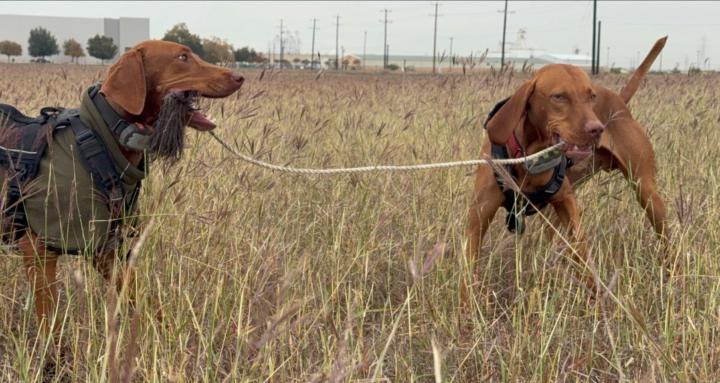
The reason I say do not use your emergency recall in a moment like this is because I made the mistake of doing this to call off my female vizsla Csili (pronounced Chili) off of some birds after having some successful practices. I had also dropped her long line and during her running around she had flushed some birds and off she went. So, I blew the whistle for her emergency recall because I thought that her toy drive was high enough for me to use what I had just taught her in this unplanned situation. Instead, I taught her that the emergency whistle recall meant “there are birds”. It took a bit of dramatic acting on my part to reteach her what the whistle recall is and then I expanded it to: Csili sees stimulus, Csili is on long line so is unable to chase stimulus, Csili turns to me and I blast the whistle while yelling “CSILI!” in a “panic” and “falling to the ground” with her toy. This reteaching was not my idea but was done at the advice of Paul Bunker. If you know Paul you will know that to no one’s surprise his training advice worked like a charm and Csili is now understanding what the emergency whistle recall is actually supposed to mean.
6
9 comments
Teaching a Reliable Emergency Recall Around Distractions
powered by
skool.com/beyond-the-leash-9053
Go beyond obedience! Build engagement, reliability, and a deeper bond through canine psychology and proven force free methods.
Suggested communities
Powered by