
3d (edited) • HOME PAGE
What Does Ifa Say About Soul Ties?
The phrase “soul tie” is not a traditional Ifá term. So we do not want to force Ifá to use language that does not come from the tradition.
But that does not mean Ifá has nothing to say about soul-ties.
When most people say “soul tie,” they are usually describing a connection that feels heavy, hard to release, or difficult to understand logically. It may feel emotional, sexual, spiritual, or energetic. A person may feel tied to someone even when the connection is no longer healthy, peaceful, or aligned.
From an Ifá perspective, the closest way to understand this is not to ask, “Is the connection with this person a soul tie?”
The better question is:
Is the connection with this person placing me in iré or osogbo?
That is where Ifá gives us a clearer lens.
Irè speaks to blessings, alignment, peace, elevation, and favorable spiritual conditions.
Osogbo speaks to imbalance, difficulty, misfortune, disturbance, heaviness, or conditions that work against a person’s well-being and destiny.
So while Ifá may not say, “This person has a soul tie,” divination may reveal that a person is in osogbo because of an affiliation, relationship, sexual connection, spiritual entanglement, emotional attachment, promise, vow, trauma bond, or harmful connection to another person.
That matters.
Because sometimes people really can become tied up in situations that disturb their Ori.
Ori is a person’s destiny, spiritual head, inner consciousness, and personal alignment. When a connection to another person begins to disturb someone’s Ori, it may show up as confusion, heaviness, obsession, loss of peace, repeated conflict, emotional instability, spiritual tiredness, or the feeling that the person cannot fully return to themselves.
This does not always mean witchcraft is involved.
Sometimes the cause is emotional attachment.
Sometimes it is sexual bonding.
Sometimes it is trauma.
Sometimes it is grief.
Sometimes it is manipulation or control.
Sometimes it is spiritual work done knowingly or unknowingly.
Sometimes it is actual spiritual interference.
And sometimes it is a mixture of more than one thing.
This is why Ifá does not rely on guessing. Ifá investigates.
Through divination, Ifá can reveal whether the connection is beneficial, unhealthy, spiritually dangerous, emotionally draining, or simply out of alignment. Ifá can also reveal whether the situation is coming through iré or osogbo, and what needs to be done to restore balance.
So yes, it is possible for a person to be spiritually or emotionally tied up through a connection with another person.
The exact cause matters, but the most important thing is this:
Ifá can help identify what is happening and what is needed for relief.
That relief may come through divination, ebó, Ori work, cleansing, prayer, ancestral work, spiritual protection, changed behavior, and stronger boundaries.
This last part is important.
Sometimes people want spiritual work to break a connection, but they keep feeding the same connection with access, intimacy, arguing, checking, obsessing, or reopening the door. Ifá is not only ceremony. Ifá is also wisdom, discipline, character, and action.
A bond cannot fully loosen if a person keeps tying the knot again.
So the balanced answer is this:
Ifá does not traditionally call it a “soul tie,” but Ifá does recognize that certain connections can place a person in spiritual, emotional, or destiny imbalance. If a connection is disturbing the person’s Ori, keeping them in osogbo, or pulling them away from peace and alignment, Ifá can reveal the root and prescribe what is needed to help them break free, cleanse, heal, or transform the situation.
Ifá helps a person understand what kind of bond they are dealing with, whether it is serving their destiny, and what steps are needed to return to balance.
24
5 comments
What Does Ifa Say About Soul Ties?
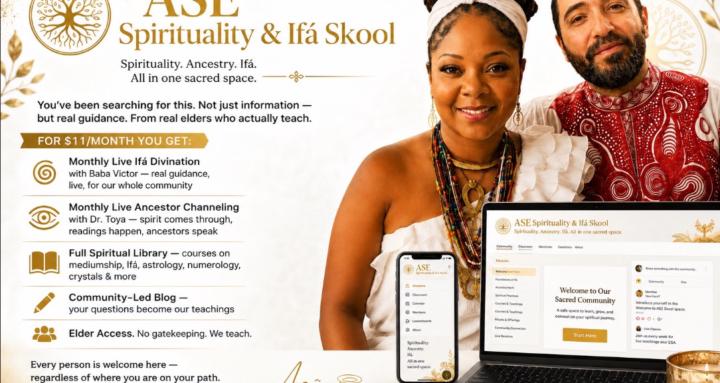
skool.com/ase
Spirituality. Ancestry. Ifá. All in one sacred space
Leaderboard (30-day)
1

+96
2

+44
3

+37
4

+34
5

+33
Powered by