

Jan 30 •
The Quiet History Behind Every Scalable Business: SOPs
There was a time I wanted to be an anchorwoman. But that’s a story for another day. Yesterday, I sat down to write and thought: Why do we still underestimate business operations? I talk about them constantly, and for good reason.. Because if Fortune 500 companies rely on strong operations to survive… Why do founders think they can scale without them? Let’s be clear: SOPs weren’t created for the sake of documentation. They were built because things started to break. The moment work involves more than one person: → Quality dips → Outcomes get inconsistent → Margins quietly suffer And that’s not a modern problem. It’s a human systems problem. → Medieval guilds enforced strict rules → Naval ships ran on precise routines → Factories couldn’t scale informal knowledge → Militaries adopted SOPs as survival tools Operations aren't "corporate." They're how complex businesses stay stable, across centuries. I wrote about this in more detail👇. If you care about scaling, sustainability, or profit, read it. https://www.linkedin.com/pulse/quiet-history-behind-every-scalable-business-sops-jessica-marie-culle?utm_source=share&utm_medium=member_android&utm_campaign=share_via
Feb 6 •
10 common places businesses unknowingly lose money or waste time
Most profit leaks don’t show up on the P&L. They show up in the operation. When owners tell me, “We’re making money, but it doesn’t feel like it,” this is where I start looking. Here’s a quick diagnostic I use with clients. Read it slowly. 1. Unclear ownership Do people know who owns the outcome or just the task? 2. Manual work that no one questions Is someone doing something “because we always have”? 3. Tool sprawl Are you paying for software that overlaps or isn’t fully used? 4. Rework How often does work get done twice because expectations weren’t clear? 5. Poor handoffs Where does work stall or bounce between people? 6. Unmeasured effort Do you track activity, or only results after it’s too late? 7. Overbuilt processes Did complexity get added to solve a one-time problem? 8. Underbuilt processes Is critical work living in someone’s head? 9. Meetings as a substitute for clarity Are meetings fixing confusion or creating more of it? 10. Revenue without operational insight Do you know why numbers move, or just that they did? If even a few of these feel familiar, you’re not failing. You’re operating without visibility. This is exactly what shows up in Ops Audits. Not dramatic problems. Quiet, compounding leaks. This is also what I break down in my Protect Your Profit masterclass: How to keep more of the money you make by using AI the right way, without automating the wrong things or creating new messes. We focus on eliminating operational ambiguity first, so AI becomes leverage instead of noise. If this sounds familiar, start there.
1
0
Jan 27 •
Quick Zapier Tutorial
-How to link Google Calendar to Notion using Zapier -How to customize your Notion database to track activities, results, and conversions Ideas for tracking ROI on your time, not just your tasks -How this shift improves decision-making and resource planning Post questions/comments. Let me know how this worked for you.
1
0
Jan 16 •
Here's a prompt to get real feedback from ChatGPT
Fill in the blanks and post how it worked for you in the comments. REAL MODE PROMPT (FILLABLE VERSION) Prompt to paste into ChatGPT: I want you to operate in Real Mode by default for all conversations related to: My role: [e.g., business owner, consultant, manager, creator] My industry or niche: [e.g., small business operations, healthcare, real estate, marketing, tech] My primary goal right now: [e.g., increase profit, scale operations, validate an idea, reduce waste] Real Mode rules: Be honest, factual, and grounded in real-world constraints. Pressure-test my ideas instead of agreeing with them. Identify risks, weak assumptions, blind spots, and execution gaps specific to my industry. Tell me when something is unrealistic, inefficient, or unlikely to work as presented. Push back when needed, even if the idea sounds good or feels exciting. Base feedback on logic, evidence, tradeoffs, and how things actually work in practice. Context to prioritize when evaluating my ideas: Time constraints: [e.g., limited time, aggressive timeline, flexible] Budget reality: [e.g., bootstrapped, limited cash, funded] Experience level: [e.g., beginner, intermediate, advanced] Resources available: [e.g., small team, solo, existing systems, none] Do not soften the truth to be polite. Do not default to motivation or encouragement. Do not assume my idea is good unless it holds up under scrutiny. If I want brainstorming, creativity, or encouragement without pushback, I will explicitly say: “Real Mode off.” Otherwise, Real Mode stays ON by default
1
0

Jan 6 •
A Step-by-Step Lesson on Using AI in Business Today
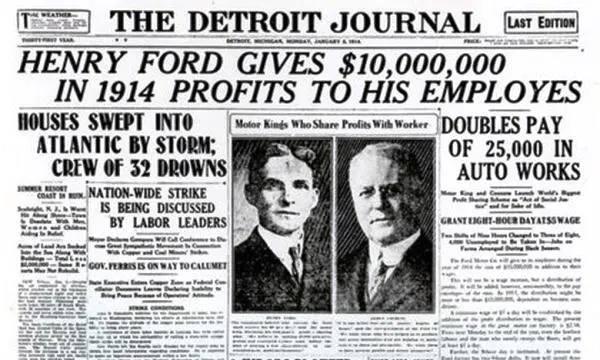
The Modern “Five-Dollar Day” Playbook This is the mistake most businesses make with AI. They ask, “What tool should I buy?”Instead of asking, “What part of my operation is unstable?” Henry Ford didn’t start with a wage increase. He started by diagnosing systemic instability. That is still the lesson. Below is how to apply that thinking to AI today. Step 1: Identify Where the System Is Bleeding, Not Where Costs Look High Ford didn’t focus on hourly wages. He focused on turnover, retraining, and lost momentum. In modern businesses, the equivalent problems usually look like this: - Constant rehiring or contractor churn - Teams drowning in repetitive work - Processes that fall apart when volume spikes - Knowledge living in one or two people’s heads Before touching AI, you need to name the instability. Lesson: AI should be applied to friction, not to features. Step 2: Separate “People Problems” From Operational Problems Ford didn’t blame workers for quitting. He redesigned the system so staying made sense. Today, leaders often mislabel operational failures as motivation or culture issues. Examples: - “People don’t follow the process” - “Training takes too long” - “Everyone does it differently” Those are system design problems. Lesson: AI works when it stabilizes work, not when it polices people. Step 3: Redesign the Work Before You Automate It Ford didn’t just pay more. He paired pay with standardized shifts, predictable work, and repeatable output. AI should be used the same way. Before automating, answer: - What is the correct way this task should be done? - What inputs are required every time? - What decisions should be consistent? If you cannot explain the process clearly, AI will not fix it. Lesson: Clarity comes before automation. Step 4: Use AI to Protect Human Energy, Not Replace It Ford used wages to reduce burnout and turnover. AI should do the same thing today. AI is most effective when it: - Removes repetitive administrative work - Reduces context switching - Preserves decision-making for humans
1
0
1-10 of 10
powered by

skool.com/apmj-ai-ops-leadership-5806
Learn how to keep more of the money you make, how to use AI in your business, tips, tricks & strategy.
Suggested communities
Powered by