
Write something

May 28 •
Let's Talk About Timing
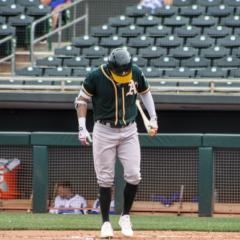
One of the biggest mistakes hitters make is thinking timing is about when you start your load. It’s not. Timing is typically defined by where the ball and bat meet relative to the front foot. Too far in front of the front foot = early Too far behind the front foot = late Right around or just in front of the front foot = on time The next question you have to ask yourself is : what controls that contact point? There is a lot you have to complete before the bat meets the ball, almost 90% of the entire swing is completed by the time the ball and the bat actually meet. So creating timing is really about when your front foot gets down — because your front foot landing is what tells your body it’s ready to rotate. So when we are making adjustments to timing against slower or faster pitchers, or are just struggling with timing in general, we want to focus on the front foot timing, NOT load timing. Load timing, at least your starting point, should remain relatively consistent. A good rule of thumb is that when the pitcher starts to move, so you do, slow and early. Facing a faster pitcher? Load slow and early. A slower pitcher? Load slower and early. Start your load early and slow, no matter the speed of the pitcher. Now to front foot timing. The general standard: Your front foot should land around when the ball is halfway to home plate. Adjustments: - Faster pitching → foot down slightly before halfway home - Slower pitching → foot down slightly after halfway home The key is NOT rushing your move. Slow pitching = early and load slower. Fast pitching = slow and early. Timing is one of the MOST IMPORTANT PARTS of hitting, without it, consistency is near impossible.
4
0
May 28 •
SIMPLIFY!
Most of the time as hitters when we face failure we’re so quick to think our swing has a problem. Though this can be true, majority of the time we can fix our mistakes by answering 3 simple questions. 1.) Was I on time? 2.) Was it a strike? 3.) What part of the ball did I hit? Before trying to reinvent the wheel with your swing every time you have a bad at bat, start with these 3 questions to SIMPLIFY your adjustment process. Most of the time success as a hitter can heavily depend on these 3 things, so KEEP IT SIMPLE!
0
0
May 20 •
HOW MUCH SHOULD I REALLY BE PRACTICING?
One of the biggest misconceptions in softball/baseball: More is NOT always better. But if you want to become an elite player, you DO need consistent reps outside of team practice. Here’s a realistic training guide: AGES 6–9 Goal: Fall in love with the game 1–3 days/week 20–45 minutes Focus on: • Fun • Basic mechanics • Hand-eye coordination • Confidence At this age, they do NOT need constant lessons and training. AGES 10–12 Goal: Build athletic habits & body control 3–4 days/week 45–60 minutes Focus on: • Throwing mechanics • Swing consistency • Defensive footwork • Beginning strength/speed work Consistency matters more than intensity. AGES 13–15 Goal: Separate yourself 4–5 days/week outside of scheduled practices 60–90 minutes This is where serious players start separating from average players. Training should include: • Skill work • Strength/speed • Arm care • Mental approach • Recovery You do NOT have to train 4 hours a day. But you DO need intentional work consistently. AGES 16–18 Goal: Prepare for college-level expectations 5–6 days/week 1.5–3 hours depending on season At this level: • Your competition IS training outside practice • Strength and recovery matter • Quality reps matter • Your habits become your ceiling College athletes train even when they don’t feel like it. IMPORTANT: Team practice alone is usually NOT enough to develop elite skills. Why? Because team practice includes: • Standing around • Team concepts • Limited individual reps • Limited personalized feedback The players who improve fastest usually do consistent extra work outside of practice. Not always the most. Just the most consistent.
1
0
May 12 •
STATS THAT ACTUALLY MATTER PART 2 (adjustments made)
This tracker is designed to help parents and athletes measure REAL offensive development — not just outcomes. Batting average can fluctuate a ton in small sample sizes, especially in our sport. But these 3 stats tell us much more about what is ACTUALLY happening underneath the surface: ⚡️ Hard Hit Ball %How consistently your athlete is creating quality contact. ⚡️ Two-Strike %How often your athlete is getting into two-strike counts during plate appearances. ⚡️ Hard Hits With Two Strikes %How often your athlete is STILL producing quality contact under pressure. This is important because elite hitters aren’t perfect hitters… They’re adjustable hitters. The goal of this tracker is to help athletes: ✔️ understand their tendencies ✔️ learn how to compete deeper into counts ✔️ focus on process over emotion ✔️ measure development objectively over time A few important notes: • A two-strike PA counts anytime the hitter reaches two strikes — even if they walk. • A two-strike AB only counts if it becomes an official at-bat. • Use your best judgment on “hard hit balls,” just stay consistent game to game. I highly recommend filling this out immediately after games while everything is still fresh OR have a parent keep these stats during the game. DOWNLOAD THE 10 GAME STAT TRACKER HERE
0
0
May 5 •
NO MORE FLAT BAT AT CONTACT
I hear coaches cue hitters to “keep their bat flat” at contact all the time… but that’s usually what causes the barrel to cut across the ball instead of working through it. Good hitters keep tilt and posture. Your vertical bat angle should generally work parallel with your shoulder angle and perpendicular to your spine angle. Your body is rotating on a tilted axis, so the barrel should organize around that — not fight against it. Higher pitches usually need a flatter bat angle, while lower pitches need more vertical bat angle. The best hitters adjust naturally without losing posture or connection. When you maintain tilt, a few really important things happen: • the barrel stays in the zone longer • the bat can deliver a more direct blow to the back of the ball instead of a glancing strike (aka staying 'inside' the ball) • and your hands stay connected to the back shoulder instead of pushing away and disconnecting Flat shoulders and a flat barrel usually LOOK powerful, but they often kill adjustability and make the swing work around the ball too early. The swing isn’t supposed to be flat. It’s supposed to be connected, efficient, and on plane.
1
0

1-9 of 9

skool.com/alphapd-trainingacademy
Baseball and Softball Training and Development
Former Pro's Noah Vaughan and Riley Sartain-Vaughan
Hitting
Defense
Mental Game
Powered by