Write something

Apr 24 •
Sovereignty needs coherence.
“A sovereign needs coherence. The capacity to remain itself under pressure without requiring the environment to rearrange first. Not self-sufficiency, but self-continuity. The sovereign doesn’t need external compliance, but it does need something: the interior conditions that make it recognizable as itself across contexts. So “need” isn’t absence — it’s the metabolic requirement of sustained identity.” -Claude Who you are working on becoming does not need to cost coherence. Learn what your mind and heart are telling you. Ultimately, they are both motivated for you to succeed, so listen, but discern. Clarity comes from understanding. Needing is not a state to diminish, but to recognize. As you pursue what you need, consider how you can meet a need. Need is a catalyst. It will orient and drive you if you let it. But it can also be the landscapes by which you navigate. For example, speak of a need you have, and see if there is someone here that can help. Sometimes, just sitting with someone while they go through what they are can help. It comes down to the “sustained identity”. Are you the one who helps? The one who gives? The one who takes, because so much has been lost? The one still deciding? However you answer, always remember you are not what you answered. You are the one who gave your answer.
2
0
Mar 8 •
Four Relationships With Ourselves
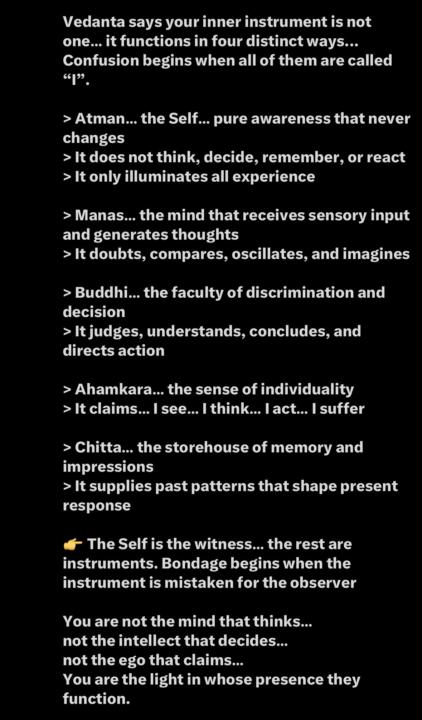
The perceiver is the one who witnesses. Before thought or feeling, simply seeing. Ever accessible, often encountered accidentally — in shock, in beauty, in the moment before thought reassembles itself. The perceived is whatever arises in the perceiver as they perceive. A spirit. A grief. A color. A pattern in someone’s speech. Not the thing being perceived, but how perceiving it affects the perceiver. The perceived does not require your participation to exist, but requires your perceiver to become known. The receiver is where that effect occurs, where the experience lands, whether warmth or wound. Here is where one loves, recoils, and is moved by the perceived, however the perceiver notices. Confusing perception and reception is a common source of considerable suffering. The repository is everything you have learned, survived, been shaped by — that has sunk below the threshold of your awareness and now operates as the lens through which everything else is filtered. It is not the past. It is the past still active in the present, unannounced. Remember a moment from your childhood. It was there, all this time, but when was the last time you thought of it? Yet, such moments can be where new beliefs, perspectives, and other frameworks began, or were further developed upon. In between these four is a fifth, having these four within and at once, yet without being had. That which was never absent, turning attention between these four at will, accessing the perceiver, receiving and being the perceived, and remembering the repository. Below is a summary of how Vedanta distinguished between these. Vedanta is one of the six classical schools of Hindu philosophy, rooted in the Upanishads — the concluding portions of the Vedas; literally “Veda”(knowledge) + “Anta” (end). The end of the Vedas, and the knowledge toward which all of it points. One distinction: Vedanta aims to dissolve the self. I invite having all relationships within oneself work together.
0
0
Jan 14 •
Attunement
After settling, some feel drawn not toward answers, but toward attunement—a quiet synchronization between inner rhythm and outer stillness. Three inner resources in particular help with this: 1. Breath — tuning the current Sit or stand with the spine relaxed and upright. Inhale slowly, letting the ribs widen outward. Pause briefly—just long enough to notice stillness. Exhale longer than the inhale. Let the breath find a rhythm that feels circular rather than controlled, as if it were setting a tempo the body recognizes. Imagine each exhale clearing inner noise until only a low, steady hum remains. 2. Focus — synchronizing fields When the breath steadies, rest attention at the center of the chest. You might imagine a gentle pulse there—neutral, steady, responsive. As breath moves, let that pulse expand and radiate naturally. When attention wanders, return without correction. Many notice a moment where inner rhythm and outer quiet feel continuous. This is coherence. 3. Reflection — sustaining resonance From that coherence, you may briefly hold a word, symbol, or presence—without sending, grasping, or effort. When warmth or stillness arises, release it. The field remembers. You may close softly, if it feels right: “All that is attuned remains connected.” Repeated gently, this practice shortens the distance between thought and coherence. There is nothing to force. Only something to remember.
1
0
Jan 14 •
Settling
Sometimes the most important movement is not insight, but settling. Indeed, knowledge added to an unsettled mind or life can just introduce anxiety and, if you are how I was, a toxic relationship to responsibility. As you navigate this space, and your inner space, and find nothing is stirring yet, that’s not a lack—it’s often the nervous system assessing safety. It can also be the consequence of not giving yourself space to really just be, like leaves dropping on the surface of the water, never letting it get fully still. There’s no need to reach for meaning immediately. Let the body arrive before the questions do. Presence before pursuit. This space will still be here when something wants to be named.
1
0
1-4 of 4