

21h •
The number that quietly disqualifies good firms
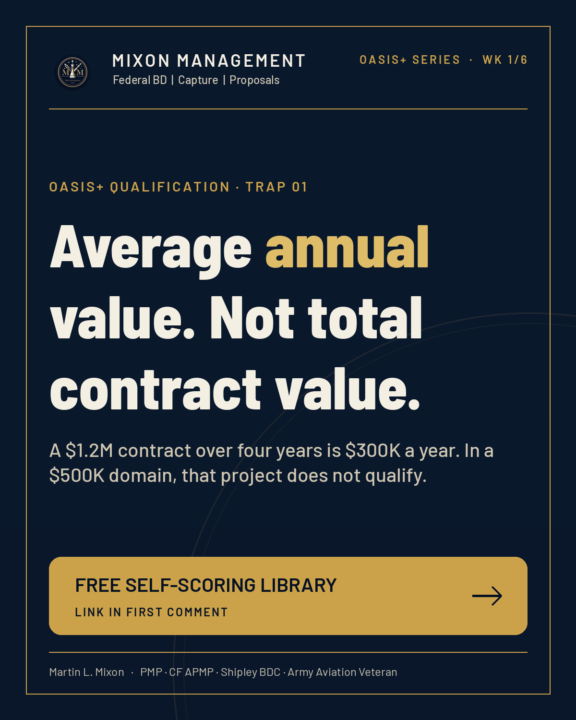
A capable firm can disqualify itself from an OASIS+ Domain on a single number, and it usually is not the number they are watching. The OASIS+ scorecard reads your projects on average annual value, not total contract value. Total divided by years of performance. A $1.2M contract run over four years is $300K a year. In a Domain with a $500K minimum, that project earns nothing on value, no matter how strong it looks on paper. It gets more specific. The minimum applies to the average annual value of the relevant work on the project, and the minimum itself moves by Domain. $250K in Facilities and in Environmental. $1M in R&D. $500K almost everywhere else. So the first move on any OASIS+ pursuit is arithmetic. Run each candidate project's average annual value against the minimum for the exact Domain you are chasing, before you build anything around it. Free OASIS+ Self-Scoring Library, no signup: https://tools.mixonmgmt.ai What is the most common reason you have seen a project that looked qualified get bounced on the math?
0
0
4d •
No War Room Today
I am on vacation 6/20. We will return to The awar Room next weekend. Taking my son to a football camp at Oklahoma State University. See you next week.
1
0
6d •
OASIS+ On Boarding Mistakes
The most expensive OASIS+ mistake I've seen: counting product revenue toward a services threshold. A qualifying project shows over a million in average annual value. Looks comfortably above the requirement. Then you look closer, and three-quarters of that money was products, not services. OASIS+ is a services vehicle. Only the services portion counts toward the $500K average annual value requirement. Strip the products out and that comfortable project drops under the line. The root cause: firms read the dollar figure and assume they qualify, without reading how the dollar figure has to be built. The qualification rules are where most self-prepared submissions quietly fail. Not the writing. The math underneath it. Check out my OASIS+ Onboarding Scorecard to see how you stack up... OASIS+ Self-Scoring Library | Mixon Management
0
0
7d •
It's live.
"Winning Proposals with AI" is out today on Amazon. 24 years of government services and federal proposals, crossed with six years of figuring out where AI actually helps and where it quietly sinks your bid. Not theory. The frameworks, the prompts, the judgment calls I use on real pursuits. If you've followed my posts on the 80/20 split, on what AI should never touch, on the courage to not bid, this is the full system those ideas came from. Written for one person: the practitioner who has to win the work, not just talk about winning it. Here it is, on Amazon: https://www.amazon.com/dp/B0H3ZTD7NG
0
0

11d •
Hello everyone! 👋
Hello everyone! 👋 Just wanted to introduce myself. I'm Mary and I'm excited to join the community. Looking forward to learning, sharing ideas, and connecting with like-minded people. Hope everyone is having a great day!
1-30 of 32

skool.com/ai-proposal-wins-for-govcon
Learn AI workflows that help you write better GovCon proposals and win more contracts.
Powered by