Activity
Mon
Wed
Fri
Sun
Sep
Oct
Nov
Dec
Jan
Feb
Mar
Apr
May
Jun
Jul
Aug
What is this?
Less
More
Owned by Wil
A community built to master AI. Learn prompt engineering, productivity, and business strategies from a 15+ year software developer.
16 contributions to Frontier AI Labs

May 31 •
The Demand Letter Machine
You know that thing where a company owes you money and you call customer service six times and nothing happens? The gym that won't cancel your membership. The contractor who ghosted after taking your deposit. The airline that owes you a refund from three months ago. You're not getting anywhere because phone calls are easy to ignore. You know what's not easy to ignore? A formal demand letter. Go to Claude and type: "I hired a contractor to paint my house for two thousand dollars. I paid a thousand-dollar deposit on March first. He started the job, did one room, then stopped showing up. It's been six weeks and he won't return my calls. Write me a formal demand letter requesting my deposit back within fourteen days. Include references to my state's consumer protection laws, mention that I'll file a complaint with the Better Business Bureau and state attorney general if I don't hear back, and keep the tone firm but professional. Also tell me exactly where to send copies of this letter to put maximum pressure on them." Claude writes you a letter that looks like it came from a lawyer's office. Most people fold the second they get something on paper with legal language in it. You didn't hire an attorney. You didn't spend three hundred bucks. You spent two minutes. Now here's the business. Post in local Facebook groups and neighborhood apps: "I write professional demand letters for people dealing with shady companies, forty bucks." Landlords keeping deposits, mechanics overcharging, companies ducking refunds. Everyone's got one of these sitting in their life right now. Five letters a week is two hundred bucks, and each one takes you about ten minutes.
0
0
May 23 •
Claude owed money hack - Not a Lawyer
Here's an almost illegal Claude hack that can get you hundreds of dollars back from companies that already owe you money, but are being nasty about fixing the thing or giving your money back. This works for some things, but not if you can just return it to Amazon. Think about the last time you bought something that broke early, a subscription that charged you after you cancelled, or a flight that got delayed five hours. Most people just eat the loss because writing a complaint letter feels like homework and you don't know if it'll just go into the void. Open Claude and say: "I bought a blender from this company six months ago and the motor died. The warranty says one year. Write me a firm but professional email requesting a full replacement. Include a reference to their warranty policy, my consumer rights, and a reasonable deadline for them to respond." Claude writes you a letter that sounds like it came from a lawyer's office (Not a lawyer). But here's where it gets wild. You can turn this into a side hustle. Post in local Facebook groups or on Nextdoor: "Got ripped off by a company? I'll write your complaint letter for twenty bucks." See if anyone bites. Every time someone comes to you, paste their situation into Claude, get back a polished demand letter, send it over. Takes you five minutes. Twenty bucks. Ten clients a week is two hundred dollars , and you're helping people get their money back.
2
0
May 21 •
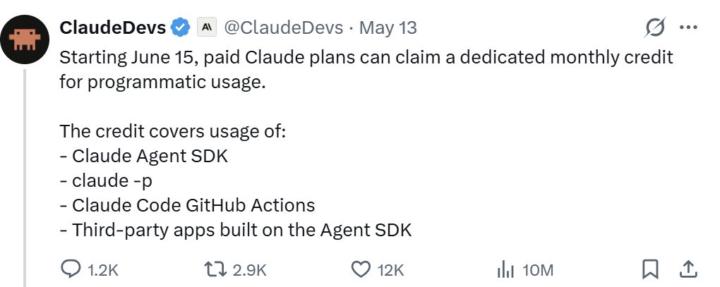
Anthropic is splitting Claude subscriptions into two pools starting June 15.
Prices stay the same. What changes is where automated usage gets billed. Pool 1 is your normal usage. Claude chat, Claude Code in the terminal, Cowork. Same limits as today. Pool 2 is new. Agent SDK, claude -p, GitHub Actions, third-party tools like OpenClaw and Conductor. All of that moves to a separate monthly credit, metered at API rates. Pro gets $20. Max 5x gets $100. Max 20x gets $200. Credits do not roll over. Burn through them and you pay API rates from there. Developers are calling it a rug pull. The frustration makes sense, people were running thousands of dollars of agent workloads on a $20 plan and no company runs that subsidy forever. Seat based pricing is turning into usage based pricing across the board. This is the first time it lands on developers directly. Anthropic is not locking third-party tools out. OpenClaw, Conductor, the rest still authenticate against your subscription. There is just a meter on it now. If you are running anything automated through Claude, your cost structure changes on June 15.
1
0
May 20 •
Claude Code Plan Mode.
Shift+Tab twice in Claude Code drops you into it. While you're in plan mode, Claude can read, search, and think, but it can't write a single file. It produces a plan. You read it. If the plan is wrong, you correct it before any code gets touched. When the plan looks right, you exit and let it execute. How to use it: Shift+Tab twice. Ask for what you want. Read the plan carefully. Push back where it's wrong. Iterate until the plan matches the reality of your repo. Then exit plan mode and tell it to execute. A few things I do inside plan mode that pay off: Ask it to list the exact files it intends to touch. Anything unexpected on that list is a red flag. Ask what it's assuming. Half the time the assumption is the bug you would have shipped. Ask for the rollback. If it can't explain how to undo the change, the plan isn't done. Stop treating Claude as a fast typist that occasionally writes code you have to fix, and start treating it like a pair you discuss the approach with first. Plans before code. Same thing I'd want from a human.
0
0

May 19 •
Custom slash commands in Claude Code.
Every Claude Code project supports them. They live in .claude/commands/ as plain markdown files. The filename becomes the command. The file contents become the prompt. Example: Create .claude/commands/review.md: Review the staged changes for: - N+1 queries - missing error handling - security issues (injection, auth bypass, leaked secrets) - tests covering the new branches Be specific. Quote line numbers. Now /review runs that prompt against your current context. No more pasting the same checklist into chat every time you open a PR. Why I use it: The prompts you reuse are the ones you've refined the most. Saving them locks in the improvements instead of typing a worse version next time. They commit with the repo. Your team gets them automatically. A new hire inherits your best workflows on day one without anyone writing a doc. You can pass arguments with $ARGUMENTS. /ticket 4123 can pull context for a Linear issue and scaffold a branch off it. The four I keep in every repo: /review for staged diffs /test writes tests for the file I'm in /explain walks through unfamiliar code paths before I touch them /migrate drafts a SQL migration plus the rollback The benefit is that once a prompt works well, you never write it again. Neither does anyone else on your team. Cost: zero. Setup time: about a few minutes per command.
0
0
1-10 of 16

@william-waldon-7476
I run Frontier AI Labs. 15 years shipping software, 4 exits, now teaching people to build real businesses with Claude, AI and automation.
Active 12h ago
Joined Apr 7, 2026