Activity
Mon
Wed
Fri
Sun
Aug
Sep
Oct
Nov
Dec
Jan
Feb
Mar
Apr
May
Jun
What is this?
Less
More
Memberships
Start a Business with No Money
479 members • Free
GenHQ - Creative AI Education
1.6k members • $127/m
AI Automation Society
418.8k members • Free
AI Essentials
9.7k members • Free
AI Creator School
8.8k members • Free
REVENUE REVOLUTION
10.4k members • Free
Women Build AI
4.9k members • Free
AI Automation Mastery
30k members • Free
AI SEO Operators
3.8k members • Free
11 contributions to AI Automation Society

2h •
My VPS turned "cursed" this week. Claude found 4 different root causes in one session
The last 4 days my home server felt cursed. Telegram bots dying almost daily, SSH access randomly blocked (had to VPN through Frankfurt just to reach my own server). On top of that, an older mystery: CPU overload roughly every two weeks that a cleanup would temporarily fix. My AI OS was supposed to be my right hand and instead it kept falling apart. Yesterday I gave Claude Code (Fable 5) SSH access and one instruction: "audit everything, find out why my system keeps dying." What it actually found (none of it was what I thought): 1. My "daily bot crashes" were planned token-refresh restarts that wiped the conversation memory. Fix: resume the last conversation on restart. 2. A second bot had been silently dead for 2 WEEKS: expired OAuth token, no auto-refresh. It looked alive, it just never answered. 3. The "blocked SSH": not the server at all. My hotel and home Wi-Fi block outbound port 22 entirely. tcpdump showed my packets never even arrived. Tailscale solved it permanently, no more VPN. 4. The biweekly CPU overload: orphaned background processes multiplying after every bot restart (this one it found in my own wiki's incident history and confirmed the cleanup cron now handles it). Best part: it documented every finding in my markdown wiki, added self-audit crons that report to Telegram weekly, and wrote "hard rules" into its own config files so future sessions don't repeat the same mistakes. It even caused one incident itself, then found and fixed it 15 minutes later and documented that too. Takeaway: don't ask AI "is my server ok?". Give it real access, ask it to point to evidence for every claim, and make it write everything down where the next session can find it. What's the longest-running "mystery bug" AI has solved for you?
0 likes • 1h
@Purushottam Kumar thank you 🙏🏻

3d •
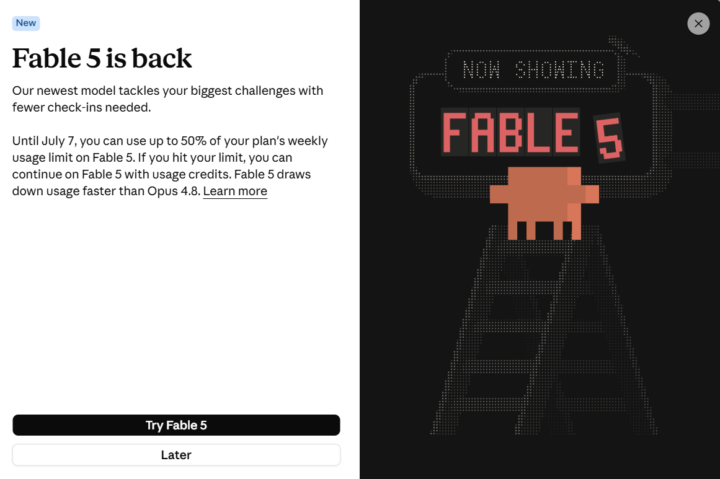
Fable 5 Is Back!
Anthropic has officially restored Fable 5 access. If you have access, you can now start building with Anthropic's newest reasoning model. A few things to note: - 📅 Until July 7, you can use up to 50% of your plan's weekly usage limit on Fable 5. - ⚡ Fable 5 consumes your weekly usage limit faster than Opus 4.8. - 💳 If you reach your weekly limit, you can continue using Fable 5 with usage credits. This is a great opportunity to test your existing Claude Code projects, AI agents, automations and workflows to see where Fable 5 performs best. I am curious: 👇 What's the first thing you are planning to build or test with Fable 5? Share your ideas, projects or experiments below so the community can learn from each other.
0 likes • 12h
Using it as an ops auditor today: gave it SSH to my VPS and asked why my setup "kept falling apart". It found a fail2ban misconfig that was banning my own IP, cleaned 15GB of caches, rewrote my wiki index and set up a weekly self-audit cron that reports to Telegram. One session. That long-horizon debugging is where it feels genuinely different from Opus.

22h •
The Next AI Advantage Isn't a Better Model Everyone is chasing the next model.
Bigger context. Faster responses. More reasoning. I think they're looking in the wrong direction. The next competitive advantage won't be the AI you use. It will be the memory you build around it. Imagine two people using the exact same model. One starts every conversation from zero. The other has years of documented decisions, workflows, lessons learned, failed experiments, writing style, business rules, and personal frameworks. Same AI. Completely different results. We're moving from prompt engineering to memory engineering. The people who systematically capture and organize their thinking today may have an enormous advantage in a few years—not because the AI is smarter, but because it understands their way of thinking. Maybe the most valuable asset we're building isn't another prompt library. Maybe it's a second brain that grows with us. Question: If your AI could permanently remember only one thing about how you work, what would you want it to remember? #AI Email Agent (9/20/24) #RAG Chatbot AI Agent (9/22/24) @Nate Herk

0 likes • 12h
Living proof of this post: same model gives me completely different results since I built a wiki my Claude maintains (Karpathy's LLM wiki idea). Decisions, failed experiments, brand voice, infrastructure runbooks, all cross-linked markdown it can reason over. To your question: I would want it to remember HOW I decide, my constraints and priorities. Outputs it can always regenerate, judgment context it cannot.

6d •
How are you checking your agent's output is still good, not just that it ran?
Something I keep hitting and don't have a clean answer for. Catching when an automation BREAKS is easy. It errors, nothing comes out, you get an alert. Catching when it quietly gets WORSE is the hard one. The thing runs fine, returns something that looks right, but the quality slipped and nobody notices for two weeks. For the mechanical parts (did the row get created, did the email send) this is simple. For anything open ended (a draft, a summary, a reply, a piece of content) I have no clean way to score it automatically. "It produced text" is not the same as "it produced good text." What I do now is a mix: a few hard checks on the mechanical parts, a human spot checking a sample, and saving the bad outputs so I can see patterns. It works, but it's manual and it doesn't scale past a handful of automations. So the open question for people running this in production: how are you measuring whether an agent's output is actually good over time, not just that it ran? Anyone using a model to grade another model's output, and does that actually catch the slips or does it just rubber stamp them? Curious what's working.
0 likes • 12h
What works for me: a second verifier agent with FRESH context grades the output against a short checklist and must point to evidence, not vibes. It catches way more than self-critique because the grader did not write the draft. And instead of asking the judge "is this good?" I ask "find 3 reasons to reject this". Rubber-stamping mostly disappears when rejection is the default framing. Bad outputs go to a folder and become counter-examples in the prompt.

13h •
AI AGENTS
WHEN BUILDING IN CLAUDE HOW DO YOU BUILT A SINGLE AI AGENT TO HAVE ALL THE OTHER AGENTS REPORT BACK TO THAT ONE?? IS THERE A PROMPT FOR THAT ? WHATS THE BEST ROUTE I CAN GET A FEW AGENTS BUILT BUT CANNOT GET THEM ALL IN ORDER EACH WITH A SEPERATE TASK, TO REPORT BACK TO THE MAIN ONE
2 likes • 12h
In Claude Code this is built in: your main session IS the orchestrator. Just ask it to dispatch subagents for each task and they report back to the main one automatically. For repeatable setups, define custom agents in .claude/agents/, each with its own prompt and tools, then the main agent delegates and collects results. No magic prompt needed, just describe what each subagent owns.
1-10 of 11
@viktoriia-didur-2106
Founder of Vimaxus | AI & Automation
Active 2m ago
Joined May 28, 2026
Powered by