Activity
Mon
Wed
Fri
Sun
Nov
Dec
Jan
Feb
Mar
Apr
May
Jun
Jul
Aug
Sep
Oct
What is this?
Less
More
Biohackinggirly’s Lab🥼🔬
2.6k
Free
BioOptimization Collective
373
Free
Mikes PEP-Talk
1.9k
$5/m
The SelfmaxxingBlueprint
1.5k
Free
Peptide Protocol Academy
110
Free
Testosterone Bible
201
Free
🍭Kandies
750
Free
5 contributions to Peptides: Out of the Shadows

Jul 27 •
HGH GROUP BUY — Polling Results - NEXT STEP
We received 7 participant vote. Under the current structure, a minimum of 10 participants was needed to reasonably support both the 24 IU and 36 IU options and their related testing costs. Final Poll Results 4 votes — MZ BioLabs ID, purity, quantity and dimer Method: HPLC-UV and/or mass spectrometry 1 vote — Finnrick/Krause ID, purity and quantity Method: HPLC-UV and/or mass spectrometry 1 vote — Chromate ID, purity, quantity and dimer/HMW Method: HPLC-UV and/or mass spectrometry 1 vote — Janoshik ID, purity and quantity Method: HPLC-UV and/or mass spectrometry Due to the low member participation, the HGH Group Buy cannot support separate testing for both the 24 IU and 36 IU strengths. After reviewing the projected costs and overall value of each option, DH has decided that the Group Buy will move forward with the 36 IU kit only. The attached Comparison Board shows the analysis supporting this decision. The 36 IU kit provides 50% more HGH for only $45 more and results in a lower overall cost per IU. The current projected price is based on seven (7) participants sharing one MZ BioLabs test. The final individual testing allocation will adjust based on the final number of participating members who actually subscribe to the buy. The projected price also assumes that the vendor’s $1,000 free-shipping requirement has been met. Therefore, no vendor shipping cost is included in the projected cost per kit. Important Testing Clarification The vendor’s product guarantee applies only when testing is performed by Janoshik. MZ BioLabs would still provide independent third-party testing, but the vendor would likely not honor its product guarantee if the results came back below the quoted values.


1 like • Jul 27
So $218 per person that includes the testing, 36iu×10 vials correct?
0 likes • Jul 27
Copy that. Well im in hopefully we get enough people
Jul 25 •
The HGH test lab poll will close Sunday, July 26 at 9:00 PM ET.
If you are committed to participating in the HGH Group Buy, please cast your vote before the deadline. A minimum of 10 committed participant votes is required. If the poll does not reach 10 votes, the HGH Group Buy will not move forward. The final testing lab selection will be determined by the participating members’ votes.
0 likes • Jul 25
I voted
0 likes • May 27
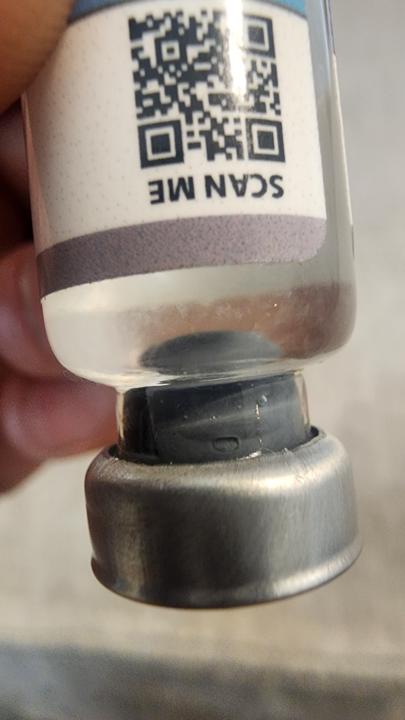
@Adam Serge hey so i just did 2ml bac water, the kiss vial was 5mg. And dang i already trashed it, i got it from fusionpeptides.com i dont have the coa but i think if i ask they will send on or i think it was posted on the product page.
0 likes • May 27
@Adam Serge copy that ty bro
May 21 •
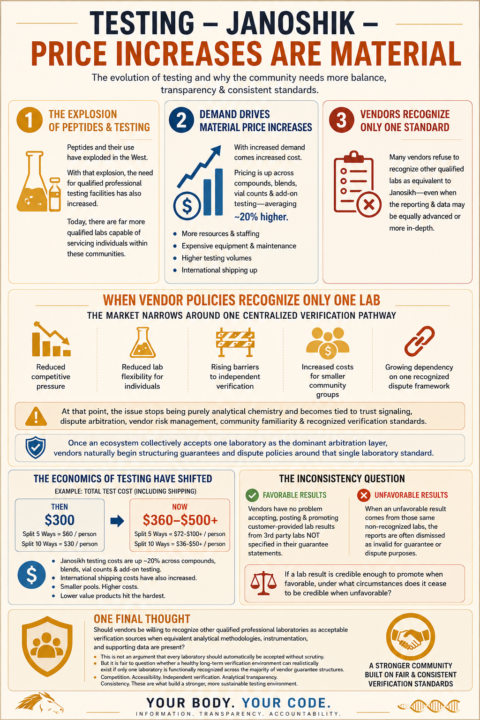
Testing – Janoshik – Price Increases Are Material
My perspective on the evolution of testing and why Janoshik became such a dominant focus within the peptide and research space. Again — this is simply my perspective. In the earlier stages of peptide community growth, awareness, access, and participation were significantly smaller than they are today. The overall market was far less developed, and very few analytical laboratories were willing to work directly with individual community members. At the time, most laboratories primarily supported: • pharmaceutical companies • universities • research institutions • commercial clients • or established business accounts Very few labs openly supported direct-to-consumer or individual-submitted peptide testing. Janoshik became one of the first widely recognized laboratories willing to support testing access for individuals within these communities. Because of that: • the reports became social proof • communities became familiar with the reporting format • and vendors eventually realized that “acceptable proof” had effectively standardized around a single recognizable laboratory name, which Over time, created a self-reinforcing cycle. The problem now is that the peptide and research space has exploded in the West. Awareness, participation, vendor growth, and overall product volume have increased dramatically over the past several years. With that growth, the demand for qualified professional testing facilities has also increased significantly. Today, there are now far more qualified laboratories capable of servicing individuals within these communities — many utilizing equivalent instrumentation, equivalent analytical methodologies, and comparable technical capabilities. At the same time, testing demand itself has increased substantially. As a result: • pricing increases are becoming material and ongoing • operational resource demands continue rising • equipment costs and maintenance requirements remain substantial • and testing volume pressures continue expanding across the industry
1 like • May 21
@John Buehler gotcha yeah ill deff do that, did you get it from ... grey ? Or someplace usa ?
1 like • May 21
@John Buehler ive never used a pen i might have to order a few
May 21 •
Reta
Any advice on 30mg reta, how to recon? How much to start with, any experience would be much appreciated
0
0
1-5 of 5
Active 3h ago
Joined May 16, 2026