Activity
Mon
Wed
Fri
Sun
May
Jun
Jul
Aug
Sep
Oct
Nov
Dec
Jan
Feb
Mar
What is this?
Less
More
Memberships
The George Method™
83 members • $9/month
HuntersHealingLab
471 members • Free
3 contributions to The George Method™

4d •
Daily Rewiring Practices
Carey Ann George | The George Method™ 🔹 DAILY PRACTICES TO MASTER YOUR STATE (Installing New Programming Through Repetition) 1. The 90-Second Interrupt (Flip the Switch in Real Time) When triggered: • Stop speaking • Drop your shoulders • Inhale through your nose for 4 • Exhale slowly through your mouth for 6–8 • Repeat 5–10 cycles Then say internally: “This is a reaction. I choose my state.” 👉 This prevents emotional chemistry from becoming identity. 2. The “Is This Mine?” Check (For Highly Sensitive Systems) Throughout the day: • Notice emotional shifts • Ask: “Is this mine or am I mirroring?” • If not yours → exhale and release 👉 This breaks unconscious absorption and enmeshment. 3. Morning State Installation (Programming Before the World Gets You) Before your phone: • Sit still for 2–5 minutes • Breathe slowly • Visualize your day going well • Feel calm, grounded, clear Not thinking it — feeling it 👉 This sets your nervous system baseline BEFORE stimulation. 4. The Identity Anchor Practice Choose your higher identity: “I am grounded.” “I am steady.” “I am in control of my responses.” Then: • Stand tall • Breathe deeply • Feel it in your body 👉 Identity must be embodied, not spoken. 5. Micro-Resets (5x Per Day Minimum) Set reminders: • Pause • Breathe • Relax your jaw • Unclench your stomach 👉 Regulation is built through frequency, not intensity. 6. The “Don’t Feed It” Rule When negative loops begin: DO NOT: • Replay the story • Rehearse the argument • Justify the emotion INSTEAD: • Shift focus immediately • Move your body • Change environment 👉 Attention is fuel. Stop feeding what you don’t want. 7. Somatic Discharge (Daily) Pick one: • Walking • Shaking • Stretching • Dancing • Foam rolling 👉 Stored tension MUST move or it becomes symptom. 8. Emotional Completion Practice At night, ask: “What did I suppress today?” Then: • Journal it • Speak it out loud • Feel it without fixing it 👉 Unprocessed emotion becomes tomorrow’s trigger.

1 like • 4d
Wonderful summary. Thank you 🙏
0 likes • 7d
Brand new here. Can someone tell me about the particulars of the Women's circle. Thank you. Vera
0 likes • 7d
@Carey Ann George thank you
16d •
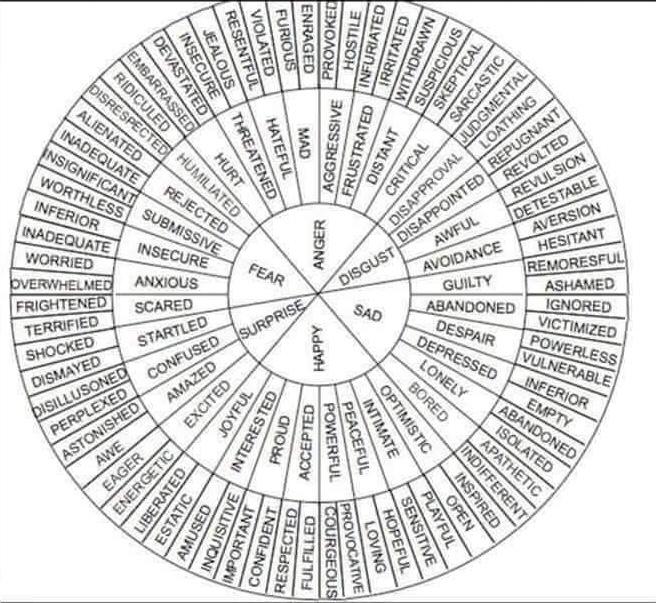
THE STRATEGIC USE OF THE EMOTION WHEEL
How to Decode a Trigger and Dissolve Its Root Most people believe that emotional triggers are the problem. They believe the anger, fear, sadness, or disgust that rises inside them is the thing they must suppress, control, or eliminate. But in reality, the visible emotion is almost never the root. It is only the surface expression of something much deeper operating beneath conscious awareness. This is where a tool like the emotion wheel becomes incredibly powerful. Not as a chart to label feelings, but as a map that helps you trace an emotional reaction back to the subconscious pattern that created it. When someone is triggered, the brain moves extremely fast. The nervous system detects something that resembles a past threat, and the body reacts before the conscious mind has time to analyze the situation. Heart rate rises. Muscles tighten. Breath changes. Stress hormones flood the bloodstream. By the time you realize what happened, you are already inside the reaction. What the emotion wheel allows you to do is slow down that process and reverse engineer it. At the center of the wheel are the primary emotional categories: fear, anger, sadness, disgust, happiness, and surprise. These are the fundamental emotional states the nervous system uses to interpret the world. But these core emotions rarely appear in their pure form during daily life. Instead, they manifest through more specific secondary emotions that branch outward. For example, what someone labels as “anger” may actually be rooted in feeling rejected, humiliated, threatened, or powerless. What appears as sadness may actually come from loneliness, abandonment, disappointment, or feeling misunderstood. The emotional wheel helps expose these layers. When a trigger happens, the first step is observation rather than reaction. Instead of saying, “I’m angry,” you begin asking deeper questions. Where on this wheel does my reaction actually live? Is the anger really anger, or is it frustration, resentment, humiliation, or feeling disrespected?
1 like • 7d
Such a beautiful teaching about emotions and patterns. I find this more difficult to put into practice in familiar relationships where my baseline is more deeply practiced to defer and to silence my own need for fun, lightheartedness & clear head space to enjoy my interactions with clients & challenging family members.
1-3 of 3

Active 2h ago
Joined Mar 24, 2026
Powered by