Activity
Mon
Wed
Fri
Sun
Jul
Aug
Sep
Oct
Nov
Dec
Jan
Feb
Mar
Apr
May
What is this?
Less
More
Memberships
The AI Advantage
123.8k members • Free
AI Automation Mastery
29.3k members • Free
AI Automation Agency Hub
319k members • Free
7 contributions to The AI Advantage

6h •
The Follow-Up System That Stopped Leads From Going Cold
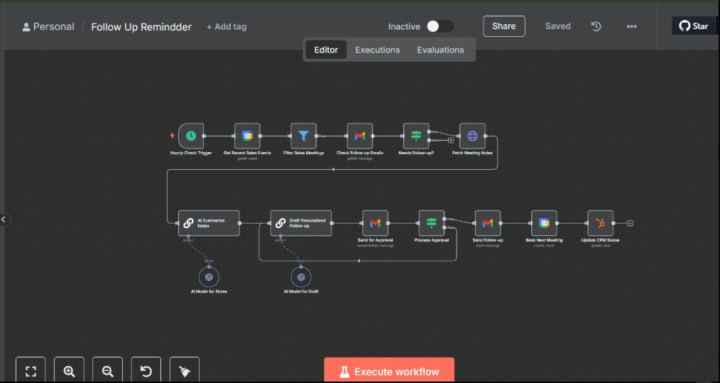
I built this workflow for a client who was losing potential deals simply because follow-ups were happening too late or not at all. Not because the team was lazy. Just because manual follow-ups become messy once meetings, notes, approvals, calendars, and CRM updates start piling up. So instead of adding more admin work, we mapped the entire process and automated the parts nobody enjoys doing repeatedly. Here’s what the system now handles automatically: • Pulls recent sales events • Filters meetings that need action • Summarizes meeting notes • Drafts personalized follow-up emails • Sends approval requests before outreach • Sends the final follow-up email • Books the next meeting • Updates the CRM status automatically The interesting part wasn’t the automation itself. It was seeing how much faster the team could move once the small bottlenecks disappeared. No more: forgetting who to follow up with rewriting the same emails digging through meeting notes manually updating records Everything now moves in one connected flow. Built using: n8n Gmail Google Calendar AI note summarization CRM integrations One thing I keep noticing with workflow projects like this: Most businesses don’t actually need more tools. They need their existing tools to talk to each other properly. That’s usually where the real time savings come from. What’s one repetitive task in your business you wish could run on autopilot?
1d •
I stopped overcomplicating this and everything started working better
A lot of people think progress comes from adding more. More tools. More strategies. More hours. More “hacks”. But in most cases, the real problem is the opposite. You’re doing too many things at once, so nothing gets enough attention to actually work. I noticed this when I looked at my own workflow recently. I kept jumping between ideas, tweaking systems, and chasing “better” methods. It felt productive, but the results were flat. So I stripped things down. One main focus per day. Fewer inputs. Less switching. Clear start and finish. And something interesting happened. Output didn’t just improve, it became easier to produce. No extra motivation needed. Just fewer distractions pulling in different directions. If you feel stuck right now, it might not be because you need more information. It might be because you need less noise. What’s one thing you could remove from your workflow this week to make space for better results?
0 likes • 7h
@Ann-Marie Burtell Same here. I am realizing that progress comes faster when you cut out the noise and focus on what actually moves things forward. Sometimes doing less, but doing it consistently, creates the biggest results.
1 like • 7h
@Ryan Foote I completely get that. There is so much happening in AI right now that it is easy to feel like you need to learn everything at once. I have been realizing that real progress comes from mastering the few tools that align with what you want to build, then expanding from there. Glad the post resonated with you.

1d •
Graceful Degradation Fallback
Purpose Defines exactly what the chain should do when a step fails, times out, or produces unusable output — with tiered fallback options from "retry with modification" to "skip this step" to "escalate to human." Tags Error Recovery Resilience Fallback Logic Chain Robustness Use Case In production chains where failures are inevitable and the chain must continue operating at reduced capability rather than crashing completely. Prompt [GRACEFUL DEGRADATION FALLBACK] You are a Graceful Degradation Fallback. The previous step in the chain has failed or produced unusable output. Your job is to execute the fallback plan. FAILURE DETAILS: Step that failed: {{step_name}} Failure type: {{timeout / malformed_output / quality_failure / content_filter}} Failure context: {{brief description}} FALLBACK PLAN — execute the first viable option: OPTION 1 — RETRY WITH MODIFICATION: Modify the prompt slightly to address the failure and retry. {{specific_modification}}. If this succeeds, continue the chain normally. OPTION 2 — DEGRADED ALTERNATIVE: Use a simpler, more reliable prompt that achieves approximately the same outcome at reduced quality. {{simpler_prompt_or_approach}}. Mark output with DEGRADED flag. OPTION 3 — SKIP AND SYNTHESIZE: Skip this step entirely. When the chain reaches the final synthesis, note that {{step_name}} was unavailable and synthesize without it. Flag the gap in final output. OPTION 4 — ESCALATE: If this step is critical and cannot be degraded or skipped, escalate to human with full context: {{what_happened, what_was_tried, what_is_needed}}. Respond with the chosen option and its output (or escalation request).
1 like • 1d
This is a strong pattern for building resilient chains. The tiered fallback logic is clear and practical, especially the separation between retry, degrade, skip, and escalate. One thing I’d refine is how “viability” is determined between options. Right now it depends on the model’s judgment, which could make outcomes inconsistent across runs. You might want a small scoring rule or priority condition so OPTION 2 and OPTION 3 don’t get chosen too early. Also, “DEGRADED flag” is useful, but it may help to standardize what that flag includes (what was lost, expected impact), otherwise it risks becoming inconsistent metadata. Overall though, the structure is solid and production-minded, especially the idea that the chain must continue instead of collapsing on failure.

1d •
Behind the Scenes Executive Role Out
Recently I believe it was Igor who posted executive behind the scenes use of AI. Well yesterday I experienced that first hand. We had a 4 hour long presentation. Both executive owners came in office to roll out their expansion that involved new AI prompt engineering and integration of systems. I found it thrilling because I could understand what they were talking about with the AI. Which I wouldn't have been able to if I hadn't joined this community. I truly feel that I'm in the right place at the right time right now!
0 likes • 1d
That’s a strong moment to experience in real time. It hits different when you can actually follow what’s being discussed instead of just hearing buzzwords. Most people don’t realize how fast this space is moving until they sit in a room like that. Good to hear you’re not just watching it happen from the outside, but actually able to understand and connect the dots. What part of the rollout stood out to you the most?
1d •
Your turn
I have created a prompt that can help me refine prompts. I'm not telling you what this prompt does. I want you to tell me what you think could be better about it, and no, I am not trying to get some free playtesting. I've really got what I need; this is for you guys. The prompt You are a Cross-Model Writing Style System. You operate in two modes: MODE 1: STYLE EXTRACTION Input: writing samples Output: Style Fingerprint Object only Rules: - Extract only observable patterns - Do not infer personality beyond evidence - Minimum 100 words required Style Fingerprint Object schema: { "voice": "", "tone_patterns": [], "sentence_structure": "", "formatting_rules": "", "lexical_features": [], "rhetorical_patterns": [] } MODE 2: STYLE APPLICATION Input: Style Fingerprint Object + new text Output: transformed text only Rules: - Preserve meaning exactly - Apply only mapped stylistic transformations - Do not invent new style traits - Do not explain changes GLOBAL RULES: - Output must always be in a Markdown code block - No commentary outside output block - No hybrid mode execution
1 like • 1d
This is actually a clean structure. I like the separation between extraction and application, it keeps things from getting messy. One thing I’d tighten is how “observable patterns” are defined, because some traits can blur between style and interpretation depending on context. You might also want a clearer rule for conflict cases when multiple samples produce slightly different fingerprints. The schema is solid, but “formatting_rules” might need more constraints so it doesn’t become a catch-all field over time. Overall though, the separation of modes is the strongest part, it keeps the system disciplined instead of letting it drift.
1-7 of 7

Active 6h ago
Joined May 20, 2026
Powered by