Activity
Mon
Wed
Fri
Sun
Dec
Jan
Feb
Mar
Apr
May
Jun
Jul
Aug
Sep
Oct
Nov
What is this?
Less
More
15 contributions to AI INSIDERS 👨🏻💻

13h •
Workflow or agent: where do you draw the line for clients?
When a client asks for an AI agent, how often does it end up being a plain workflow with one model step in the middle? I lean workflow by default and only hand control to an agent where the path really can't be predicted, like a live phone call. Everything around it stays boring and testable. Where do you draw that line, and has a client ever pushed back on it?

19h •
fixing audio latency when chaining ai voice clones with automated video renderers
when generating programmatic variations for client ad sets we noticed rendered mp4 files occasionally had a 150ms audio offset because the tts file header length did not match the ffmpeg stream sync. adding a simple audio normalization pass that trims leading silence before passing to the video renderer fixed sync completely across bulk batches. curious if anyone else running dynamic ad pipelines has dealt with variable audio padding
0 likes • 13h
Trimming leading silence is the right fix. Two more things worth checking in bulk runs: some TTS APIs return different sample rates per request, so resampling everything to one rate before ffmpeg removes another source of drift. And aresample with async=1 on the mux step catches small offsets that still slip through.

4d •
Describe the missed-call offer without naming a tool
Take the missed-call recovery offer that showed up in here. Now remove these words: AI Voice agent CRM Workflow Automation What is left? A business misses a call. The caller gets a fast response. The conversation gets routed to the right person. The owner can see what happened. That is the offer. The build comes after the buyer understands the outcome. I would write it in 3 layers: 1. Outcome: what changes for the buyer 2. Process: what happens after the missed call 3. Tools: what runs the process Start at layer 1. Save the tools for the build plan. 👇 Can you describe your current offer in one sentence without naming a single tool?
0 likes • 2d
@Ian Kirk Not yet. I mostly build for agencies, so next time I demo it I'm leading with the call summary instead of the call itself and seeing how they react. Curious if you've seen owners respond better to that framing.
1 like • 14h
@Ian Kirk Will do, I'll share what I see here once I've tried it.
3d •
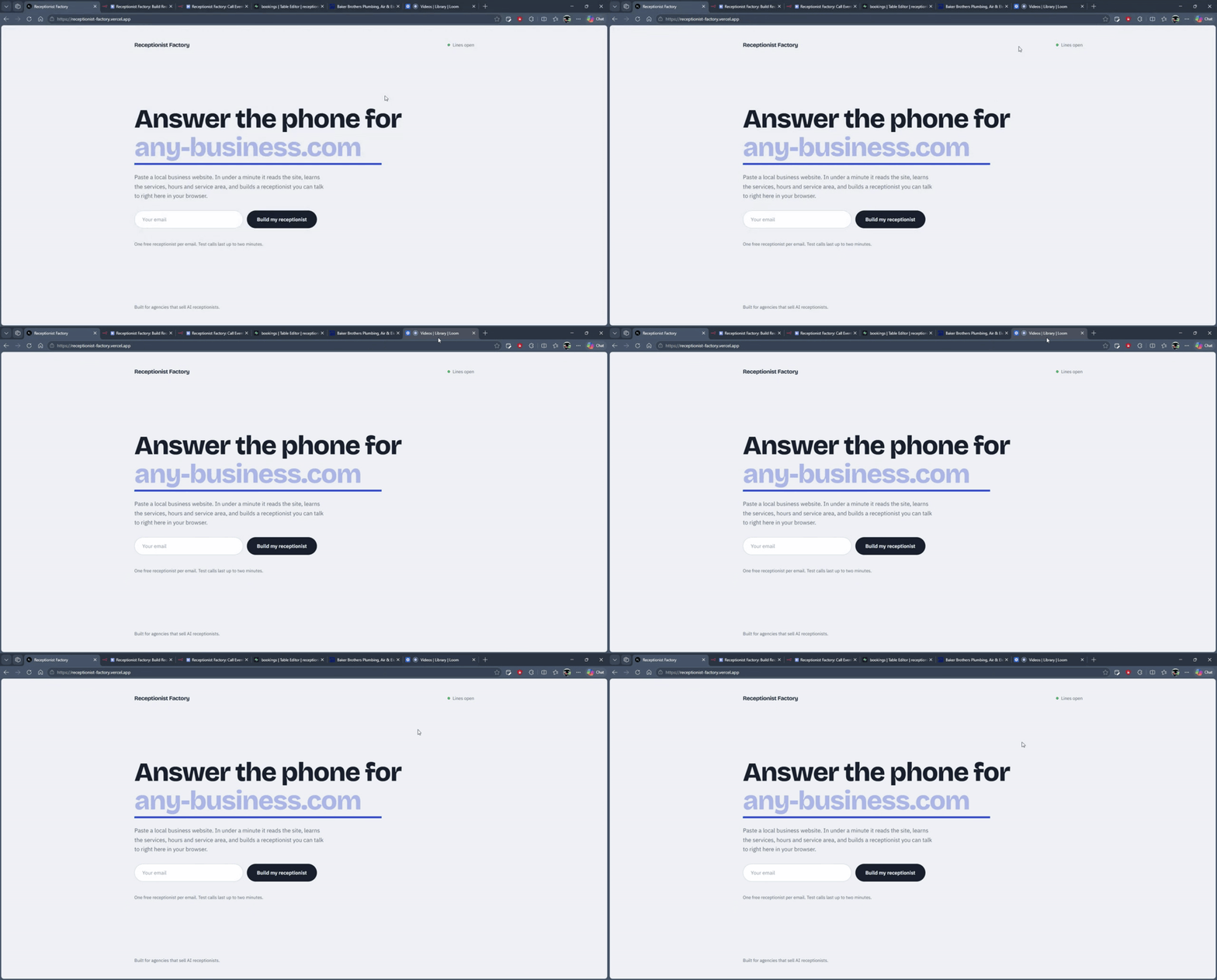
I built a system that turns any local business website into a working AI receptionist in about 15 seconds
Hey everyone. Jay suggested I share what I'm building, so here's the latest one. Paste any local business website and about 15 seconds later you have an AI receptionist for that business. It reads the site for services, hours, service area and safety rules, writes its own instructions, and takes calls right in the browser. Bookings land in a database with every detail, and the whole backend runs as two n8n workflows: one builds the receptionist, one routes everything that happens during a call. Part 1, live build and a real call: https://www.loom.com/share/fd364a3d486341eca2a3760d6525772d Part 2, the n8n workflows behind it: https://www.loom.com/share/95fc74ee45dd403baf48d7da127318d2 Fair warning, I'm not a natural on camera yet, so the delivery is a bit careful. The build is what I want you to see. Happy to answer questions on how any part of it works. If you'd like to try it yourself, email me at [email protected] and I'll send you a private link.
1 like • 2d
@Ian Kirk Same three I'd pick. Handoff is the one I watch most, since a receptionist that won't let a caller reach a person loses trust fast. Stale pages are why I'm adding an owner confirm step before any number goes live.
1 like • 14h
@Ian Kirk Home services first, like HVAC, flooring and plumbing. A missed call there is a lost job, and the owner is usually on a roof or under a sink and can't pick up. The call summary should land well with them too.

2d •
How to write a voice agent script that does not sound like a script
The fastest way to make a call feel robotic is to write it like an email. Spoken language works differently. A few rules that help: Keep each line short. If you cannot say it in one breath, split it. Ask one question at a time. Two questions in a row and people answer only the second one. Plan for interruptions. People talk over the agent, so write lines that still make sense if they are cut off halfway. Say the name of the business early, so the person knows who is calling or who they reached. Always offer a way to reach a human. It builds trust and it protects you when the call goes sideways. Read the script out loud before you ship it. If it feels awkward to say, it will feel awkward to hear. Then test it with five real people who do not know how it works and ask them what felt off. What is the one phrase you always cut from a script?
0 likes • 2d
The one question at a time rule is the big one. One I'd add from my own test calls: write numbers, times and prices the way they're spoken, like "three thirty" instead of 3:30, or the voice reads them out strangely. And keep confirmations short. "Got it, Tuesday at three" sounds human, repeating the whole booking back sounds like a form.
1-10 of 15

@umer-mehmood-3401
I build the tech behind AI agencies: LLM apps, n8n/Make automations, CRM integrations and full stack web apps. 2+ yrs shipping production code.
Active 9h ago
Joined Oct 29, 2026
Lahore, Pakistan
Powered by