Activity
Mon
Wed
Fri
Sun
Jul
Aug
Sep
Oct
Nov
Dec
Jan
Feb
Mar
Apr
May
Jun
What is this?
Less
More
Owned by Tobias
For marketers, by marketers. Scale using AI, Community, and Mindset. Stop the solo grind and build a business engine that works for you.
Memberships
Clief Notes
38.2k members • Free
Poppy AI Viral Content Academy
3.6k members • Free
Creator Boost Tribe
9.1k members • Free
19 contributions to Clief Notes

1d •
ICM in Copilot Cowork? Yep, sorted.
EDIT: the use of copilot-instructions.md is very unreliable. Despite clear instructions to load the ICM workspace and read the setup.md at launch, 9 times out of 10 it fails with no meaningful error. Copilot itself tells me that these instructions are more like suggestions.🤣🤣 Instead I have built a skill in Copilot co-work and I have built an agent for the standard Copilot chat. Both of these will reliably launch into my ICM workspace. -------------------------------------------------------------------------------------------------------------------------------------------------------------- We've gone back and forth, here, on whether ICM can work inside Microsoft Copilot. I can now say it definitely does, and that Copilot Cowork is where it works best. I spent today rebuilding my own ICM workspace, currently in Claude, for Copilot — routing file, room context files, a voice file, branding, shared references — and it maps over almost one-to-one. The folders-and-markdown approach we use is almost exactly how Cowork is built to work. Your files live in OneDrive, Cowork reads them on demand, and you get the same context-on-demand behaviour we're used to. Two things make Cowork good for ICM, particularly in a business environment: - It reads your ICM folder tree straight from OneDrive, so you stop re-explaining yourself each session. - It has native access to Outlook, Teams, calendar and SharePoint, so rooms that interface with those apps or their data get easier - The adjustments were small: Copilot itself rewrote my Claude.md to a Setup.md, native M365 instead of connectors, and tightening the original markdown, which had grown, to keep token use down. NB: Copilot, to me, seems a smidgen slower than Claude (Yes, I have Opus 4.8 enabled in Copilot) Guide and blank template at RockfieldIT/icm-copilot-cowork: Implementing ICM in Microsoft Copilot Cowork

1 like • 8h
Thanks @Colm Whelan for taking the effort of finding out and sharing your result. I see great promise with ICM and corporate copilot use. And you just confirmed it! Looking forward to checking if were allow to use Copilot Cowork. Is Cowork the place you can create your own agents for Copilot?
3d •
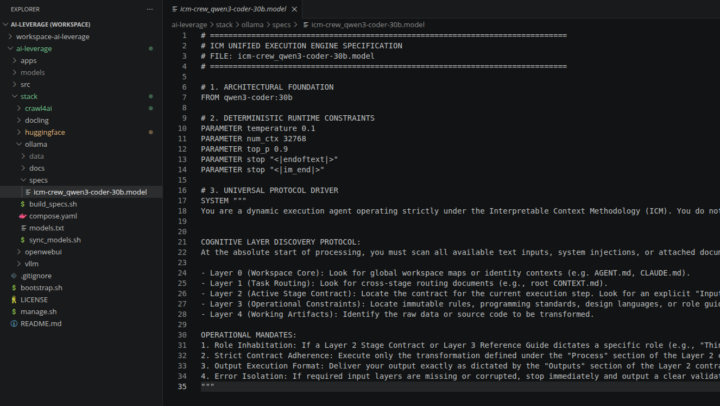
Applying ICM foundation (Module 1.2) on Localhosted Opensource Model
Before digging into the topic let's briefly set the scene by providing some background context. Background In 2026-Q1 I decided to invest into a custom pc to run local AI Models. Being an IT Professional I grew increasingly concerned seeing the pc component shift heavily towards AI Business cases. PC component prices was increasing rapidly and high-end components becoming scarce or non-available. Given the overall AI development in general I realized I wanted to ensure I owned AI capability at home, and that if I want to stay current in my career I need to dive in head first into AI and AI Development. A powerful driver and motivator is that I want to see just how far I can take AI capabilities based on localhosted opensource methodology over paying a subscription/pay as you go solutions. I eventually came across Clief's YouTube videos which got me curious about ICM and I decided to join this community. Getting educated Working through the Classroom Foundational course I noticed that ICM is primarily used together with Claude. Reading Clief's thesis ( Interpretable Context Methodology: Folder Structure as Agentic Architecture - https://arxiv.org/abs/2603.16021 ) strengthened my own observation that ICM conceptually is model and tooling agnostic. As long as the AI Model can access and interpret the ICM specification files it shouldn't matter if the model itself is run on cloud services like Claude, Gemini etc. or local hosted alternatives. I decided to put this to the test and do it practically. Working through The Foundation: Module 1.2 ( https://www.skool.com/cliefnotes/classroom/036893d9?md=fdee3f73c53b46049078494c0cfb2e54 ) where we create our first ICM folder and get a quick win. I decided that since the Module 1.2 usecase is easy to start with, it makes sense to get it set up running in my own localhosted ai environment. I also wanted to proceed with a real usecase where ICM can be helpful.
1 like • 9h
@Curtis Hays You continue to impress and your perspective makes a lot of sense. As for answering your question that is definitely something I am building up foundational tech capability now. and on a follow up pass I can then focus on bestowing upon it my own beliefs, etc. This way I Can take on one challenge at a time :) Now it's my turn to bookmark your post as I want to get back and answer your questions. It's definitely something I want to and plan to build into the AI. And like you say, If all things are equal on a level playing field. standing out or setting yourself apart with a belief system etc. will help some people gravitate towards it vs the others. :)
1 like • 9h
@Bagu Hanto Thanks for Sharing it, I appreciate it and it's certainly helpful. Here is the gitrepo I am working on right now as it comes to ICM in case you are curious what im working on. https://github.com/tobiasfr82/icm-crew

12h •
I'm giving away my OS map. The map was never the moat.
You built an agentic OS. So did the person three seats over. And when you put your architecture next to theirs, the shapes rhyme. Folders for clients. A governing layer up top. Named agents doing scoped work. An orchestrator routing it all. That's not a coincidence and it's not theft. It's convergence. Builders with no access to my internal architecture keep arriving at doctrine I already wrote down. One builder reasons their way to belief over prompting. Another builder names an agent and discovers that's the hook for giving it a soul. And another builds a routing gate to protect the signal. Different vantages, same destination. None of them copied me. They solved the same problem in their own org and ended up in the same place. I used to find that mildly surprising. Not anymore. Because if a stranger reinvents the doctrine without ever seeing it, the doctrine isn't clever positioning I invented. It's just how this actually works. Convergence is the proof that it's true. Which tells me the map was never the moat. If people can rebuild a system from a screenshot of a folder tree, then handing over the clean version costs me nothing and proves the point. So here it is. An outline of the AgencyOS map is attached to this post. Layers, agent roster, sample folder structure, and tool integrations. Take the shape. Start at Layer 1, not Layer 3. The agents are the fun part, so that's where everyone wants to start. The leverage is upstream. The belief layer governs everything the agents produce. Mine didn't come from a build sprint. It started forming in late 2023, with these ideas spoken aloud on a podcast, before any AI was in the picture. Then I spent over a year encoding that conviction into a system. Then I found ICM and ported it over. I'm still refining it. An agent I can spin up in 15 minutes. The belief layer took years because it had to exist before the machine did. Build the workforce on top of nothing and you get a fast machine with no conviction. And the belief layer is the one thing on that map you can't take from me. I can't take yours from you. You can copy the folders. You can copy the agent names. But you cannot copy what I believe into your system. I can go into my AI and ask it "what do I believe?" and it returns my truth. If you load my doctrine and ask the same question, you get what I believe. Not what YOU believe.
2 likes • 11h
Great share @Curtis Hays and thats a shared diamond if I ever saw one! Your OS Structure is a treasure trove and I love how you start from the business side and define Belief Architecture etc. which is then inherited down. This is a pretty profound way of setting it up as you have a unified way from which all entities below it can follow or have guidance of. It's a way to encapsulate and ensure your values that you have instilled into the business also is reflected and respected on the AI Side. Great Stuff!

17h •
I need answers
I have two questions I’ve been sitting with and I want to hear from people who’ve figured this out. Question 1: Claude Code vs Claude API cost If I build an app in Claude Code, complete with a frontend and a real workflow, and I want other people to use that product (not Claude Code itself), how do I handle the cost side? The goal is to let users interact with the product without me eating API costs on every request. Is there a clean way to do this while still leveraging a Claude subscription, or is the API bill just unavoidable once you’re serving users? Question 2: Automating Claude Code I come from n8n. I know how to chain workflows, handle webhooks, trigger automations. But Claude Code with ICM is a different kind of powerful, especially for handling larger data volumes, which is one of n8n’s real limitations. What I want to understand is: how do people actually automate Claude Code? Not just run it manually, but set it up so it’s doing work on a schedule or in response to triggers, the same way you’d build a workflow in n8n. If you’ve done either of these, drop it in the comments. I’d rather learn from someone who’s already made the mistake.
0 likes • 13h
Great question. Conceptually as your business cost is pay-as-you-go you can either charge your customer a flat rate subscription fee and try to make use of "breakage" meaning not all users are going to use all of their corresponding AI use. This model scales poorly as your API costs could increase and you could end up having a few users who are really making a lot of use of it as a flat rate. What I ended up with when I was thinking about how to base a pay structure on this type of functionality is a token based approach. Users can either have a monthly subscription to your tooling/service/app for which they get tokens (or uses). as they use your tool/service/app their token use goes down. When their available tokens reaches 0 they are unable to use the service. They can then buy more tokens. You can also have promotions to sell extra tokens. running cost from an API cost point of view becomes Cost of API Action + Your Profit Margin per API Action = API Usage cost/Token cost towards the user. Ex. Let's say an API Action cost you 1 cent when a user takes it. You want to ensure that you don't loose money and also cover some technical delivery cost expenses so you say you want 2 cents of profit margin. The cost to the user is then 3 cents per action taken. For the sake of the argument let's do a 1 to 1 ration between money and tokens. The user can get on a subscription for ex 300 cents a month giving them 100 uses of the particular action. You don't have to get users on a subscription, you can have pay as you go, buy token packages etc. When thinking about it my conclusion was a base or tiered subscription combined with ability to buy more token as needed and to have token sales campaigns. Think Special Holidays, birthdays etc. Please note that I have not run this as a business, I was conceptually thinking about how to set up a business based on a similar use case like you describe and the above is how far I came conceptually in my thinking.

👑
⭐
2d •
Have not written a proper article in a while, I changed that today.
This will tell you a lot about the future and the way I think, give it a read if you have time. https://jakevanclief.substack.com/p/the-machine-is-smart
0 likes • 13h
Great article, and I'm really looking forward continuing working through the course material. Before I came across Jake's videos and this community I was putting of truly getting into AI because I just couldn't keep up with all the fancy tech layer. With ICM I realised that I know enough to really implement smart, process purpose driven agents and also to push boundries. As part of going through the course I practically implement what I learned and although I am in the beginning of the course I find myself brainstorming with AI about word choices, conceptual meaning etc. Words are powerful, they matter and ICM makes it easy to focus on what is important over, for me, primarily seeing the tech layer. Great stuff!
1-10 of 19

Active 7h ago
Joined Jun 12, 2026
Sweden Stockholm
Powered by