Activity
Mon
Wed
Fri
Sun
Jul
Aug
Sep
Oct
Nov
Dec
Jan
Feb
Mar
Apr
May
What is this?
Less
More
Memberships
Handball Coaches by eduk84life
113 members • Free
21 contributions to Handball Coaches by eduk84life
1d •
🔁 WIN OR LEARN MONDAY 🧠 .
Sometimes you win. Sometimes you learn. This weekend: Could you celebrate a win — or a learning? Hopefully both.
0 likes • 3h
With one game to play, we managed to secure our place in the league. When things weren't going our way, and it was looking as if we were the most likely to get relegated, we tried to influence our mental state. We rallied around a credo (pass for pass, shot for shot, action for action) that encapsulated the focus on what we could do ourselves, where we are powerful and can actively influence. We wanted to draw away the attention from potential failure, the stress of relegation and what was happening for other teams. This surely was only one part of the solution, but it helped massively in my mind - and it felt, like we 'unlocked our potential' for the final stretch of the season, which we had only shown glimpses of throughout the season. Essential (obvious) learning: focus intensively on the things you can influence, and try to ignore everything else. Helps the own game and even more so, the mentality. Fun fact: since not talking relegation included not looking at the table or the outcome of other matches, I didn't realized we were safe until 10 mins after the final whistle :D
22d •
Plyometrics!!
Another one from my favorite YT channel about plyometrics and how to progress. Mat Mcinnes Watson is my Plyoguy from Instagram and I try to integrate his stuff in the Training, although we already jump a lot during practice.
0 likes • 22d
thanks for the input. for me, athletic training consists of three layers: 1) and most impotant: handball fitness --> get your sports-specific reps in, the contact, the sprints, the movements, etc. I'm not a fan of running laps or doing straight sprints, especially if i can adopt it into a handball setting. 2) heavy-load/max strength: building force and power, essential for injury prevention as well. 3) plyometrics: transitiong the built force into movements, high jumps, fast acceleration and deceleration, lateral movements, change of direction, shot speed/power etc. All relying on #2 though, especially for improvement with adult athlethes. https://www.instagram.com/milocoaching/ this is a great account i get a lot of ideas from, with lots of scientifc background and great array of exercises.
0 likes • 18d
@Damir Djukic as of right now, since I'm not in charge of every session, it differs. Usually I'd try to implement one sprint/COD and one bodyweight plyometrics session for everybody during the week, takes about 10-15 mins each. Next year I'll be working with a crossfit studio, so we got the possibility to work very specifically there.
Apr 20 •
Recap: Julian Rux Webinar
We had a really good session with Julian Rux 🙌 And somehow, it raised more interesting questions than answers 🤪 — which is exactly what we want here. And at one point it felt like he predicted Magdeburg losing a game on 7m 😅 But actually, it just shows how powerful data can be when you understand patterns. A few thoughts that stayed with us: - Are we maybe overvaluing simple stats like goals? - Do we really look at shot quality — or just outcomes? - How often do we adjust our game based on our strengths… instead of copying others? - One key takeaway: 👉 Data should help us reflect — not make things more complicated And also: 👉 The biggest value is before and after the game, not during We’d love to hear from you: 💬 What do you already track with your team? 💬 Where do you feel data could help you more? Let’s use this space to exchange ideas — that’s what this community is about 🤝
1 like • Apr 20
We definetly overvalue goals. We were rather proud of our team's defense at the beginning of the season, since it was best or second best even though we were sitting in last place. The defense isn't bad, but our pace of play and consequently less attacks for both teams definetly 'helped' in regards to that statistic. Generally, I think a good coaching approach involves both: reliance on stats (and as a rule of thumb: the deeper the statistical analysis the deeper the insight it offers) and qualitative analysis. What am I analysing and maybe what 'gut feeling' does my experience and knowledge tell me? (For all of those who haven't read it: a HUGE recommendation to look into "Thinking Fast and Slow" by Daniel Kahnemann about biases, heuristics and the working ways of our brain - highly adaptable to being a coach)
Apr 17 •
Thursday Question (late this week 🙈)
Missed it last week and a bit late today, sorry… but I didn’t want to skip it again. Watch this clip 👇 Thursday Question:How much should a team adapt to the strengths of one exceptional player? Curious to hear your thoughts – let me know in the comments below.
0 likes • Apr 20
I'd agree with Tugay. I think there's a great benefit to having star players obviously, but especially from my experience this season: if they are not integrated into a system that works it's not sustainable to use it that way. As much as I hate to bring it up @Damir Djukic but our last game against you was the best example in my opinion, where our star player could shine because he was set up by the team for it and didn't need to do it himself - which didn't work for us numeroures other times this season. Additionally, I think football is itself too different from handball to be compared here, since it can be doable to defend with 10 players and have one 'rest', sort of similar to Messi at Barcelona.
Apr 13 •
WIN OR LEARN MONDAY 🧠
Sometimes you win. Sometimes you learn. One thing you would do differently next weekend after what you saw in the last game?
0 likes • Apr 13
@Fabian Kastner Although there can surely be done more, I'd argue that we include such training methods quite a bit. I sometimes feel like we need to work on our general mindset how we deal with 'failing' a little, and I mention this quite often towards the players, but a downward spiral is hard to break. As one scholar I recently read pointed out, 'adaptive perfectionism' is a strong base a a character trait: we hate to make mistakes, but they don't concern our self-esteem. In the specific situation we're in, it's quite hard to find a good foundation. With a significant loss yesterday in relegation battle (that can be traced back to missing resilience/self-esteem), we don't have the opportunity to practice until our next game on wednesday, where we need to be resilient and believe in ourselves, so this is quite a hard task to do. My approach is to focus on the little things and the things we can control, but it's easier said than done - especially if we can't create positive experiences in training sessions in between.
0 likes • Apr 13
@Damir Djukic out of interest: What did you learn from your game on the weekend?
1-10 of 21
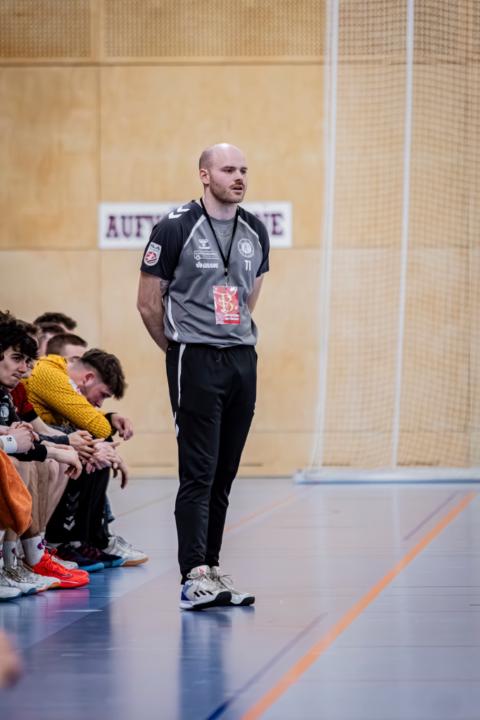
@timo-issing-8297
Former player turned coach due to injuries, currently at WAT Fünfhaus.
Active 3h ago
Joined Jan 14, 2026