Activity
Mon
Wed
Fri
Sun
Nov
Dec
Jan
Feb
Mar
Apr
May
Jun
Jul
Aug
Sep
What is this?
Less
More
4 contributions to FirstCall DPC

Mar 14 •
Choosing Your Market & Model
Today is where strategy replaces emotion. Most new owners choose insurance because it feels secure.Strong operators choose private pay because it builds control. Cash flow = survival.
2
0
Mar 14 •
MORE ON DPC
This isn’t just business. It’s responsibility. It’s trust. It’s someone’s mother, father, or child. Lead like it matters — because it does. 💙🏡 #HomeCareCEO #dpc
2
0
Mar 13 •
Hello everyone
I noticed that members in this community are not active as it's supposed to be Let do some little intro What's your niche in DPC
2
0
Dec '25 •
Why We Built This — And Why We Never Quit
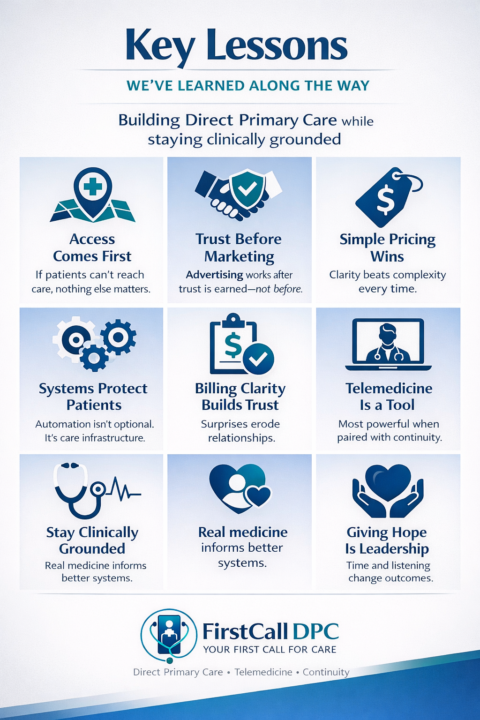
What pushed us to build something different wasn’t a business idea. It was what we were seeing every day in the emergency department. A huge number of patients who come through the ER are there for one simple reason: they don’t have access to primary care. Not because they made poor decisions. Not because they didn’t care. Simply because access didn’t exist. Some arrive poorly treated—not from neglect, but from delay. Others wait four, five, sometimes six hours in an emergency department for minor illnesses that could have been handled safely and efficiently through telemedicine if access were available. That stayed with us. We weren’t trying to replace emergency medicine. We were trying to protect it—by keeping patients out of the ER when they didn’t need to be there, and by creating an economical, accessible way for people to get care earlier. From the beginning, we knew Direct Primary Care was the direction we wanted to go. But we also knew access alone wasn’t enough. Telemedicine had to be part of the solution. Not as a shortcut. Not as a replacement for real care. But as a way to remove unnecessary friction. We don’t believe doctors are “getting it wrong.” Most are overwhelmed—buried under red tape, documentation, and systems that make meaningful care harder every year. The intent is there. The time is not. At the same time, both of us were still working roughly 150 hours a month in the emergency department. We were very intentional about keeping those worlds separate. As tempting as it might have been from a business standpoint, we never pitched our clinic to patients in the ER. That line mattered to us. We wanted this built the right way—or not at all. There are plenty of colleagues who think we’re crazy for taking this path. That’s fine. What’s driven us hasn’t changed: an undying drive not just to be successful, but to create something better. Staying clinically grounded has always mattered. Emergency medicine keeps you honest. It also makes it clear that better access and longer appointments create space—for conversation, for prevention, and for alternatives before defaulting to the usual pharmaceutical path.
0 likes • Mar 13
Absolutely correct about this
0 likes • Mar 13
@Graves Fromang are you done with your practice now
1-4 of 4
@theo-martins-5456
Writing and translation, Expertise in GOVT Contracts and Proposal Writing
Active 26d ago
Joined Mar 12, 2026
Powered by