Activity
Mon
Wed
Fri
Sun
Nov
Dec
Jan
Feb
Mar
Apr
May
Jun
Jul
Aug
Sep
Oct
What is this?
Less
More
Owned by Suzanne
For women 40+ struggling with menopause weight gain, emotional eating, cravings, sleep and energy. Rewire your mind, release weight, reclaim your life
SkoolKit | Skool CRM Toolkit
1.2k
5.0
$2/m
The Reinvention Project
150
5.0
Free
VIP Soul Circle
2.3k
Free
Compelling Communicators
325
5.0
Free
Skool Events Daily
500
5.0
Free
The Content Revenue Lab
1.2k
5.0
Free
SKOOL PARTNERS ⭐️🚀
1.5k
5.0
$27/m
Coaches Life Lab 2.0
807
5.0
Free
Skool Launch Lab
408
5.0
Free
1 contribution to Joyful Mind Community

May 14 •
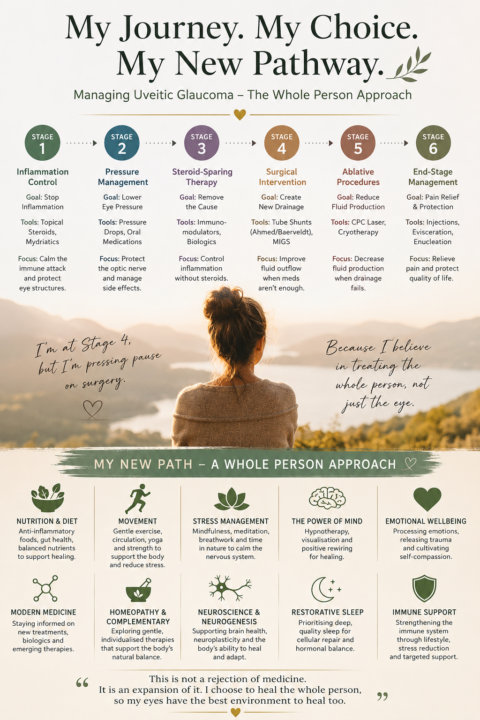
When Saving the Eye Starts Damaging It: Why I’m Pressing Pause at Stage Four
There’s a phrase often used in ophthalmology when dealing with chronic inflammatory eye disease: “It’s a balancing act.” And honestly, that’s exactly what it feels like. For years, my treatment journey has involved trying to preserve the structure of my eye while also managing the consequences of the very treatments designed to save it. It’s a constant negotiation between inflammation, pressure, pain, vision, medication tolerance, and surgical intervention. Clinically, I now sit at what would be described as Stage 4 of the uveitic glaucoma pathway, surgical intervention. But this is where I’ve decided to pause. Not because I’m “giving up.”Not because I’m ignoring medicine.But because I no longer believe the current pathway has fully considered the whole person. The Standard Journey The traditional progression often looks something like this: Stage 1: Inflammatory Control High-dose steroids and dilating drops are used to stop the immune system attacking the eye. Stage 2: Pressure Management As steroid use increases eye pressure, glaucoma medications are introduced to try and protect the optic nerve. Stage 3: Steroid-Sparing Therapy Systemic immune-modulating drugs and biologics are introduced to reduce dependency on steroids. Stage 4: Surgical Intervention When pressure remains uncontrolled, drainage surgeries or tube shunts are often recommended. And this is the point I’ve reached. Why I’m Pressing Pause What I’ve realised is that throughout this entire journey, almost every intervention has focused on the mechanics of the eye. Pressure.Drainage.Inflammation.Structural preservation. But very little attention has been paid to: - chronic stress, - nervous system dysregulation, - trauma, - sleep, - inflammation as a whole-body process, - nutrition, - movement, - metabolic health, - emotional wellbeing, - neuroplasticity, - or the role the mind may play in healing and adaptation. No one has truly sat down and explored the wider terrain of what might be contributing to ongoing inflammation and immune dysregulation.

0 likes • May 14
Ohh my goodness @Amanda Joy I resonate with everything you have said! Not one of our body systems and organs work in isolation- everything is designed to work as a whole. When we hit midlife a whole new set of conditions is presented to us as women - and this is definitely not considered in the medical world. Inflammation or Inflammaging is a relatively new term and has dramatic impacts on our health in all the challenges you have listed- and the mind and stress are overarching all of this. Well done on taking a pause and addressing your condition from a mind body connection perspective 💕
1-1 of 1
@suzanne-ingleton-5646
Helping midlife women rewire emotional eating, release weight & reclaim their health using Eating Psychology, Clinical Hypnosis & Lifestyle Medicine
Active 11m ago
Joined May 2, 2026
Adelaide Australia