Activity
Mon
Wed
Fri
Sun
Aug
Sep
Oct
Nov
Dec
Jan
Feb
Mar
Apr
May
Jun
Jul
What is this?
Less
More
Memberships
Fingerstyle Tab Club
1.3k members • Free
7 contributions to Fingerstyle Tab Club

2d •
Beginner Questions - What Is a Slash Chord? (C/B)
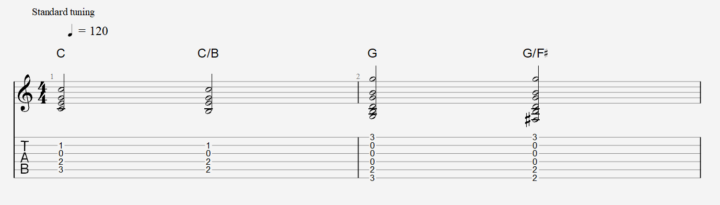
You might sometimes see a chord written like this: C/B This is called a slash chord, and it's much easier to understand than it looks. The first letter (C) tells you the main chord you're playing. The letter after the slash (B) tells you which note should be the lowest note (the bass note). Usually the bass note in the same note as the chord, it C major the bass note is C. With C/B, you're still playing a C major chord, but instead of the bass note being C, you change it to B. On the guitar, this usually means that the top part of the chord stays almost exactly the same, while you move or change one of the fingers on the bass strings to create the new bass note. In other words, you're not learning a completely new chord. You're simply making a small change to the bass while keeping the rest of the chord sounding like C major. I've put a few tab examples below to demonstrate this. Why do songs use slash chords? Slash chords are very common in songs that were originally written on the piano. A pianist's left hand usually plays the bass notes, while the right hand plays the chord. Because the two hands work independently, it's easy to keep the same chord in the right hand while changing the bass note underneath. This creates a much smoother sound, especially when the bass moves one note at a time instead of jumping around. So whenever you see a slash chord, remember: - The first letter tells you the chord. - The note after the slash tells you what the bass should play. - Most of the chord will stay the same—you'll usually just make a small change to the bass note. Once you recognise this pattern, slash chords become much less intimidating and start to feel very natural. If there's anything else in music you don't understand, let me know and I'll create a post like this to answer it. Thanks Jack

0 likes • 21h
I don’t get it. What is a bass note? if it’s C/B, where are your fingers on the frets and which finger changes?
17d •
🎸 New FREE Tabs – Hey Jude, Leaving on a Jet Plane, Yellow Submarine & More
Hi everyone, Before I get into this week's new tabs, I just wanted to say a big thank you to everyone who's already been trying out the new 7-day free trial. It's been great to see so many new faces exploring the full site, and I'm really pleased I can finally offer people the chance to have a proper look around before deciding whether to join. If you want to come and have a look at the full site and get access to my full back catalogue of materials - you can do the free trial here. Now, onto this week's music... This week's release is a little different. I need to make an unexpected trip back to the UK to visit an elderly relative, so rather than leave you without any new material next week, I've bundled this week's and next week's releases together into one larger collection. This Week's Bundle 🟢 FREE - Hey Jude – Full Fingerstyle Arrangement - Yellow Submarine – Level 1 - Love Me Do – Level 1 🔒 Tab Club / Full Members - Crimson and Clover – Full & Easy Versions - Leaving on a Jet Plane – Full & Easy Versions - Yellow Submarine – Level 2 - Love Me Do – Level 2 The free tabs are in the classroom tab as usual. If you'd like to work through the complete bundle, including the Full & Easy arrangements and the Level 2 versions, they're available in the Fingerstyle Tab Club for $7 a month. You can download them in the classrooms tab. And they're also included as part of the full membership, which you can now try with the 7-day free trial here. I hope you enjoy the new arrangements, and thank you, as always, for being part of the community. Have a great week! Jack
1 like • 17d
I like this song! Thanks. 😊
28d •
Help! I'd Love Your Feedback on My Video Lessons Format
Hey everyone, I'm working on turning more of my tabs and exercises into video lessons, but I'd really appreciate your input. I learned guitar before YouTube existed, and if I'm honest, whenever I have used them I've often found many online lessons a bit slow and frustrating. Sometimes I just want to see exactly what someone is playing without having to sit through lots of talking first. I've posted my step-by-step lesson showing how to play my easy arrangement of The Godfather. When I'm teaching a technique, exercise, or course lesson, I think explanation and narration are important. But when you're learning a song, I'm not so sure. So I'd love to know: - Do you find the narration and explanations helpful? - Or would you prefer the song broken into sections with less talking and more playing? - Would a slow demonstration with a close-up of both hands be enough? - Do you like hearing why certain fingers are used, or do you mainly want to see what to play? - What makes a video lesson most useful for you? There's no right or wrong answer. I'm genuinely interested in how you prefer to learn, and your feedback will directly influence how I create future lessons. Thanks in advance for your help—I read every comment and really appreciate your input. Jack 🎸
2 likes • 27d
I find the explanations and narration very very helpful. I most appreciate when you slow down enough for us to practice along. The way you did the “Godfather” lesson is just perfect. I also find it extremely helpful when you explain which finger goes where on the fretboard.
Jun 10 •
Beginner Questions - How Chord Charts Work (And Why I Hate Them)
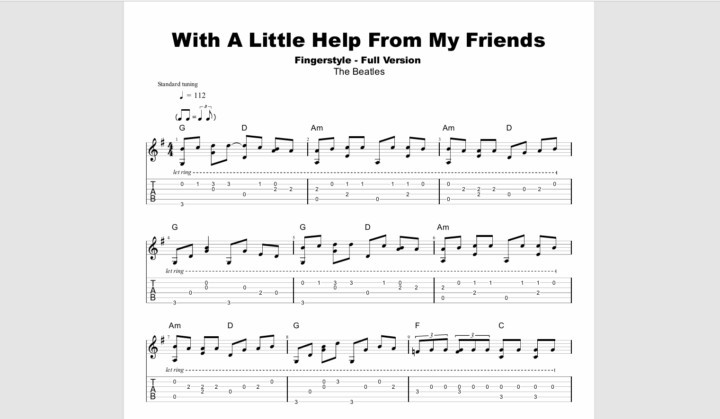
My title might be a little clickbait, but I've always found the way chords are presented in chord books and on websites like Ultimate Guitar confusing for beginners. Let me explain why. I've attached two versions of With A Little Help From My Friends. One is my arrangement and the other is a typical chord chart from Ultimate Guitar. When a band plays a song, all of the instruments are following the same underlying structure. The music is organised into bars, and most beginner songs are in 4/4 time, meaning each bar contains 4 beats. When a chord changes, it will often happen: • At the start of a bar (beat 1) • Halfway through a bar (beat 3) This is why counting is so important. In my arrangement, you can clearly see exactly where the chord changes happen because the music is divided into bars. We don't normally write the beat numbers on the music, but you can still see whether a chord comes in at the start of a bar (beat 1) or halfway through a bar (beat 3). Once you understand that, it becomes much easier to know exactly when to change chord. The problem with many online chord charts is that the chords are placed above the lyrics. The chord is simply written above whichever word is being sung when the change happens. This is useful for singers, but not always for guitar players. The spacing between words doesn't tell you how long to hold a chord for. A singer might squeeze lots of words into one bar, then hold a long note for two bars. Looking at the lyrics alone can make it seem like some chords last much longer than others when they actually don't. So how should you use chord charts? My advice is to listen to the song while looking at the chords. Don't worry too much about following every lyric. Instead, try counting: 1, 2, 3, 4... 1, 2, 3, 4... and see if you can hear where the chord changes happen. You'll quickly notice that in most beginner songs the changes happen at the start of a bar or halfway through a bar. Once you can hear and count those changes, chord charts suddenly become much easier to follow because you're following the rhythm of the song rather than trying to guess from the spacing of the lyrics.
1 like • Jun 11
@Jack Gration Ahhhh!!! I see now, thanks. I think it will take me many many moons to figure out when to change chords on my own. 🥴 When people write these lyrics with chords written above them, they should really write measure marks as well! This would be very, very helpful.
0 likes • Jun 13
@Jack Gration I understood what you meant, but I always use the word “measure.” 🙂
Jun 9 •
Beginner Questions - Why Are Chords Written Above The Music If We Don't Play Them?
One thing I've realised from talking to members is that if one person is confused about something, there's a good chance several other people are wondering the same thing. So I'm starting a new series called Beginner Questions where I'll answer questions from members. Nothing is too basic. In fact, the "simple" questions are often the most important ones. If you've ever been confused about something, leave a comment below and I'll try to answer it in a future post. Today's question came from a member working through my beginner version of The Godfather: "Why are there chord names written above the music when we don't actually play those chords?" Great question. The standard in music notation is to include the chords being played in the song, even if your particular part doesn't use those chord shapes. Think about a band with a rhythm guitarist and a lead guitarist. The rhythm guitarist plays the chords, while the lead guitarist plays melodies or solos. Even on the lead guitarist's music, you'll often see the chord names written above the notes. This helps them understand how their part fits together with the harmony of the song. That's exactly what's happening in the Godfather arrangement. The chord names are there to show you the harmony behind the melody, but you don't need to play those chord shapes. You're simply following the tab. Fingerstyle guitar can make this a little confusing because sometimes we play full chords, sometimes partial chords, and sometimes just single melody notes. At beginner level, the best approach is simple: Follow the tab, play the notes you see, and don't worry too much about the chord names above the music. As you progress, those chord symbols will start to make more sense and you'll begin to see how melodies and chords fit together. Now it's your turn... What beginner guitar question would you like me to answer next? Leave it in the comments below.
0 likes • Jun 10
@Jack Gration This is exactly what I don’t understand either. I’m looking forward to your answer. Sometimes I look at a song and the lyrics are written with the letter name of the chord above it, but I too, do not know when to change chords.
1-7 of 7
@susan-ballew-3184
I am a 2.5 - 3.0 recreational pickleball player. I have been playing for about eight months. I also work full-time as a Kindergarten teacher.
Active 21h ago
Joined May 18, 2026