Activity
Mon
Wed
Fri
Sun
Nov
Dec
Jan
Feb
Mar
Apr
May
Jun
Jul
Aug
Sep
What is this?
Less
More
Mastering.com Members Club
37.8k
4.5
Free
9 contributions to Mastering.com Members Club

🚀
12d •
Free plugin for Premium Members 🎁
I have a free plugin to give away for all Premium Members today! The plugin is BASSROOM by Mastering the Mix (usually $79). This is a really unique and fun plugin for EQing your low end - it sounds great too. "When your low-end is muddy or weak, your entire mix suffers. BASSROOM shows you exactly how to shape it, for low-end that hits hard, sounds clear, and translates across every system." Moving forward, we're going to try and get a free plugin every month for you guys as a perk for being a Premium Member. (If you're not a Premium Member yet, you can upgrade here to instantly unlock the free coupon code. The cost for a month of membership is a lot less than what the plugin would cost you to buy.) ➡️ Claim your plugin code by entering your registered email address on this page: https://support.mastering.com/codes This will be the email address you signed up with on our website or here in Skool, depending on how you became a paid member. You will only be able to claim the plugin code if you're an actively paying member. If you have any trouble, please contact [email protected] or leave a comment below. 🚨 BUT that's not all... We also have a new 30% discount for all Premium members at Naturl Audio, the makers of the popular new AL-1 limiter. This discount can be access at the same page as above. Simply enter your email, and you'll also be able to request your unique discount code. Enjoy! Rob


0 likes • 8d
Thank you 😊🥳
26d •
Do you clean your studio space?
How often, and with what? I'm just curious, and interested. 🤔😁
1 like • 21d
@Randall Juhl thank you for this advice! I keep it off when not in use, and wipe things down every week or two. I'm not hearing any fan noise, so that's encouraging.
0 likes • 21d
@Toby Sillars thanks Toby! The dust build up in those cracks bothers me a bit. I'll give this a try!

Aug 21 •
Your favorite moment in Produce-A-Thon with Damien?
Unfortunately I couldn’t attend the event but definitely planning to watch the replay if available. What was your favorite moment?
3 likes • Aug 21
I found this event fascinating. It really kept my full attention. Day 2 felt the most informative. This kind of music is a mystery to me, but now I understand how some of these sounds are made, even if I'm not sure I could make them myself. Damian's primary use of audio samples, as opposed to MIDI, was also refreshing.
Jan 13 •
Troubles with Logic's Smart Tempo
Hello fellow Logic Pro experts! This question is for you. In our studio we often arrange music on a Yamaha psr-sx900. We then import a WAV file into a Logic Pro session. When I import the wave file, it follows the built in click or metronome well in the beginning, but slowly moves so that by the end of the (usually 7-8min) song it's completely out of sync with the click. There's no noticable tempo change though, as in internally the music sounds ok without the click. Smart Tempo is set to Keep (same as the tempo from the keyboard), and both "Set new recordings to" and "set imported files to" are set to OFF in the Smart Tempo project settings. Flex and Follow is OFF for the chanel, and I make sure the first downbeat of the file aligns with a downbeat on the grid. Also, everything is quantized on the keyboard before it's arranged into a MIDI file (style) and exported to audio. When I set Smart Tempo to Adapt, I see lots of small changes on the tempo line and sometimes hear noticable changes in the file itself. When I set Smart Tempo to AUTO, sometimes it's ok, but sometimes the music slows down or speeds up very obviously. So, Keep seems the least destructive. I'd rather Logic not alter my file at all. It really slows down my workflow and is super frustrating. Any thoughts??
0 likes • Jan 21
@Tom Baldwin thanks for this suggestion, I'll see what's possible considering our set up!
2 likes • Mar 9
Just an update for anyone still following this thread: Our current solution to this problem is to connect our Yamaha to our workstation/DAW via MIDI cable and audio output, open the MIDI style file created by the Yamaha in Logic, confirm all instruments sound as they should, check levels, hit play (for the keyboard) and record (for Logic). So, the Yamaha is playing the MIDI (according to the Logic clock) and Logic is recording the audio. From this, we get a consistently in-time audio file of the music.
🚀
Feb 27 •
Vocal workshop starts Monday
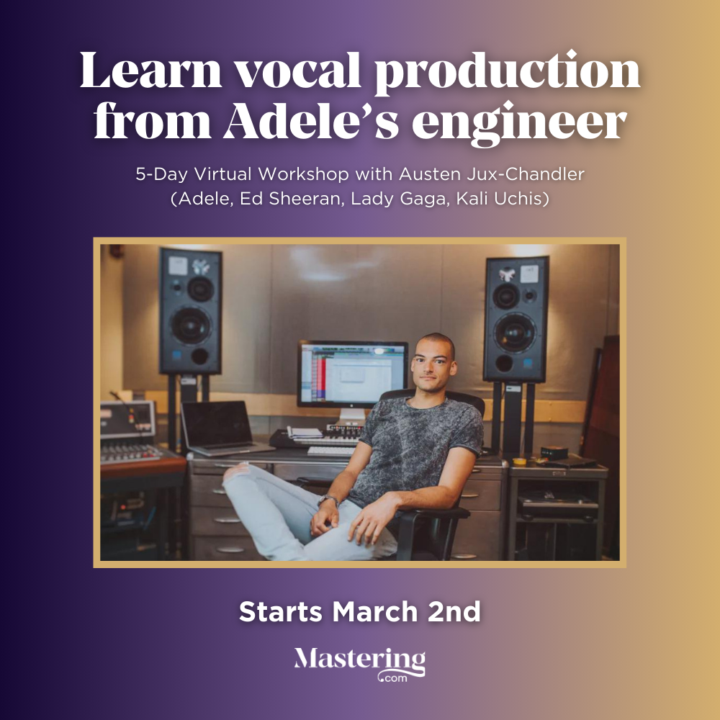
In case you missed it, our 5-day Vocal Production Workshop with Austen Jux-Chandler (Adele, Ed Sheeran, Lady Gaga, Kali Uchis) starts this coming Monday, March 2nd, at 12pm Eastern Time. If you don't have your ticket yet, it's not too late. Grab a ticket here before the event starts on Monday. I have included the original post below with all the info. Hope to see lots of you there! Leave a comment below if you're coming 🔥 ------------- Super excited to share something with you today that's a first of it's kind for Mastering.com We're hosting an exclusive 5-day Vocal Production workshop where you'll get to learn the A to Z of recording and mixing vocals from Adele's very own engineer. Introducing Austen Jux-Chandler. Austen won a Grammy for recording Adele on her album, 25. In the attached photos, can see him on stage (second from the left) accepting the Grammy with Adele. But that's just the tip of the iceberg. Austen has also recorded Ed Sheeran, Lady Gaga, A$AP Rocky, SZA, Mark Ronson, and John Legend. He has earned a reputation as one of the top vocal producers in the world. We recently hung out with Austen at Lion Share Studios in LA, where he told us that he prefers to record at his artist's homes, rather than multi-million dollar studios. It helps create a more comfortable environment that improves the performance, he said. That's when I knew we had to do something with Austen, so he could show you step-by-step how he's able to record Grammy-winning vocals in a bedroom. So, starting March 2nd, Austen is going to spend 5-days with students live on Zoom, teaching his entire methodology from session prep to recording, editing, comping, mixing, creative effects, and more. Austen has never opened up his process like this before, so don't miss this chance to learn from one of the best in the industry. All the info is here: https://courses.mastering.com/product/1769595511504x935745290124299100?utm_source=Skool
0 likes • Feb 28
Can't be there Monday, but I intend to be there the other days.
1-9 of 9

@stephanie-biggs-8791
Hi! I'm Stephanie.
So much to say, and so little time.
Active 4d ago
Joined Nov 23, 2025
Powered by