Activity
Mon
Wed
Fri
Sun
Sep
Oct
Nov
Dec
Jan
Feb
Mar
Apr
May
Jun
Jul
Aug
What is this?
Less
More
Prompt-to-Print
55 members • Free
The Kind Copy Movement
1.9k members • Free
Wealth Mastery Academy
3.7k members • Free
Pink Print Prep Skool™ (P3)
1.5k members • Free
Digital Art with Adriane
67 members • Free
The Quote Collective
136 members • Free
Circular Machine Knitting
2.1k members • Free
Di-Maccio Art Academy
5.2k members • $7/month
Affinity Creatives
2.4k members • Free
15 contributions to H E F F · creative

Jun 9 •
🎨 Painting Edges Made Easy (It's Just Like Colouring In!)
Remember when you were a kid and you liked to colour in? One of the first things I learnt was to colour around the outer edges first. Once the outline was done, it became much easier to stay inside the lines and fill in the rest of the picture. Painting works much the same way. Whether you're painting flowers, landscapes, portraits or buildings, you're eventually going to come across areas where you need to paint neatly along an outer edge or follow a line. It could be the edge of a flower petal, the side of a tree trunk, the outline of a face or the roof of a house. That's what this lesson is about. Learning how to load your brush correctly and control the paint so it flows smoothly along those edges without fighting you every step of the way. Choosing the Right Brush Your brush plays a huge role in this exercise. For practice, I'd suggest using either a flat brush or a filbert brush about 1 cm wide, with bristles around 1 cm long or slightly longer. You want a brush that can hold enough paint while still maintaining its shape. Brushes that are too short often don't carry enough paint, while brushes that are too soft can be difficult to control. Preparing Your Paint If you're using acrylics, lightly wet your brush first. Dip about one-third to halfway into clean water and allow the moisture to travel up through the bristles for a few seconds. Next, start working the brush into your paint. Rather than plunging straight into the centre of the paint blob, begin at the outer edge and gradually mix the moisture into the paint. You're aiming for a smooth, creamy consistency — almost like a slurry. Be careful not to make it watery or runny. If it's too thin, the paint will flow uncontrollably when applied. For oil painters, the principle is exactly the same. Instead of water, use a small amount of linseed oil or your preferred painting medium to improve the paint's flow and help it glide smoothly from the brush. Practising Your Lines On a spare sheet of paper, draw a few straight lines and curved lines.

🔥
1 like • Jun 13
@Ben Heffernan Great advice.
May 20 •
🎨 Have You Ever Heard of Lapis Lazuli? Me Either… But This Is Interesting (and It Once Cost More Than Gold!) 💰
Imagine walking into an art store today and seeing a tiny tube of blue paint worth more than your car 🚗 That was basically Ultramarine Blue during the Renaissance — roughly 500 to 700 years ago. This wasn’t just “blue paint.” This was luxury.Power.Status.The colour of the rich 👑 The pigment came from a rare stone called Lapis lazuli, mined deep in the mountains of Afghanistan and shipped across dangerous trade routes into Europe. Artists then had to crush the stone into powder and carefully refine it into pigment by hand And the craziest part? The finest Ultramarine Blue was sometimes worth MORE than gold 🥇 Yep… painters were literally brushing wealth onto canvas. That’s why wealthy patrons often demanded it in contracts: “Use genuine ultramarine.” Because they were paying a fortune for that brilliant glowing blue 🔵 You’ll notice many old Renaissance paintings show Virgin Mary wearing deep blue robes. That wasn’t random. Blue became associated with holiness and importance partly because the pigment itself was so expensive It was basically medieval luxury branding 😄 Meanwhile today… we squeeze ultramarine acrylic from a $10 tube while eating a meat pie in trackies 🥧😂 Makes you appreciate modern paint a bit more hey. I sure do! Cheers Heff...
🔥
1 like • May 20
Yes, I wear Lapis Lazuli bracelets.
🔥
2 likes • May 21
@Ben Heffernan I wear Lapis Lazuli bracelets. I also wear Amethyst, Tigers Eye, along with many others.
Apr 27 •
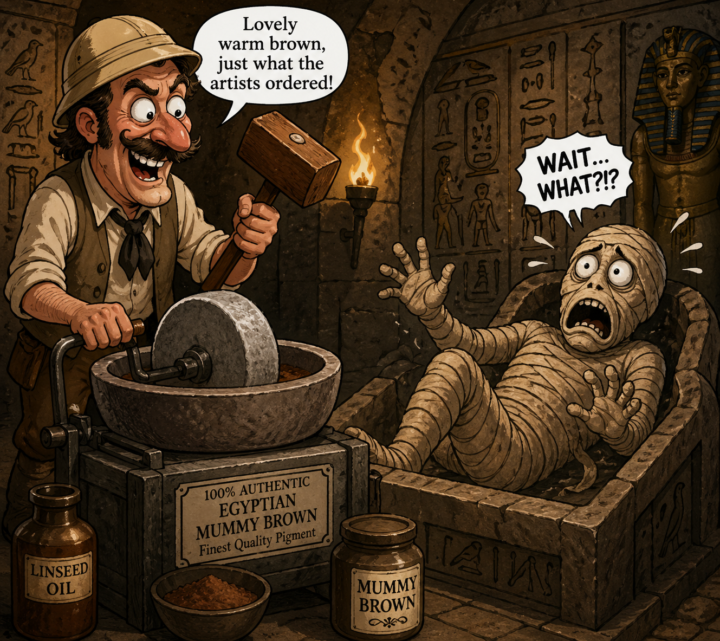
Does anyone know the story behind Mummy Brown?
🎨 Did Artists Really Paint With Mummies? As strange as it sounds… yes, they did. For hundreds of years, artists used a paint colour called Mummy Brown — a rich transparent brown pigment made partly from ground-up Egyptian mummies. Human remains, linen wrappings, and resin were crushed and mixed with oil to create a warm earthy colour loved by painters in the 1700s and 1800s. It became popular because it created beautiful shadows, glowing skin tones, and deep transparent layers that other browns struggled to match. Many respected artists used it, often without thinking too deeply about where it came from. The trade was fed by a growing European obsession with Ancient Egypt. As tombs were opened and artefacts shipped overseas, mummies became collectibles… and sadly, also raw material. Some were sold to museums, some to private buyers, and some ended up in pigment factories. One famous story tells of artist Edward Burne-Jones. When he discovered his tube of Mummy Brown was made from an actual person, he was horrified. He reportedly buried the paint tube in his garden out of respect. By the early 1900s, real Mummy Brown began disappearing. Supplies ran low, public attitudes changed, and people realised how disturbing the practice truly was. Paint makers eventually replaced it with synthetic versions using ordinary pigments. Today, when you see “Mummy Brown” sold in modern art ranges, it contains no mummy at all — only a colour recreation. So next time you squeeze out Burnt Umber or Raw Umber, be thankful. Some old paint history is better left in the tomb.
🔥
1 like • Apr 27
@Ben Heffernan I did not know this.
Nov '25 •
🎨 Welcome to H E F F · Creative! Introduce Yourself 👋
G’day legends! Heff here — truckie, tradie, and part-time artist finally getting the chance to create again after life and work got in the way for a while. This space is for anyone who’s ever felt that same pull to pick up the brush and have a crack at art again. I also run a YouTube channel — Ben Heffernan Art — where I share easy tutorials, time-lapses, and creative tips for beginners and returning artists. Drop a quick intro below 👇✅ Who you are✅ What kind of art or creative stuff fires you up✅ Bonus: Share a pic of your workspace or your latest project! Let’s build a laid-back, inspiring corner where we can all learn, share, and have a laugh along the way.Cheers,— Heff 🎨🔥
🔥
0 likes • Mar 24
@Wendy Scott Welcome.
🔥
0 likes • Mar 24
@Connie Stegall Welcome.
Mar 24 •
Instead of a card give this as well!
If you're here you probably have a creative streak that you like to give a flex here and there? Well i have just dropped this video on an easy painting that will be sure to give a few smiles to that special 50 year old. Now I'm using 50 here I've already done a 40 year old painting....? Hmm well you'll get the gist. See you in there, Heff.
🔥
1 like • Mar 24
@Ben Heffernan Love this idea for birthdays.
1-10 of 15
🔥
@stefanie-byrd-1480
Artist I 🧬Genealogy I Family History I Photography.
I also research my family history and DNA genealogy.
Active 31m ago
Joined Nov 27, 2025