Activity
Mon
Wed
Fri
Sun
Jul
Aug
Sep
Oct
Nov
Dec
Jan
Feb
Mar
Apr
May
What is this?
Less
More
Memberships
Escape the Matrix
209 members • Free
25 contributions to Escape the Matrix

Mar 19 •
Beyond ideas of right and wrong… there is a field.
I have long been moved by the mystical world of Rumi. This piece captures something of that spirit, especially in the energy of this Pisces New Moon. It resonates deeply within me, and I hope you may find a sense of peace in its words and melody, as I have in these times… “where love remains as the only truth”. The symbol of Pisces shows two fish swimming side by side, held together by a delicate thread at the center. One moves toward the depths of the unseen… the other toward the currents of the world. They do not separate. They are tethered— a reminder that within us lives both the longing to dissolve into something greater… and the call to remain, to feel, to love within this human experience. The thread between them is the quiet knowing that neither path is complete on its own. And perhaps that is the “field” Rumi speaks of… Below is the original description and link from the video/song, shared here as written: This song is inspired by the timeless wisdom of the great Sufi mystic Jalāl ad-Dīn Muhammad Rumi. In his poetry, Rumi speaks of a place beyond judgment, beyond identity, beyond the endless noise of praise and blame — a place where the soul remembers its true nature. The “field” he describes is not a physical place. It is a state of being. A space where the mind falls silent… where the self dissolves… and where love remains as the only truth. Through music and verse, this piece invites you to step beyond the boundaries drawn by the mind and rest in the stillness of that inner field — the place where souls meet, where words fade away, and where the heart finally come” https://youtu.be/SnEdGAeudQ0?si=zywEfyboUIGRA9JF
Mar 18 •
Giving Voice to What Moves You
There’s something compelling about the idea of glimpsing beyond one’s usual understanding… and then returning to the shared human experience of living within it. Something in that movement reshapes how we speak, relate, and make sense of things. And within that, a willingness to express what feels true, even knowing it may be received in many different ways. How do you experience or make sense of that movement?
Mar 16 •
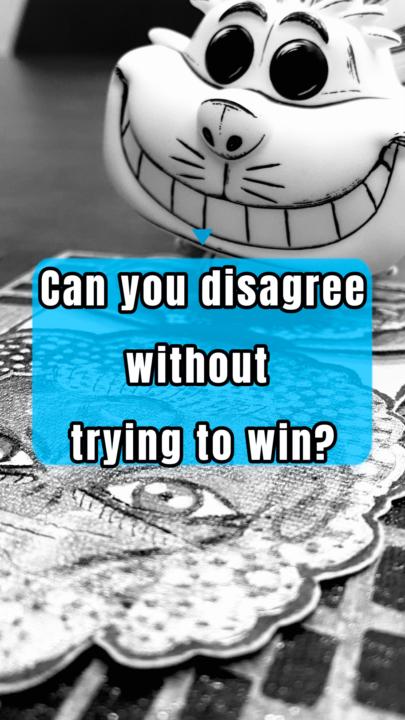
A conversation is not a destination, or is it?
We do not listen to a song just to get to the final note. We do not watch a film just to reach the ending. So why do so many people treat conversation like the only thing that matters is who wins? The dance is the point. You can win the point and still lose the person.
3 likes • Mar 17
I notice that when I’m in a conversation it’s more about what’s happening between us as we talk. The shifts in tone, the pauses, the things that don’t get said… that’s where I feel the real exchange. Drawing from conversation’s very definition, the act of turning together, feeling what’s alive between the words, is part of what matters. We learn so much from what rushes in to replace silence or tension. And understanding grows quietly in those moments when we aren’t trying to steer or control an outcome. I find that genuine curiosity guides what emerges, and paying attention like that gives a sense of connection I wouldn’t get from just “winning” a point or reaching the end. And might I add a metaphor that comes to mind? It’s like a surfer with their board…sometimes the water is calm, sometimes turbulent, sometimes daring, sometimes carrying you forward in a ride. The conversation, like the water, asks us to attune, adjust, and flow. We read the waters, feeling whether to take the wave on or let it pass, moving with what’s present rather than forcing anything… NoThing is loss something is ever gained.

Mar 8 •
A Blueprint for Conscious Communities ? 🎬
Here is our latest podcast episode. A discussion on a topic very close to my heart. 🎬 Watch it here 👈 👈👈 and take part by leaving a comment or question below. Are Conscious Communities really possible?
Poll
15 members have voted
1 like • Mar 16
Awareness and sincere, committed effort seem essential in any such endeavor. Without them, even the most heartfelt vision can easily become another performance of agreement rather than a genuine field for growth. When Justin spoke about his experience of communal living, I recalled something I experienced when I was much younger while living abroad. The circumstances were different, but the spirit was similar. We rotated responsibilities within the community and shared in spiritual communion among people from many different backgrounds. Culture, language, and traditions were exchanged as naturally as helping one another with daily life. Experiences like that are deeply humbling for the ego. They make it difficult to cling too tightly to a single identity because the shared essence of our humanity becomes so evident. You begin to see that beneath surface differences there is something profoundly common running through us all. That recognition takes time, and it also requires reflection on how it applies to oneself in context of the greater whole and how it can be expressed in practical living. In Justin’s reflection on how that community eventually dissolved, and how different people walked away holding very different interpretations of the experience, I think this is quite revealing. How we come away from such experiences often shows where we currently stand on our own evolutionary path. The phrase “separating the wheat from the chaff” I think can be applied here as a lesson of an inner process. We take what nourishes growth and allow the rest to fall away. Moments like that often arise when circumstances ask us to rise above our discomfort. This is where the strength of will is tested. It can be understood through the recurring human metaphor of the mountain or the climb. Across cultures and fields of life, we see this image of ascent. Something in the human spirit seems drawn toward elevation. The higher the climb, the stronger the pull of gravity. The pressure increases… At that point, one either gives up or continues upward. Even in everyday life, we see this principle. A parent may rise above their own individual needs to care for a child, or an adult child may do the same for aging parents. But even here there is a worthwhile question… are we acting purely for the other, or is there also something in ourselves that seeks growth through that sacrifice? These are subtle but important distinctions.
Mar 5 •
Polarity and the Intelligence of Tension
A curious thing about polarity is that once people begin talking about it, the conversation itself often becomes part of that polarity. Human psychology is wonderfully mischievous like that… This reflection was inspired by the discussion Lucia M. started on Conflict and Activism: https://www.skool.com/escape-the-matrix-9926/on-conflict-and-activism?p=e23141d1 I think it is a genuinely worthwhile conversation to have. Hearing different perspectives on polarity is valuable, especially right now, because each viewpoint tends to illuminate some piece of the larger picture that none of us can see alone. In discussions like these, we often move through a few different roles. At times we are participants, expressing a position. Sometimes we act as mediators, attempting to bridge perspectives. And then there is the observer. In truth, we move between all three. That triune dynamic is interesting. We often speak about duality, yet many philosophical and spiritual traditions point to a third element that changes the nature of the relationship entirely. When there are only two points, tension exists between them. But tension is not purely destructive; it also contains creative potential. The pressure between two poles can give rise to a third point—a place where something different becomes possible. From that third position we can begin to perceive connection, new perspectives, and sometimes even harmony emerging from what initially appeared only as opposition. Sometimes this third position can seem abstract, almost impractical, as though stepping back from the poles risks avoiding the real problems that need solving. But there is another layer to consider. Each individual is, in many ways, the sum total of their past experiences, impressions, and conditioning. The future we move toward depends greatly on how clearly we can see the present moment. Part of that clarity involves the slow work of becoming aware of our own psychological residues—those unconscious reactions and inherited patterns that quietly shape how we respond to conflict and difference. Working through those layers in many ways it is central to spiritual practices.

2 likes • Mar 6
@Lucia M. I understand you’re emphasizing activism grounded in action and its capacity to reduce conflict both individually and collectively. What I was sharing wasn’t meant as a study of my own experience, but rather a natural outgrowth of dialogue and exchange, which is a beautiful thing. Insights and inspiration emerge in these conversations, and as I noted, this seems to be echoing across the wider stage in ways that invite reflection beyond just the immediate example. It’s interesting too how the manifestation of these polarities shows up in real-world conflict and activism, even in war and social struggles. These lenses let us see how the abstract or metaphysical patterns like polarity, tension, and observation play out in tangible, practical ways. So I view these conversation as connecting the subtle with the visible, helping us understand the dynamics at both levels.
1 like • Mar 6
@Chris Gritti lol, I’ve found myself there too. I actually think it’s a really healthy place to be, It’s like hovering just above the surface of the dialogue close enough to notice the words, the emotions, the energies moving between participants, yet slightly removed so you can see the patterns unfolding beneath the exchange.
1-10 of 25

@shulamit-irish-4090
I question performative spirituality. I seek real connection, shared humanity. "The history of mankind is the movement toward greater unification." LT
Active 46d ago
Joined Feb 19, 2026
INFJ