Activity
Mon
Wed
Fri
Sun
Nov
Dec
Jan
Feb
Mar
Apr
May
Jun
Jul
Aug
Sep
What is this?
Less
More
4 contributions to Future Producer Society

Jul 12 •
Jermaine Dupri's $18 Million Royalty Lawsuit: What Every Producer & Artist Needs to Know
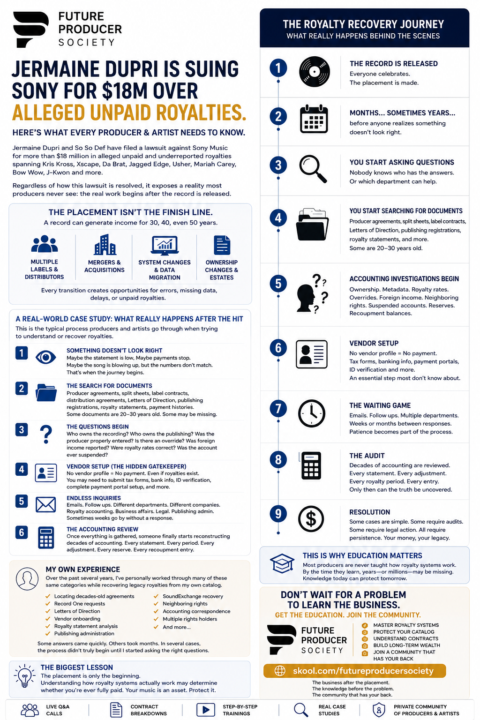
When most people read the headlines, they see one story: "Jermaine Dupri and So So Def sue Sony Music for more than $18 million in alleged unpaid royalties." The conversation immediately becomes about who's right, who's wrong, and whether the lawsuit will succeed. But if you've spent enough time in the music business, you see something very different. You see a reminder that the biggest challenge often begins after the hit record is made. Regardless of how this lawsuit is ultimately resolved, it highlights something every producer, songwriter, artist, and independent label should understand: Getting paid isn't a single event. It's an ongoing business process that can last decades. Most Producers Think The Process Looks Like This Create the beat. Get the placement. The record is released. Royalties arrive. The End. Unfortunately, that isn't how the music business works. In reality, a successful record can generate income for 30, 40, or even 50 years. During that time, the rights attached to that recording may pass through multiple labels, distributors, publishers, royalty systems, accounting departments, mergers, software migrations, estates, business managers, and ownership changes. Every one of those transitions creates opportunities for administrative errors, missing information, delayed payments, or unresolved questions. The Work Usually Starts When Something Doesn't Add Up Many producers don't begin investigating their royalty accounts until they notice something doesn't seem right. Maybe a statement looks unusually small. Maybe royalties stop appearing. Maybe a song becomes more successful than expected, but the accounting doesn't reflect that success. Maybe another producer mentions they're receiving payments you never knew existed. That's when the real work begins. Not making music. Finding answers. The Search For Information One of the biggest misconceptions about royalty recovery is that someone simply "checks the numbers." In reality, the process often starts with locating documents that may not have been seen in years.

2 likes • Jul 12
Great info!! Thanks for sharing!!
Jun 30 •
ISRC Explained: What Every Producer Needs to Know About the Most Important Code Attached to Your Music
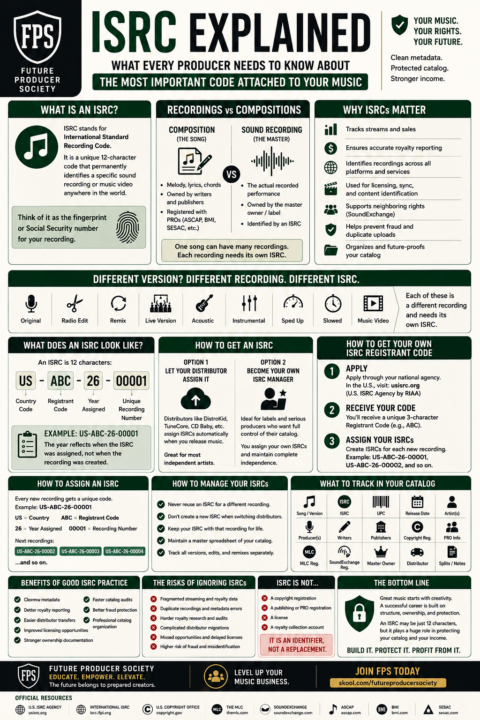
If you've ever distributed a song through DistroKid, TuneCore, CD Baby, Symphonic, or another distributor, you've probably noticed something called an ISRC. Most producers see it, accept it, and move on. The problem is that very few creators actually understand what an ISRC is, why it matters, or how it affects their ability to collect royalties, organize their catalog, and prove ownership of their recordings. In today's AI-driven music industry, understanding metadata is no longer optional. Your music is competing in an ecosystem where millions of tracks are uploaded every month, and every recording needs a digital identity that follows it wherever it goes. That's exactly what an ISRC does. What Is an ISRC? ISRC stands for International Standard Recording Code. Think of it as the fingerprint or Social Security number for a sound recording. Every commercially released recording receives its own unique ISRC that permanently identifies that recording anywhere it appears in the world. Whether your music is streamed on Spotify, sold on Apple Music, licensed for television, uploaded to YouTube, or distributed to dozens of digital platforms, the ISRC is one of the primary identifiers that tells the industry exactly which recording is being used. One of the biggest misconceptions among independent artists is believing an ISRC identifies the song itself. It doesn't. It identifies the recording. That's an important distinction. Songs and Recordings Are Not the Same Thing Imagine you write a song called Never Looking Back. That song is the composition. Now imagine you create: - The original studio version - An acoustic version - A live version - A remix - An instrumental - A radio edit - A sped-up version - A slowed version They're all based on the same composition. But they are different recordings. Each recording should have its own ISRC because each one represents a unique master recording. This is why you'll often hear music professionals refer to "the composition side" and "the master side."
1 like • Jun 30
Thank you. This is good to know.
Jun 16 •
Why I Keep Telling Producers To Release The Work
This week, Variety announced that viral short film Open Door is being developed as a feature film. As many of you know, the lead actor Sean Anthony Baker and I are long time friends and business partners. I've had the opportunity to watch this project evolve up close from the early stages, and it's another reminder of something I constantly preach inside Future Producer Society: You don't need permission. You need proof. A short film became a feature opportunity. Not because someone believed in the idea. Because the audience did. Millions of views became leverage. Leverage became opportunity. Opportunity became a deal. The exact same principle applies to producers. Stop waiting for the placement. Build the catalog. Stop waiting for the audience. Create the content. Stop waiting for validation. Create the proof. That's the game. And that's exactly what we're building inside FPS.
1 like • Jun 21
This is so good!!!
Aug '25 •
Welcome to the Future Producer Society (Start HERE)
I’m Collin “Jugrnaut” D. — multi-platinum, Grammy-nominated producer from the Arkatech Beatz legacy, with credits across Big Pun, Nas, Jadakiss, Raekwon, Prodigy of Mobb Deep, Max B, Killer Mike, Lloyd Banks, Freddie Gibbs, Mýa, and more. I built this community for producers and independent artists who are serious about leveling up in today’s industry — including the rise of AI, new creator tools, changing monetization, and the business skills most people never learn. This isn’t just a “group.”It’s a place to connect, learn, sharpen your craft, and move forward with creators who actually want to win. How to Get Started: 1️⃣ Introduce Yourself Below Tell us who you are, what you make, and what you’re working toward. 2️⃣ Check the Categories Post in the right lane: Wins, Collabs, Producer Path, Artist Path, AI Tools, etc. 3️⃣ Engage Consistently The more you contribute, the more the community works for you. What You Can Expect Here 🔥 Insider knowledge from 20+ years in the industry 🔥 AI workflows, creative tools & modern production strategies 🔥 Placement, licensing, publishing & monetization guidance 🔥 Support from a serious network of producers & artists 🔥 Accountability, challenges & growth-focused conversations We’re here to make sure you don’t just create —you progress. Drop your intro below. Let’s build.— Collin “Jugrnaut” D.
1 like • Jun 21
Glad to be here! I have a catalogue, however before creating and releasing any music videos, I want to have my songs properly registered for distribution, etc. I hope this community can help me with that!
1-4 of 4
@sherahdanielle
Creative Director | AI Creative Consultant | Filmmaker | The Shalom Coach
Active 9h ago
Joined Jun 21, 2026
Powered by