Activity
Mon
Wed
Fri
Sun
Oct
Nov
Dec
Jan
Feb
Mar
Apr
May
Jun
Jul
Aug
Sep
What is this?
Less
More
Owned by Sharon
I help holistic-minded people overcome chronic health limitations and simultaneously improve their longevity through simple daily actions.
Sushi Skool
66 members • Free
Business Growth Workshops
75 members • $19
The Dr. Z Clinical
478 members • Free
🌾 From Oven to Market
78 members • $5/month
The Profitable Speaker Circle
434 members • Free
Defunk’d Design
14 members • $27/month
The ShiftShow
90 members • Free
The Flame Keepers
195 members • Free
The Creative Jukebox
111 members • Free
80 contributions to Oasis Builders
🔥
Jul 20 •
Before We Add Another Plant
Plants may look separate, but none grows alone. Each respond to sunlight, water, soil, insects, neighboring plants, people, and the season. A nearby plant may provide shade, attract pollinators, cover soil, or slow wind. It may also compete for water, light, root space, or access. Companion relationships are rarely as simple as good or bad. A plant that helps today may create crowding later. Dense planting may protect soil quickly, while also bringing pruning, thinning, and harvesting decisions sooner. Before adding another plant, choose one already growing and look around it. Notice what grows above, beneath, and beside it. Watch where sunlight falls, where water moves, where people walk, and where plants may expand. Consider how those relationships may change through the season. Taking one picture each month can make those changes easier to see. Choose one plant this week and tell us one relationship you noticed around it. What is your first observation before adding another plant?
Poll
10 members have voted

1 like • Aug 2
@Jim Flach Amen!
1 like • Aug 2
@Jim Flach sooo true!!
🔥
Jul 7 •
July Seed Starts for the Fall Garden
By mid-July, the summer garden can feel full and tired at the same time. The tomatoes are working, the heat is building, and it may not feel like the right time to think about lettuce, broccoli, kale, collards, cabbage, or fall greens. But this is the quiet window where the fall garden begins. It is not time to replant everything outside because it is hard for fall crops to establish in the mid to late summer heat. The soil can be too hot for good germination, the surface dries quickly, and small seedlings can struggle before they ever get a fair start. So instead, we start a small steady succession indoors or in a protected seed-starting space. Then, as late summer heat begins to ease, we move sturdy young plants outside. Lettuce is a good example. Looseleaf types are usually the easiest and most forgiving for a July indoor start. Slobolt, Salad Bowl, Red Sails, Tropicana, and Ruby are good practical choices. Romaine takes longer, although it gives a fuller fall harvest and holds well as the weather cools. Jericho, Parris Island Cos, and Green Towers are all worth considering. Butterhead and Bibb types are tender and sweet, although they are less forgiving in heat. Buttercrunch is probably the safest first choice for this type. So, for a simple strong fall start, we could begin with: Main lettuce crop: Slobolt, Red Sails, Salad Bowl, Tropicana Romaine row: Jericho, Parris Island Cos, Green Towers Tender fall heads: Buttercrunch, Little Gem, Nancy Dependable fall backbone: collards, kale, broccoli, cabbage, kohlrabi, and Swiss chard Trial crops: Brussels sprouts, Florence fennel, Asian greens like tatsoi, mizuna, Tokyo Bekana, and bok choy, plus beets in trays. Once the seeds are selected, seedling care is just as important as the variety. We need to keep trays cool, bright, and evenly moist. A hot greenhouse or sunny porch can cook fall seedlings in July. Use a small fan for airflow if you can and avoid heavy nitrogen that makes weak, stretchy plants. Before transplanting, harden the plants off with morning sun and outdoor air for several days. Then transplant in the evening, water them in well, and give them light shade for the first week or so.
3 likes • Jul 7
Lettuce, cabbage
🔥
Jul 4 •
Appreciation for Community
On this day, I am reminded that freedom is not only something we inherit from history, but something we practice in how we live, speak, care for one another, and stay rooted in truth. A free people are strongest when we remember our connection, honor the dignity of each person, and choose courage over fear. May this day bring gratitude, responsibility, and a deeper sense of unity. Thank you for being an important part of the Oasis Builders community both here and abroad. You are all greatly appreciated.
3 likes • Jul 4
My garden is the biggest and most thriving one I’ve ever had from the hat 🧢 ve learned and your h lo in this community! I have root vegetables, leafy herbs and fruiting veggies mixed in nearly every bed.and they are thriving! A bit of wild growth as I haven’t had the time I wanted to k p up with the vibrant growth spurts this last month. Our potatoes have grown tremendously, the s hash are flowering, and leaves are getting bushy on the cukes and beans and zucchini. Thanks Jim!!!
3 likes • Jul 5
@Jim Flach agreed!
🔥
Jun 22 •
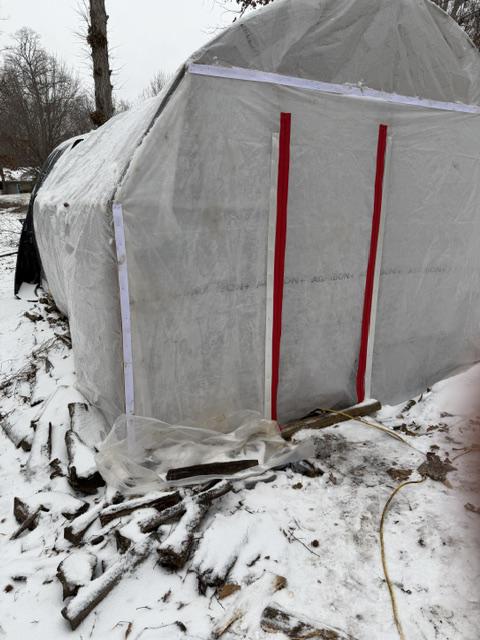
How I Built and Use My Cattle Panel Poly Tunnel
I built my poly tunnel from cattle panels, and it has been one of the more useful experiments on the homestead. I used 16-foot cattle panels and arched them across a 12-foot span because that is what my space allowed. If I had more room, I may have gone closer to a 14-foot span because it would give a little more growing width while still leaving plenty of headroom. The tradeoff is that a wider span lowers the center height. The 12-foot span worked well for my bed layout. A person can usually reach comfortably into a 32-inch bed when there is access from both sides. With 24-inch walkways, the layout works out like this: 32-inch bed, 24-inch walkway, 32-inch bed, 24-inch walkway, 32-inch bed. That equals 144 inches, or 12 feet. In real life, I would still leave a little room for posts, side rails, plant growth, straw bale insulation and general working space. This simple layout worked out well. With the 12-foot span and roughly 5-foot side walls, the center height is close to 9.5 to 10 feet, depending on how the panel bends and where it is fastened. With the same side wall height, a 14-foot span would be closer to an 8-foot center height. That would still be enough headroom and would give a little more floor or straw bale space. There are several ways to build a cattle panel poly tunnel, and some are much more permanent than others. Mine was built as a one-man, lower-cost experiment, not as a finished commercial greenhouse where I arched the panels from one side to the other. Another way would be to run the panels lengthwise with a pitched roof. In the design, the north wall can be more solid, act as an insulator and a wind break. I have seen people use straw bales along the north wall for insulation, water barrels with aquarium heaters or solid construction with insulation. For my first build, I used 7-foot T-posts so I could get about 5 feet of side wall height. I placed 1 1/4-inch PVC tees on top of the posts, then ran 3/4-inch EMT conduit through those tees as the side rail. The ends of the cattle panels were then wired to the EMT with wire bag ties.
3 likes • Jun 22
Will keep following this. I don’t have it on my to-do list yet, but I’m definitely interested in elongating some seasons and being able to start more things earlier.
🔥
Jun 9 •
New Thought on my Watering Experiment
By varying the water to tomato beds from 1/4" - 1" per week equivalent, am I just training drought resistant tomato plants or am I determining how much water a tomato plant needs?
4 likes • Jun 10
Proof is in the pudding, how do they look so far?!
1-10 of 80

@sharonwilliamsprahldc
Adventurer, Mom, Wife, Doctor of Chiropractic, TBI Thriver, Herbalist
Active 2h ago
Joined Jan 9, 2026