Activity
Mon
Wed
Fri
Sun
Nov
Dec
Jan
Feb
Mar
Apr
May
Jun
Jul
Aug
Sep
What is this?
Less
More
Owned by Scott
Learn how to find, evaluate, and buy businesses that actually cash flow 🪓
Learn how to evaluate and acquire a business in less than 12 months 🐺🪓
Skoolers
154.2k
Free
Acquisition Ace
2.9k
Free
19 contributions to Acquisition Wolf (Free)

Apr 15 •
22 Calls → First Deal
A 24-year-old reached out a few weeks ago. No experience. Just got started. I told him one thing: Start asking owners if they want to sell. He made 22 calls… and already found a deal. Most people here are overthinking this. It’s not a knowledge problem. It’s a volume problem. How many calls are you actually making this week? Let me know if the comments below. Watch the full call breakdown on YouTube here 👇
1
0
Apr 6 •
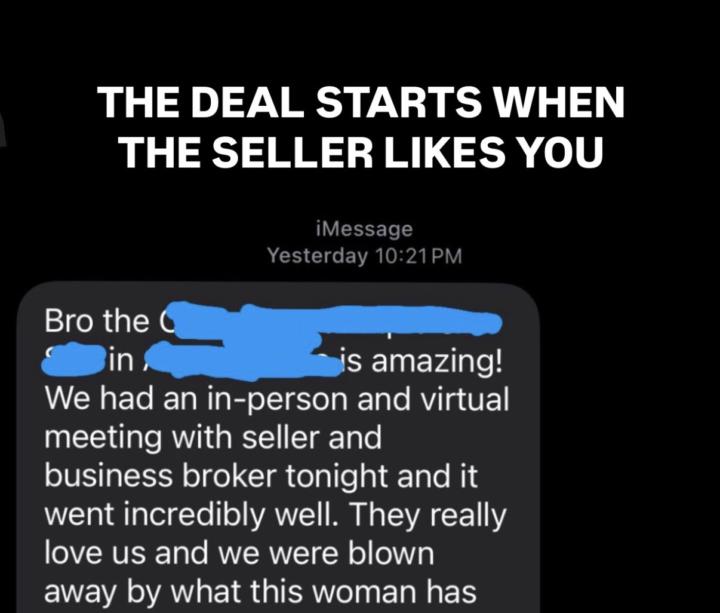
This is how deals actually start
Most people think buying a business is about numbers It’s not This is a message from someone inside the mentorship after getting in front of a seller Before anything is signed Before financials are finalized The relationship is what moves the deal forward
1
0
Mar 26 •
What’s the biggest thing stopping you from buying a business right now?
Drop it below. I’ll help you work through it
0 likes • Apr 1
@William Mulder That’s usually where most people stall out. What’s been stopping you from taking the next step on any of those?
1 like • Apr 4
@William Mulder check your Skool DMs
Apr 1 •
How this deal was actually funded
Most people think they need a lot of money to buy a business. That’s usually what stops them from even starting, because they assume they need hundreds of thousands sitting in the bank. But that’s not actually how this works. We recently looked at a deal with my brother that’s a good example of this. It’s the largest cat sitting business in Northern Virginia, where they send people into homes while owners are away and take care of their cats. The business was doing about $186,000 a year in profit and was listed for $650,000. We ended up getting it under contract for $625,000. Here’s how the deal was structured: $250,000 down $375,000 seller financed over 6 years at 8% So most of the purchase price was not paid upfront. Now here’s the part most people don’t realize. We’re not putting up the $250,000 ourselves. We’re bringing in one investor to cover that. In exchange, they get 33% of the business. They don’t operate it. They don’t manage anything day to day. They just participate in the upside while we run and grow it. So we’re acquiring a business that already exists, already has customers, and already makes money… Without needing to fund the entire deal ourselves. This is how a lot of deals actually get done. It’s not about having all the money. It’s about knowing how to structure the deal. Using seller financing. Bringing in the right investor. Putting the pieces together. If you’re only thinking in terms of “how much cash do I have,” you’re looking at this the wrong way. Scott
1
0
Mar 19 •
Where are you at right now?
Working a job, running something, or just exploring? Drop it below
0 likes • Mar 24
@Niket Sethi That’s a big move, congrats on getting the lease done. Sounds like a bit of a sprint right now getting everything reopened. What’s your plan for driving traffic once you’re open?
0 likes • Mar 26
@Niket Sethi That makes sense. Exterior + signage is huge, especially competing with Wawa/Sheetz where convenience and visibility drive everything. Free coffee is a smart move early on. You might also think about how to give people a reason to switch habits, not just try you once. Are you planning to differentiate on anything specific (price, speed, product mix, local feel), or mostly trying to match what’s already working and execute better?
1-10 of 19

@scott-parker-3148
I'm a small business entrepreneur based in Arlington, Virginia. You can find out more about me on scottparkerbrands.com.
Active 81d ago
Joined Jan 11, 2026