Activity
Mon
Wed
Fri
Sun
May
Jun
Jul
Aug
Sep
Oct
Nov
Dec
Jan
Feb
Mar
Apr
What is this?
Less
More
Owned by Ryan
Personal Training Academy is a community for trainers and fitness enthusiasts to connect, share knowledge, and grow together.
Memberships
Educated Meatheads
9k members • Free
Skoolers
194.4k members • Free
12 contributions to Personal Training Academy

Nov '25 •
The Art of In-Person Training: Structure, Clarity, and Engagement
In-person training is different from online coaching. Online, people buy information. In-person, they’re buying experience and structure. The clearer your service, the more confidence your clients will have in what they’re enrolling in. People work hard for their money—they want to know they’re joining something thought-out, not something improvised on the spot. A strong trainer–client relationship starts with clear terms. The client needs to know what’s expected of them and what they can expect from you. Training isn’t a service where you “drop your body off” and pick it up later, improved. Real change requires full engagement inside and outside the gym. It’s like enrolling in school—you can cheat and coast through classes, but you won’t graduate with the same results as the person who showed up, took notes, and participated. Effective program design starts with information. Before writing a single workout, you gather data: goals, experience level, injuries, lifestyle, occupation, and availability. In my experience, the average client trains twice per week for 30–60 minutes. Their schedule determines the structure—if they train back-to-back, say Monday and Tuesday, I’ll run an upper/lower split instead of two full-body sessions to allow recovery. In my experience, most people enjoy full-body sessions because they get to train the muscles they love every time they show up. A good trainer also understands how nutrition affects performance, recovery, and body composition, and can weave in cardiovascular work intelligently—either as its own day or through circuit-style training. Some will argue that circuits make you a “jack of all trades, master of none,” but in the real world, clients often aren’t willing or able to train like athletes. Your job is to meet them where they are—making training accessible, enjoyable, and sustainable—while still delivering the results you promise. Most trainers start in commercial gyms, where the typical client is new or inconsistent with training. These clients often respond well to even basic programs because consistency, not optimization, is their missing link. Don’t let social media convince you that your job is to impress other trainers. Your responsibility is to deliver a structured, professional service that builds trust, produces results, and gets people genuinely invested in their own fitness journey.
1 like • Nov '25
@Sulav Subedi thanks for the comment, welcome to the community! 💪
Nov '25 •
Recovery Adapts—So Should Your Volume
Social media makes it seem like everyone needs the same amount of volume to grow. In reality, recovery and volume tolerance change with training age. Recovery isn’t a fixed capacity, it’s an adaptation that evolves with consistent training, not a one-size-fits-all rule.
0
0
Oct '25 •
There’s More Than One Way to Butter Your Bread
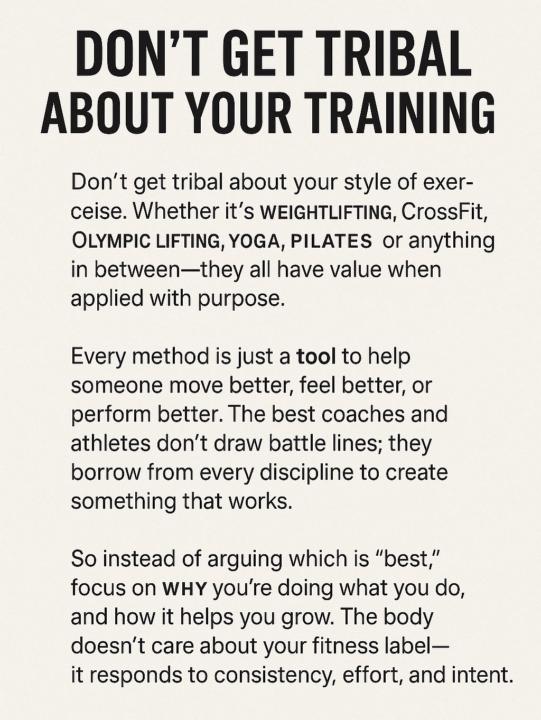
Don’t get caught up thinking success as a trainer only comes from social media. Just because someone posts every day doesn’t mean that’s the only path — or even the best one — for you. Some of the most successful trainers you’ll ever meet barely post at all. They’re in the gym six days a week, packed with clients, and their social media is nothing but pictures of their dog and a few vacation shots. Their business runs entirely off word of mouth — and that’s still success. There’s no single formula. Some trainers thrive online. Others build strong in-person communities. Both are valid. What matters is finding what works for you, staying authentic, and building something sustainable on your own terms. Your success doesn’t have to look like anyone else’s. Butter your bread your way.
0
0
Oct '25 •
Developing Your Training Model
Take the time to truly understand the body — how it moves, adapts, and responds to different types of training. Your training model shouldn’t just be a collection of exercises; it should be a system built on a deep understanding of how to create change. Learn how to apply the right kind of force at the right time to produce the adaptation you or your client is after — whether that’s strength, hypertrophy, endurance, or mobility. The more you understand why something works, the more effective you’ll be at getting results. A good trainer isn’t one-dimensional. Hypertrophy-style training works incredibly well for most people, but a well-developed cardiovascular system, coordination, and movement efficiency are just as essential. Take pride in becoming well-rounded. The best coaches aren’t just strong — they’re educated, adaptable, and capable of meeting anyone where they’re at. Build your model with purpose.
0
0
1-10 of 12

Active 146d ago
Joined Oct 18, 2025