Activity
Mon
Wed
Fri
Sun
Jun
Jul
Aug
Sep
Oct
Nov
Dec
Jan
Feb
Mar
Apr
May
What is this?
Less
More
Memberships
Clief Notes
27.9k members • Free
5 contributions to Clief Notes

👑
⭐
21d •
🧪 Take this 2-minute survey.
A friend of ours @Joseph Fioramonti built a tool called Constellations (If you have a watch or attended the first ever afternoon tea session. You'll know who I'm talking about). It measures something most people and most companies get wrong: the gap between what you think you respond to and what you actually respond to. Take it here 👇(also I am NOT getting paid for this and this is not some sponsored thing. Joe does really cool work) https://gen.constellations.app/constellations/survey/d269cab5-coca-cola/skool 📋 How it works: You'll see a grid of Coca-Cola images across two pages. Drag the green (+) dots to the images that make you want a Coke right now. Drag the red (-) dots to the ones that don't. Hit submit. That's it. 🧠 Why this matters: Every day we interact with systems that run on words. Search engines, AI tools, prompts, interfaces. The words we use are becoming instructions. They're becoming code. But here's the problem. If someone asks you "what kind of marketing works on you?" you'll give an answer. And that answer will be mostly wrong. Because desire and language live in different places. You feel a response to an image before you can explain it. You scroll past something or stop on something before your brain catches up with a reason. Constellations measures that gap. The space between what you say you want and what you actually respond to. This is the same problem companies spend millions trying to solve. It's the same problem you'll run into when you build anything that depends on understanding what people actually care about. And it's the kind of thinking that separates people who build things that work from people who build things that look right on paper. Take the survey. @Joseph Fioramonti will compile the results And provide a report shortly! He is an expert in branding and psychology and can come up with some really amazing reports.

2 likes • 21d
It seems reasonably priced compared to potential return from the outputs.
👑
⭐
29d •
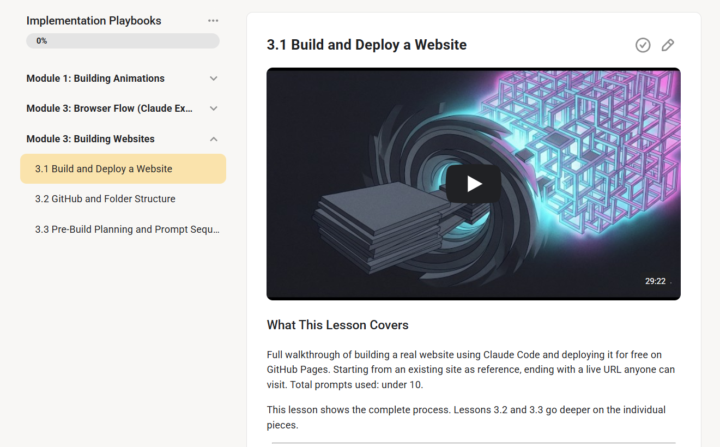
☄️New module live! 30 min Deep Dive Video !
New module live in Implementation Playbooks: Building Websites Three lessons covering how to build and deploy a real website using Claude Code and GitHub Pages. Free hosting, no Wix, no monthly fees. I also break down how Claude Code already writes project memory for you (you do not need to build a complex memory system, it is already happening) and how I structure my prompts to keep token usage as low as possible throughout a real build. Start with 3.1. The video walks through the entire process from analyzing a reference site to having a live URL you can send to anyone. Under 10 prompts total. 3.2 and 3.3 go deeper on the pieces that went by fast in the video(And I will be recording new videos for soon). If you have ever pushed an API key to a public repo or burned through tokens rebuilding something you should have planned first, those two are for you.
0 likes • 21d
I am doing QA on a website I built using ClaudeCode. The "I should have done this earlier" comment haunts me.
👑
⭐
Mar 2 •
Who's here? Drop your intro.
Tell us three things: 1. What you do (job, industry, student, career-changer, whatever) 2. What brought you to Clief Notes 3. One thing you're trying to figure out right now related to computing or AI I'll respond to every single one. And read each other's intros too because the person who's stuck on the same problem as you might already be in this thread. I'll go first I am Jake, I have been working in tech for 15 Years, building with Generative AI for 3 Years straight now! Excited to teach and learn! That's it. Simple, scannable, gives you data on who's joining and what they need, and keeps the feed clear for content that retains people past week one.
2 likes • 28d
I love the agnostic approach that is taught here. Current projects are focused on AI impact on business models.
0 likes • 21d
@Jake Van Clief I am analyzing business models that were not previously feasible due to labor costs and/or other variables which AI excels in.

22d •
12 Weeks. Real Projects. $250K in Prizes. Let's Talk.
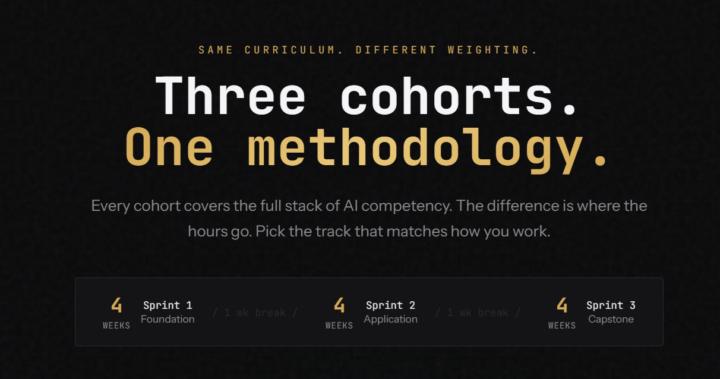
For those who missed the first post or just joined: The Lyceum is a 12-week program we're building. Live instruction from Jake and the Eduba team. Small cohorts. Real projects. You build something from week one, not watch tutorials. At the end, a competition with real prizes. Eduba's first certification, backed by the same methodology we've used to train Fortune 500 teams. Now here's what we've locked in since then. The Structure Three 4-week sprints with a 1-week break between each. Not 12 straight weeks of grind. You build, you breathe, you come back sharper. - Sprint 1: Foundation — Core methodology. Everyone starts here. - Sprint 2: Application — You're building. Real project, real progress. - Sprint 3: Capstone — Finish what you started. Demo day prep. The breaks aren't fluff. They're built in so you can catch up, refine, or just live your life without falling behind. The Cohorts Same curriculum across all three. The difference is where your hours go. Technical — Developers, engineers, technical founders. You're building a tool or production system. 30% of your time goes to Claude Code and integrations. Another 30% to production systems and capstone. This is the builder track. Business — Ops, managers, founders, consultants. You're automating a process or designing a system spec. Heavy emphasis on workflow design (30%) and decision frameworks (25%). You direct the work without writing the code. Creator — Marketers, educators, solo operators. You're building a content production system. One person replaces the team. 25% on content pipelines, 20% on workflow design. This is how you scale yourself. Pick the track that matches how you work. The methodology transfers no matter which one you choose. A 4th Cohort? We're considering adding a team cohort if there's enough interest. This would be for companies that want to enroll multiple employees, or for people in the community who want to form their own team and build together. If that sounds like you, let us know in the comments.
Poll
486 members have voted
2 likes • 21d
Is there a cost to join this? And, what kind of time commitment is realistic?
👑
⭐
28d •
I TOLD YOU SO!
For those of you who've been following me on social media for a while, you've heard me say this over and over: building your own agent frameworks is a waste of time. Stop doing it. Stop paying people to do it. Stop learning how to do it. (Unless you like local projects, that's fun) Anthropic just published this today: https://www.anthropic.com/engineering/managed-agents Here's what it is in plain terms. Managed Agents is a hosted service where Anthropic runs the entire agent infrastructure for you. The loop that calls Claude, the sandbox where code runs, the context management, crash recovery, security, scaling. All of it. You define what the agent should do (system prompt, tools, connections to your systems) and they handle the rest. The key line from their own engineering team: "Harnesses encode assumptions about what Claude can't do on its own. Those assumptions need to be frequently questioned because they go stale as models improve." They gave a specific example. They built a workaround into their harness because Sonnet 4.5 would quit tasks early when it sensed its context limit approaching. When they ran the same harness on Opus 4.5, the problem was gone. The fix became dead weight. One model release made their own engineering work obsolete. Now think about what that means for every startup and every freelancer building custom agent harnesses and selling them to clients. Every assumption they baked into their code is a bet against the next model release. And the frontier labs are shipping new models faster than anyone can maintain a harness. This is the thesis. Your value lives above whatever just got commoditized. The infrastructure layer of agents just got commoditized. The thinking about what to build, why to build it, and how to structure the work around it did not. That's what we teach here. That's why we focus on the 60/30/10 framework, on understanding which layer a problem belongs on, on prompt architecture and workflow design.
2 likes • 28d
It seems that the value we(humans) provide is shrinking. And, those people who have deep experience in a field are going to be the ones who are most able to harness AI as it becomes democratized.
1-5 of 5
@richard-chover-3202
Food Manufacturing Expert. Ops/R&D/Recruiting/Continuous Improvement
Active 2d ago
Joined Apr 7, 2026
Powered by