Activity
Mon
Wed
Fri
Sun
Aug
Sep
Oct
Nov
Dec
Jan
Feb
Mar
Apr
May
Jun
Jul
What is this?
Less
More
Memberships
Japanese in Real Life
25 members • $7/month
HI
Hiking in Japan
26 members • Free
My Easy Korean
1.3k members • Free
Chika's Language Lab (Free)
25 members • Free
7 contributions to Japanese in Real Life

Mar 19 •
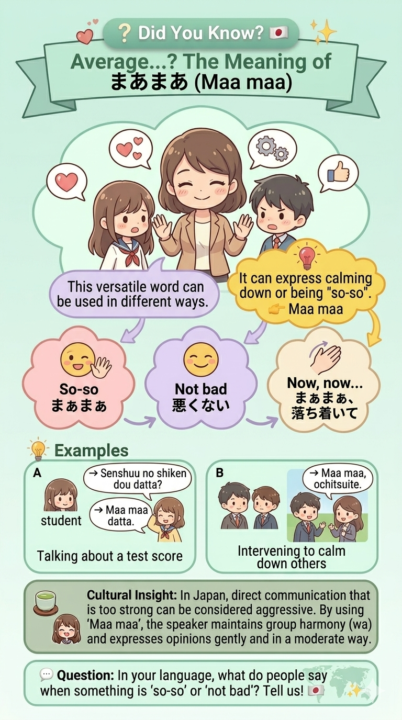
Do you know the Japanese expression “まあまあ (Maa maa)”?
This phrase can have several meanings depending on the situation. It’s often translated as: “So-so.” or “Not bad.” But it can also mean: “Now, now…” (when calming someone down) It can express: Something that is okay or average Calming someone down during an argument Saying something is good enough Examples Someone asks how something was → Maa maa desu. (“It was so-so.”) Two people are arguing and someone intervenes → Maa maa, ochitsuite. (“Now, now… calm down.”) Talking about your test score → Maa maa datta. Cultural Insight Japanese communication often values soft and moderate expressions. Words like maa maa help people avoid sounding too negative or too extreme. Question In your language, what do people say when something is “so-so” or “not bad”? #nihongo #japan #japanese

1 like • Mar 19
in german, we typically say: "na ja." or "so lala." (for average things). "nicht schlecht." or "mittelmaß." (neutral and modest). to calm someone down: "na na..." or "reg dich ab." (similarly soft) or "beruhig dich bitte."
Mar 16 •
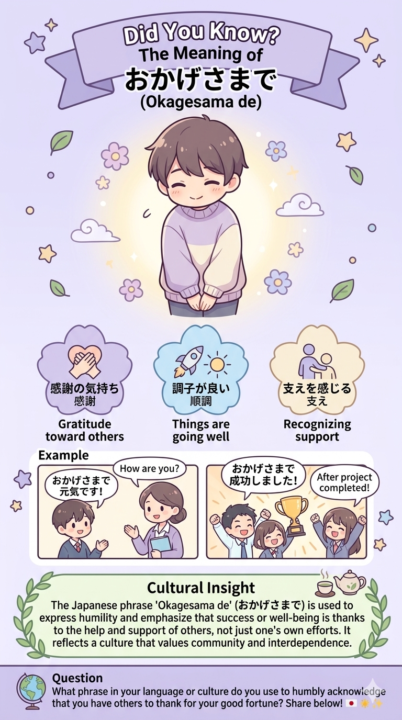
Do you know the Japanese phrase “おかげさまで (Okagesama de)”?
This phrase is used to humbly say that things are going well thanks to others. It’s often translated as: “Thanks to you.”or “Fortunately.” But the deeper meaning is closer to: “Thanks to everyone’s help.” It can express: Gratitude toward others Saying things are going well Recognizing support from people around you Examples Someone asks how you are doing→ Okagesama de genki desu.(“I’m doing well, thanks to you.”) Talking about success→ Okagesama de umaku itteimasu.(“It’s going well thanks to everyone.”) Cultural Insight Japanese culture often emphasizes humility and gratitude.Instead of saying “I did it,” people may say “okagesama de” to recognize the support of others.
2 likes • Mar 19
@Brent Rex @Akiko A thank you very much for the explanation ... it's very interesting.
Mar 16 •
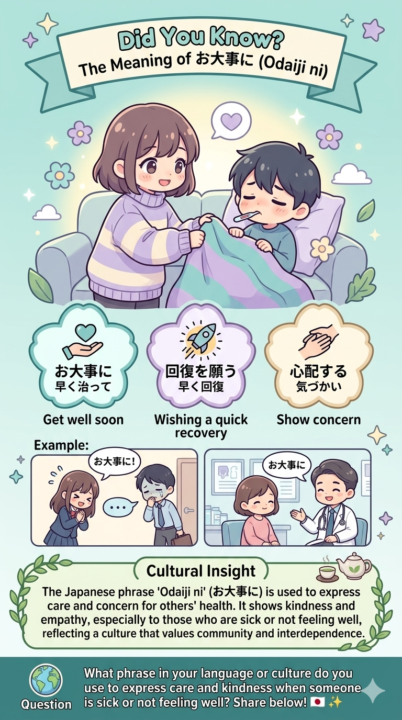
Do you know the Japanese phrase “お大事に (Odaiji ni)”?
This phrase is used when someone is sick or not feeling well. It’s often translated as: “Take care.”or “Get well soon.” But the deeper meaning is closer to: “Please take good care of yourself.” It can express: Wishing someone a quick recovery Speaking to someone who is sick Showing concern for someone’s health Examples A coworker says they have a cold→ Odaiji ni. Someone leaves work because they feel sick→ Odaiji ni shite kudasai. At the doctor’s office, doctors often say→ Odaiji ni. Cultural Insight In Japan, expressing care and concern for others’ health is very common in daily conversation. Saying odaiji ni shows kindness and empathy. Question What do people say in your language when someone is sick or not feeling well?
0 likes • Mar 19
in german, we typically say "gute besserung!" (get well soon!), which is the most direct and common translation. but we also say ... pass auf dich auf! (take care of yourself!) werd schnell gesund! (get better quickly!) gesundheit! (for sneezing, but not suitable for illness)
Feb 27 •
Practice Quiz 33 💰 Money Words
1️⃣ お釣り(おつり) Romaji: otsuri → ___ 2️⃣ 千円(せんえん) Romaji: sen en → ___ 3️⃣ 万円(まんえん) Romaji: man en → ___ 4️⃣ 財布(さいふ) Romaji: saifu → ___ 5️⃣ 値段(ねだん) Romaji: nedan → ___ It's all about the ベンジャミンズ, Baby!

1 like • Mar 11
@Akiko A i've the same issue with japanese, because i've to calculate what it means when multiple numbers come before 'man'. like この車は二百五十万です。 😅
Mar 8 •
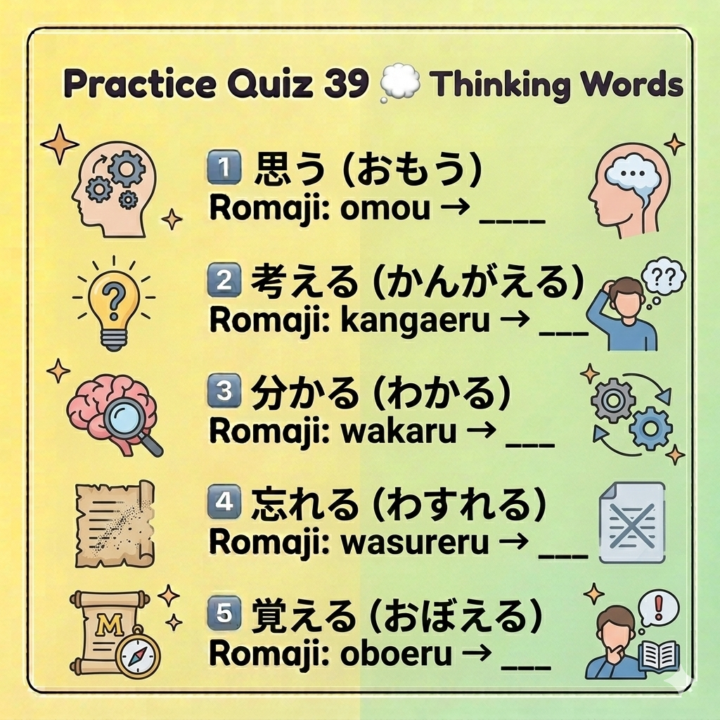
Practice Quiz 39 💭 Thinking Words
1️⃣ 思う(おもう) Romaji: omou → ___ 2️⃣ 考える(かんがえる) Romaji: kangaeru → ___ 3️⃣ 分かる(わかる) Romaji: wakaru → ___ 4️⃣ 忘れる(わすれる) Romaji: wasureru → ___ 5️⃣ 覚える(おぼえる) Romaji: oboeru → ___
2 likes • Mar 11
1️⃣ to think, to suppose 2️⃣ to think about, to consider 3️⃣ to understand 4️⃣ to forget 5️⃣ to memorize, to remember, to learn
1-7 of 7
