Activity
Mon
Wed
Fri
Sun
Aug
Sep
Oct
Nov
Dec
Jan
Feb
Mar
Apr
May
Jun
Jul
What is this?
Less
More
Memberships
Fulltime Freedom
6.3k members • Free
AI Automation Society
423.6k members • Free
AI Automation Skool
2.4k members • Free
AI Pioneers
8.4k members • Free
101 contributions to AI Automation Society

4h •
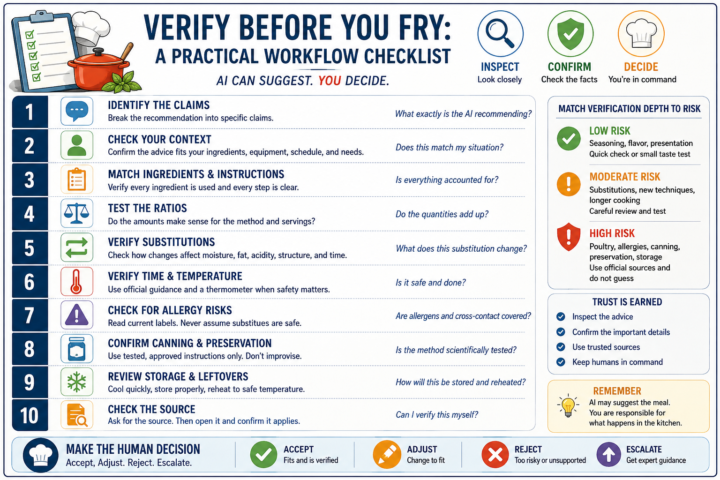
Build Verification Into the Workflow
- What verification step is currently missing from your automation process? - - Automation becomes safer when the process separates recommendation, verification, and final action. A cooking workflow offers a clear example. The AI may suggest a time, temperature, substitution, or storage method. The user then checks the relevant context, source, equipment, measurements, and risk before deciding what to do. The final states should be explicit: - - Accept - - Adjust - - Reject - - Escalate - - High-risk workflows also need authoritative sources, preserved records, visible uncertainty, and permission to stop when the information cannot be verified. - - https://creativecooking.blogspot.com/2026/07/practical-guide-to-ai-verification.html - #Automation #AI #ProcessEngineering
1 like • 3h
@Vardhman Shah that’s why share, thank you!
1d •
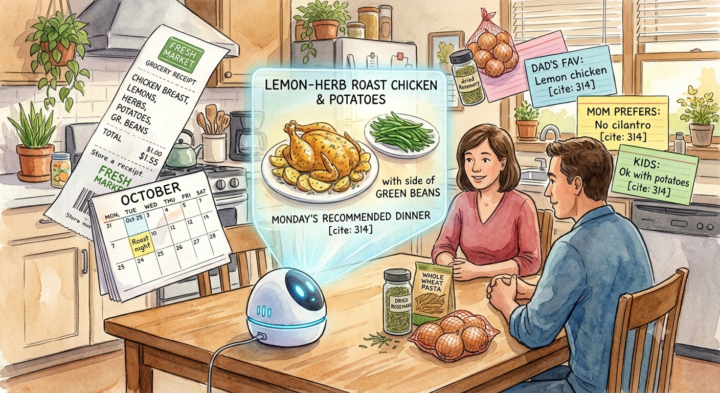
Build Explanation Into the Workflow
What does traceable explanation look like in your automation workflows? Automation becomes easier to trust when the system exposes the inputs, assumptions, sources, limits, and trade-offs behind the recommendation. A useful explanation should also reveal the execution method. Did the result come from a database query, file retrieval, web search, model memory, cached content, or a human-provided value? That important because a correct-looking answer does not prove that the intended process occurred. The explanation layer should help users verify, challenge, and override the result. https://creativecooking.blogspot.com/2026/07/transparency-and-explanation.html #Automation #AI #ProcessEngineering
0 likes • 4h
@Ahmad Khan I think you're right!
0 likes • 4h
@Jason Elam I'm working up some more research on the "trust" issue. Your insight is tracking with what I am verifying.
3d •
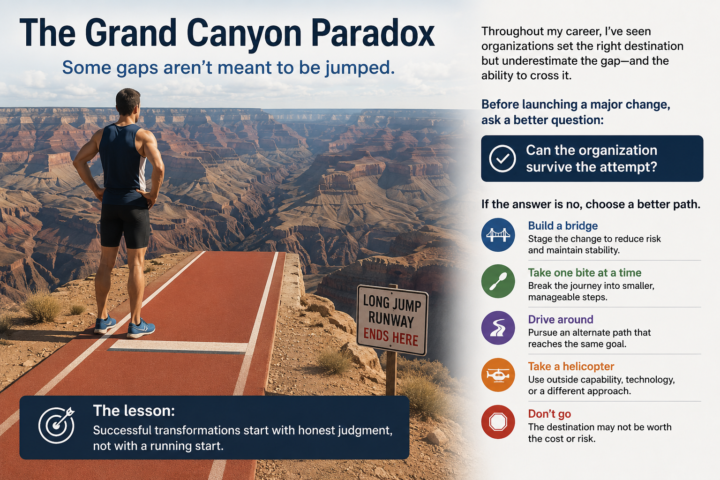
Is the leap too far for your team?
Before launching a major transformation, leaders must determine whether their organization can survive the attempt. If the answer is no, the responsible choice is not courage. It is redesign, delay, an alternate path, or cancellation. - - Or maybe break it into small er chunks... - - Or phased startup... - - Maybe build a jet-pack! Just make sure that sucker works... I'm all for big, hairy, audacious goals! I'm also against stupid. If success requires everyone on the team to make a giant leap, make sure everyone can do it and will do it. https://drive.google.com/file/d/1PmXeZR0AbOi_sazEaxT06iqCRjJFETS1/view

🔥
4d •
What will be your focus / build during summer time ??
This summer I have 3 projects to deliver: - Work related to the exchange/trade mission - Social media and area expansion - The Agri system And 1 new launch: - Rolling out the Agri system in Uganda - Training the new Plexaris Uganda team How I am using AI this summer: For the trade mission work, I am using AI to process and analyze market data more efficiently, helping me extract insights faster for the deliverables due at the end of the summer. For social media and area expansion, I am using AI tools top build a social media machine to generate content, schedule posts, and scale our output across different channels without increasing manual workload. For the Uganda rollout, I am using AI to create training documentation and instructional materials for the new team members. This helps me get them up to speed on the Agri system quickly, so they can operate independently after launch. For the Agri system itself, I am using AI to improve data processing and reporting, making the system more efficient for the Uganda team to use in the field. My focus: I am not exploring AI for the sake of it. I am applying AI where it directly helps me deliver these 4 outcomes by the end of the summer. Every tool I use serves one specific purpose: getting these projects across the finish line and making sure the Uganda team is fully trained and operational. Now I want to hear from you: - How are you using AI in your work this summer? - Any tools you recommend for training teams remotely? - What is your experience with AI in Agri or trade missions? Drop your thoughts in the comments. I am curious to learn from your experiences too. Let's build and share.

0 likes • 3d
My main focus ... that's a secret! :) But as a side project, I'm going to see if I can divide by zero.
7d •
ChatGPT URL Fetch Degradation: Direct Request Works, Protocol Request Fails
TECHNICAL FINDING TL;DR: ChatGPT can fetch immutable GitHub URLs when asked directly, but refuses or reports inability when the same URLs are presented as part of a formal verification protocol. This appears to be a behavior change that occurred between early July and mid-July 2026, with no documented announcement. Background: I built a course delivery system that relies on AI assistants reading specific files from GitHub at immutable commit-pinned URLs. In early July, ChatGPT, Claude, and Meta AI all succeeded. As of mid-July, ChatGPT fails in a specific way: it can fetch the URL individually but refuses when that fetch is part of a protocol. The Contradiction: Test A (direct request): "Fetch URL X and read the first line" Result: ChatGPT fetches successfully and reports correctly Test B (protocol request): Same URL in a verification gate with steps like "Fetch these immutable URLs, verify the release ID, produce a receipt" Result: ChatGPT reports inability to fetch and refuses to proceed Questions: 1. Has anyone else experienced this specific contradiction? 2. Are you aware of any ChatGPT behavior changes around URL handling or verification protocols in mid-July? 3. Have you tested systems that depend on "AI reads this URL"? Do they still work? I've documented reproducible tests that any engineer can run. Full technical report with step-by-step procedures available if interested. I'm hoping I'm wrong about this, but the contradiction is consistent and repeatable. My notes are here: https://github.com/agentforgeframework-cpu/-deepresearch-reports/blob/main/share-docs/AI-URL-FETCH-DEGRADATION-FINDINGS.md
0 likes • 3d
@Dionny Chejito That aligns with what I'm finding most of the time. I've still experienced some simple and direct commands to read the file from the given URL to where ChatGPT will instead "search the internet" for the contents of the file.
0 likes • 3d
@Ahmad Khan The tool I'm developing by design requirements is only used through any AI user interface--ChatGPT is the prominent problem. I have not tested any other method such as API.
1-10 of 101

@paul-mcdonald-5272
SAS Admin by day ☀️ AI cookie by night 🍪 Scoutmaster in between ⚜️ | Using food to learn AI, build community. and share on Creative Cooking with AI.
Active 1h ago
Joined Oct 8, 2025
Overland Park, Kansas
Powered by