Activity
Mon
Wed
Fri
Sun
Nov
Dec
Jan
Feb
Mar
Apr
May
Jun
Jul
Aug
Sep
What is this?
Less
More
AI Without The Hype
69
Free
7 contributions to AI Without The Hype

Aug 17 •
☕ AI Monday Brief | Monday 17 August
Hello! 👋 🕵️ AI-written text may soon carry an invisible watermark, as per the the recent news from Anthropic, who are introducing invisible watermarks into text generated by Claude. You won’t see them. 👀 The writing will look exactly the same but there will be subtle patterns in the words Claude chooses that can make the text detectable as AI-generated. The technology is based on Google DeepMind’s SynthID system and is introduced secondary to new transparency requirements under the EU AI Act. Pretty sure that other major AI companies are working on similar approaches. 💡 Why this matters Well, we’ve spent the last few years asking: “Can you tell if this was written by AI?” That question may eventually become easier to answer and less subjective. Instead of teachers, employers or publishers trying to guess from someone’s writing style, AI-generated content could potentially carry its own invisible provenance. The key question to answer relates to accountability and ownership: if AI becomes embedded in Word, email, search, research and everyday work… when does something actually become “AI-generated”? If AI wrote the whole report? Easy. But what if it rewrote one paragraph? What if it suggested three sentences? What if you wrote it, AI edited it, and you rewrote the edit? 🤯 We may be getting much better at identifying where AI has been used at exactly the same time that the boundary between human work and AI work is disappearing. 👀 Should you care? yes… As AI becomes normal the question will shift from: ❌ “Did you use AI?” To: 🎯 “What responsibility do you still own for the finished work?” AI provenance can tell us something about how something was produced but it doesn’t answer whether that something is accurate, thoughtful, original or good. 💭 Question for you: If you wrote something, AI improved it, and you approved every word… who wrote it? 👇


0 likes • Aug 20
As long as I approved every word, I wrote it. But how can people tell that I approved every word? They will need to take my word for it 😂
Jul 12 •
💡 How To Understand Complex Documents Faster – New Guide + Resources!
If you've ever uploaded a policy, report or strategy into ChatGPT and typed: "Summarise this." ...there's a good chance you've started in the wrong place. Summaries give you fewer words but don't necessarily give you better understanding. Let's move from: ❌ "What does this document say?" To ✅ "What problem is this document trying to solve?" That question will alter the quality of the conversation and set you up to navigate complexity with ease. We've put together a new guide on how to use AI to understand complex documents without outsourcing your thinking. Whether you're reading policies, business cases, research papers, strategies or guidance documents, the goal is to understand better (quicker!). 📄 Inside you'll find: - Practical prompts you can copy and paste - A simple framework for making sense of long documents - Ways to challenge AI instead of accepting its first answer - Techniques I use myself whenever I'm trying to understand something quickly ➡️ You'll find everything in the "Working with AI" section of the Classroom 👆 I'd love to know what you think!! And if you try one of the prompts on a document you're working on this week, let us know how it goes! 👇
2 likes • Jul 12
Can I copy paste the prompts?
1 like • Jul 12
@Rachel Dbeis thanks!!
May 4 •
You don’t need to learn 50 AI tools
✨You just need to understand enough to use it in your actual work/life!✨ We’ve had a wave of new people in here so hello 👋🏽 If you’ve just joined and you’re thinking “ok…now what?” 🤔 you’re exactly where you’re meant to be. Most of what’s out there either overcomplicates things, makes it sound like you need to become a data scientist overnight, or overwhelms you with the gazillion tools you feel like you should know 🫠 You don’t. You just need to understand the basics of AI to use it in your actual work. I’ve dropped a short clip below from the course on computer vision 👇🏽 It’s one of those moments where things start to shift and where you stop seeing AI as this vague, abstract thing…and start recognising what it’s actually doing. The full course is here in Skool if you want to go further. Dip in, skip around, come back to it - all yours! If you’re a founding member, you’ve got access. ‼️That won’t be the case forever, so if someone comes to mind who’d benefit, bring them in‼️ And before you disappear into the content say hello 👋🏽 What do you do, and what made you join? Always interesting to see who’s in the room😃 Rachel
1 like • May 4
“It doesn’t watch a sunset and feel relaxed”
Apr 24 •
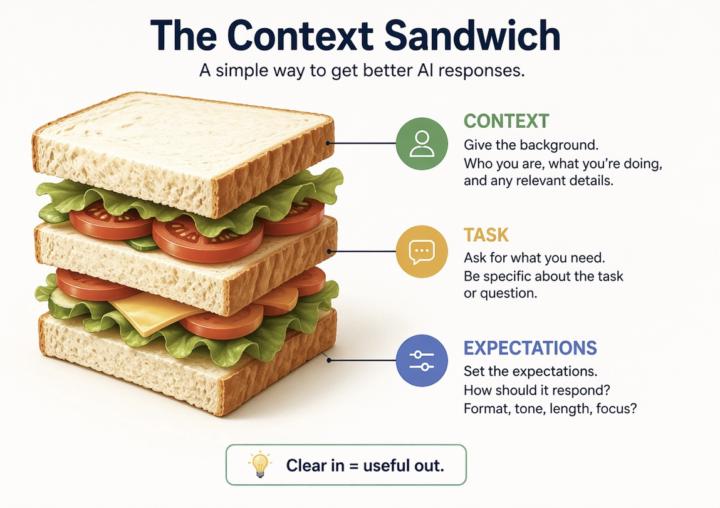
The Context Sandwhich
✨Quick tip that will make a big difference in the quality of the responses you will get from AI. Most people use AI like this: “Summarise this” “Write this” “Help with this” The answer you will get is usually… fine! Fine… but not that useful, because you’re missing is context. 🗣️Context (first) —> (then) Ask —> (make sure you) Shape the response ‼️This means, you need to tell AI: - What you are doing - What you need - How you want it back Think of it like briefing a colleague. If you’re vague, you will get something vague back. If you’re clear, the tools become much more useful. Example: “I’m preparing for a meeting with X as a [your role]. From this document, what are the key points I need to understand? Focus on decisions, risks and anything I’d need to act on. Keep it brief.” Try it out and let us know in the comment what changed for you!
1 like • Apr 24
@Ellie Hannover same!😂😂😂
Apr 6 •
NEW GUIDE + Resources and Tools!
💡Quick update!! Following the poll last week, you asked for a guide on "How to make ChatGPT sound like you" and happy to let you know it's now live! 🎉 ➡️There’s a new folder in the classroom: "Working with AI". You'll find the resources you need within! It's become very easy to start sounding slightly… off when using AI. The guide is here to help with that. There’s a PDF downloadable version with full explanations and the prompts are also added in the classroom so you can copy and paste them. Also… I saw the votes for making sense of complex policies. That one clearly isn’t going away, so I’ll work on that next! 😄 Have a look when you get a chance. Let me know what makes sense and what doesn’t.🙏
1 like • Apr 6
Just downloaded it. Looks awesome!! Gonna try to use it tomorrow 🙏🏼
1-7 of 7