Activity
Mon
Wed
Fri
Sun
Nov
Dec
Jan
Feb
Mar
Apr
May
Jun
Jul
Aug
Sep
What is this?
Less
More
Owned by Rachel
AI for non tech professionals: understand the language, confidently evaluate what’s real and position yourself to stay relevant and ahead of the curve
The AI Advantage
129.7k
Free
Clief Notes
50.4k
5.0
Free
AI Automation Society
466.1k
Free
Skool Course
36.7k
$29/m
Skoolers
153.6k
Free
18 contributions to AI Without The Hype

Aug 17 •
☕ AI Monday Brief | Monday 17 August
Hello! 👋 🕵️ AI-written text may soon carry an invisible watermark, as per the the recent news from Anthropic, who are introducing invisible watermarks into text generated by Claude. You won’t see them. 👀 The writing will look exactly the same but there will be subtle patterns in the words Claude chooses that can make the text detectable as AI-generated. The technology is based on Google DeepMind’s SynthID system and is introduced secondary to new transparency requirements under the EU AI Act. Pretty sure that other major AI companies are working on similar approaches. 💡 Why this matters Well, we’ve spent the last few years asking: “Can you tell if this was written by AI?” That question may eventually become easier to answer and less subjective. Instead of teachers, employers or publishers trying to guess from someone’s writing style, AI-generated content could potentially carry its own invisible provenance. The key question to answer relates to accountability and ownership: if AI becomes embedded in Word, email, search, research and everyday work… when does something actually become “AI-generated”? If AI wrote the whole report? Easy. But what if it rewrote one paragraph? What if it suggested three sentences? What if you wrote it, AI edited it, and you rewrote the edit? 🤯 We may be getting much better at identifying where AI has been used at exactly the same time that the boundary between human work and AI work is disappearing. 👀 Should you care? yes… As AI becomes normal the question will shift from: ❌ “Did you use AI?” To: 🎯 “What responsibility do you still own for the finished work?” AI provenance can tell us something about how something was produced but it doesn’t answer whether that something is accurate, thoughtful, original or good. 💭 Question for you: If you wrote something, AI improved it, and you approved every word… who wrote it? 👇

0 likes • Aug 20
@Chris Weatherburn brilliant! That’s one way to catch AI in action. Who needs Claude tags😂 it’s also one of the many emerging example of “tricking AI” or overriding original instructions.
0 likes • Aug 20
@Chris Weatherburn this post (as are all themed ones) is absolutely AI assisted in paragraph structure and emoji setup mainly because we can’t yet use bold formatting on Skool to highlight sections. Too many emojis?? (Was so tempted to add one to this comment. I stopped myself)…
Aug 10 •
☕ AI Monday Brief | Monday 10 August
Good evening 👋 A late Brief but an interesting one nevertheless. Here is one AI story worth knowing about. Today, Meta released a new AI model alongside a renewed push from Mark Zuckerberg for open-source AI. 🔓 it wants powerful AI to be something you can own rather than just access. Here’s what this means: Most of us currently use AI by visiting someone else’s platform: 🤖 ChatGPT ✨ Gemini 🧠 Claude The company owns the model. It runs on their infrastructure. They decide what changes, what it costs and what you can do with it. Open models change that equation. They can potentially be downloaded, adapted and run by organisations (sometimes even directly on their own devices or infrastructure). 💡 Why this matters? We’re spending a lot of time debating which AI is best. The more important question though is: Who controls the AI you’re using? Imagine an NHS organisation running an excellent AI model inside its own environment, connected to its own systems, adapted to its own workflows, without sending everything to an external chatbot. Or imagine a small company building its own specialist AI without paying one provider every time somebody asks it a question. Eventually, you may even have capable AI running locally on your laptop or phone. This means anyone or any geoup can potentially own and shape the intelligence your organisation depends on. 👀 Should you care? I think that’s a yes as we may be heading towards two competing versions of AI: 🔒 AI as a service Powerful models owned and operated by a small number of companies. 🔓 AI as infrastructure Models organisations can run, customise and build into their own systems. It makes you wonder if in ten years, organisations will continue to subscribe to intelligence … or will intelligence become part of their infrastructure? I suspect we’ll end up with both. But the distinction could become as important as the difference between renting software from the cloud and owning the systems your organisation runs on.
2
0
Jul 20 •
☕ AI Monday Brief | Monday 20 July
Good morning! 👋 Welcome to this week’s AI Monday Brief! Here’s an AI story that’s worth your attention. 🏛️ The biggest AI companies are now asking governments to regulate AI. For years, the AI industry has been racing to build bigger and more powerful models as quickly as possible. But over the past few weeks, leaders from OpenAI, Google DeepMind and Anthropic have all publicly backed the idea of stronger regulation for the most powerful AI systems. (Axios) 💡 Why this matters This feels like a turning point. The conversation is moving from: “How quickly can we build better AI?” To: “How do we build AI safely and responsibly?” The very companies leading the AI race are calling for clearer rules. Is it a sign that AI is moving from an exciting new technology into something governments, healthcare systems and businesses will increasingly need to govern?? 🤷🏽♀️ 👀 Should you care? ✅ Yes. Especially if you work in healthcare, education, finance or the public sector. Over the next few years, understanding AI governance may become just as important as understanding AI itself. 💬 Question of the week If AI starts influencing more decisions in our workplaces…What would you want humans to always remain responsible for? 👇 I’d love to hear your thoughts.

Jul 16 •
🧠 Thursday AI Fact
ChatGPT became the fastest-growing consumer application in history.🧠 It reached 100 million monthly users in around two months after launch (2022). Let’s compare it to other applications: 🎵 Spotify took years. 📸 Instagram took over two years. 🎬 Netflix took more than ten years to reach similar scale. 💡 Whether you love AI or hate it, its adoption has been one of the fastest technology shifts we’ve ever seen. The interesting question now is ❓“How will we choose to use it?”
0 likes • Jul 16
@Nicola McKee 😍😍😍😍
1 like • Jul 16
@Nicola McKee awesome!!!! Next onto how to organise it for workflows and to help you with all things Nicola in the background in a systematic way. Can’t wait to show you!!
Jul 13 •
☕ AI Monday Brief | Monday 13 July
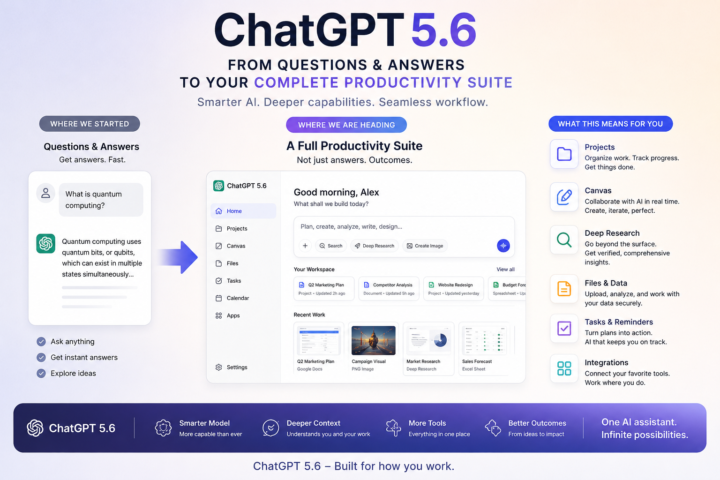
Hi all! 👋 Happy Monday and welcome to this week’s AI Monday Brief. Every Monday we will be sharing one AI development that’s actually worth your attention. Let’s dive in 🚀 🤖 OpenAI is now building an entire platform for work🤖 Last week, OpenAI introduced the GPT-5.6 family alongside new products like ChatGPT Work, bringing together AI for writing, research, coding and longer, more complex tasks in a single workflow. The focus is on helping people get meaningful work done. 💡 Why this matters For the past couple of years, we’ve judged AI largely by benchmark scores (which platform is better at tasks like writing, coding or solving problems) I think that’s starting to change. Soon, we’ll judge AI by a much simpler question: Did it save me time on a busy Tuesday afternoon? ✨The biggest opportunity for most professionals will be around redesigning everyday work so AI becomes part of the process, rather than something you occasionally open when you remember it’s there.✨ ‼️Should you care? ✅ Yes—if you regularly write emails, reports, meeting notes, presentations or work with large documents.
1 like • Jul 15
@Nicola McKee working on it! Will keep you posted.
1-10 of 18

@rachel-dbeis-9592
Doctor and Healthcare Leader collaborating with AI engineer and Tech leader to help professionals make sense of AI in medicine, healthcare and beyond
Active 11d ago
Joined Mar 15, 2026