Activity
Mon
Wed
Fri
Sun
Nov
Dec
Jan
Feb
Mar
Apr
May
Jun
Jul
Aug
Sep
Oct
What is this?
Less
More
The Conscious Creation Academy
419
5.0
$27/m
20 contributions to Understanding Neville Goddard

May 29 •
Manipulation
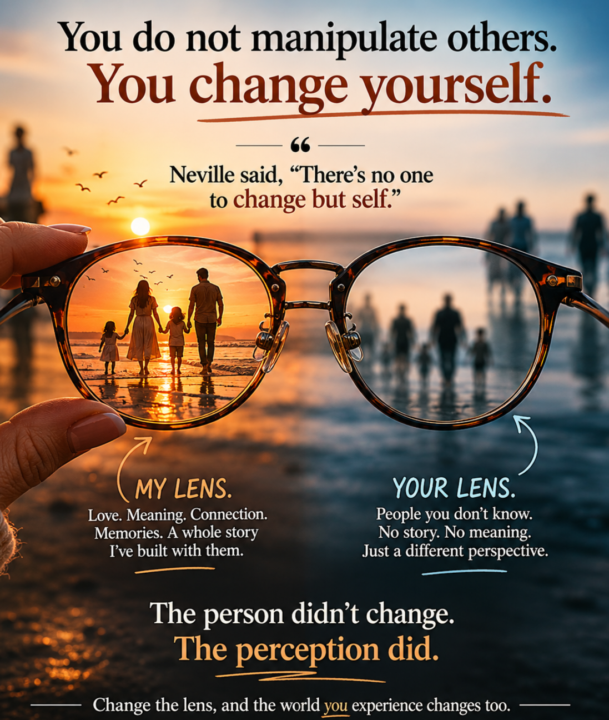
You do not manipulate others. You change yourself. Neville said it clearly: "There is no one to change but self." Think about it. I have two children and I love them with everything I am. I am married, and in my eyes my husband is the best man in the world. That's why I chose to spend my life with him. But to you, the person reading this post, they are simply people you don't know. Even if you met them, you would never see them exactly as I do. Why? Because you would be looking through your lens, not mine. The same person can be loved by one, disliked by another, admired by one, ignored by another. The person didn't change. The perception did. This is what Neville was trying to teach. Your experience of people is filtered through your assumptions, beliefs, expectations, and the meaning you give them. When Neville spoke about changing self, he wasn't talking about controlling minds. He was talking about changing the lens through which you see the world. Change the lens, and the world you experience through it changes too. So before trying to change someone else, ask yourself: What am I assuming about them that I keep proving true?

2 likes • May 31
@Ken B I am going through this too. And I think you're lightyears ahead of other people who don't even have the decency to question themselves about what they know and whether their advice is good for other people. I would say to never assume you know what is best, period, because there is always something beyond what we know now or can know or perceive. And to offer everything in terms of how you see it. If something resonates and aligns, then they can use it-- but my worst experiences in life come from taking someone's advice as fact. Always, at some point, it backfires. The best help has always been when people help me learn how to think versus telling me what to think.
1 like • May 31
It also helps for me to learn about multidimensionality. Learning about how there are many dimensions to experience, removes the temptation to have to assert that I know what is best. When my mind is baffled enough to see how vast what is happening involves, then I learn there are many things going on and my own point of view becomes less tempting to be used as a perfect solution. I begin to see the real solutions come from the process of life itself rather than this or that answer.
May 16 •
Decide what you no longer want
You don’t always need a perfectly clear vision of your future to begin changing your life. Sometimes it starts with realizing that the way you are living, feeling, or experiencing life no longer feels right for you. There is so much pressure around manifestation and personal growth to know exactly what you want, to visualize every detail, and to feel completely certain about the outcome. But many people are still discovering themselves while they heal, grow, and outgrow old versions of their identity. At certain stages of life, the only thing that feels fully clear is the discomfort. The exhaustion. The emotional heaviness. The realization that you can no longer keep accepting experiences that diminish your peace, self-worth, or emotional wellbeing. That awareness is important. The moment you stop normalizing what hurts you, your internal world begins to shift. You start seeing things differently. Your reactions change. Your standards change. The version of you that once tolerated certain situations slowly disappears. Clarity often develops through movement, not through having every answer in advance. You are allowed to leave behind what no longer aligns with you even before you fully understand where you are going next. A new life can begin with a simple realization: “I cannot continue living like this anymore.” For many people, that is the beginning of everything.

2 likes • May 16
God, your writing is so authentic and true. I got into manifestation thinking I was somehow escaping the trappings of the world, but I realize now I only got into more of the pressure of having to manifest a certain way from manifestation culture! Yes, this is the beginning of everything to make that shift! I once did this in the past, and it was wonderful. Then I learned about manifesting. I then undid what I learned in the past to find out what I had been missing in so far as understanding why I never manifested my desires from whatever mistakes I made. I then got into more and more of the pressure of manifestation culture and started to forget why I came into this. Thank you so much! This really has helped me to come back into the right place again!
May 9 •
I AM
I keep seeing people ask: “Did Neville teach that we are God?” Neville’s answer was centered on consciousness, not the human ego. He taught that the divine presence people search for externally is actually the awareness within them — the “I AM.” His perspective was deeply rooted in scripture and mystical interpretation. One of the verses Neville referenced most was: «“I have said, Ye are gods; and all of you are children of the Most High.” (Psalm 82:6)» Jesus later repeats this verse in John 10:34 after being accused of blasphemy. Neville believed this was revealing man’s divine nature rather than promoting separation between God and humanity. Another foundational verse for Neville was: «“I AM THAT I AM.” (Exodus 3:14)» He taught that “I AM” is the name of God and that every person uses this divine identity constantly through awareness itself. This is why Neville often said: «“Your own wonderful human imagination is God.”» He was not speaking about personality, status, or self-importance. He was referring to the creative power of consciousness. This same idea appears in writings outside the Bible canon. In the Gospel of Thomas, Jesus says: «“The Kingdom is inside of you.”» And also: «“When you know yourselves… you will realize that it is you who are the sons of the living Father.”» Neville interpreted these teachings psychologically. To him, scripture described states of consciousness and inner transformation. The Gospel of Philip contains another statement that aligns closely with Neville’s view: «“Truth did not come into the world naked, but in symbols and images.”» This mirrors Neville’s teaching that the Bible is written in symbolic language and must be understood inwardly. Ancient Hermetic texts also carry similar ideas. In Poimandres, humanity is described as divine in nature and connected to the mind of God. People should also remember that Neville did not arrive at these conclusions casually. He spent years studying scripture, Hebrew symbolism, mysticism, Kabbalah, and esoteric teachings before forming his interpretation of the Bible.

1 like • May 15
Thank you for this well documented research. This is truly a gift, a blessing to see it all laid out in this way.
May 13 •
The secret technique that unlocks your manifestation
There’s no secret method, magic affirmation, or one-time technique that suddenly changes your entire life overnight. Anyone selling manifestation that way is usually selling fantasy, not real transformation. Real manifestation work goes deeper than surface-level positivity. It requires honesty, self-awareness, discipline, and the willingness to look at the beliefs, assumptions, fears, and emotional patterns that have been shaping your reality for years. Neville Goddard never taught people to chase techniques. He taught that consciousness is the only reality. The techniques were never the power. You are the power. Techniques are only tools meant to help you move into a new state of being. A genuine coach doesn’t just throw temporary motivation at you or promise instant miracles. They help you untangle the stories, identities, and assumptions you’ve been living from so the change becomes natural and lasting. A lot of people are attracted to glamorous promises because they want relief fast, and that’s understandable. But lasting results come from depth, consistency, and genuine inner work. Don’t rush the process. Do the work properly. When the transformation is real within you, the results stop feeling forced because your entire state has changed.

1 like • May 15
@Pauline Walker I like your honesty.
1 like • May 15
Difficult for me to accept too.

2 likes • Apr 25
Thank you SO much for making a video to respond to this! I truly feel touched that you went out of the way to respond to my comment with a whole video. It really helps me to see you lay this all out, especially with acknowledgment of the difficulty of this, and what it is like when things are "quiet." I never thought of that--they do get quiet and I often then at that moment freak out. The way you put "not interrupting the subconscious" has really made this click for me. What astonishes me is to recognize this has been going on my entire life and I kept misunderstanding it and causing so much inner turmoil by going back to the old story. Thanks for putting into context not acknowledging the old story also when it gets quiet. Hearing it in words helps together in a context allows my brain to recognize a new pattern to anchor myself to! I appreciate how you humanize this path and acknowledge the real moments of what it is like. Neville Goddard didn't do that as far as I know--in a way, although he put it out in a kind of scriptural precise fashion, it makes it harder to relate to without having it explained from someone who acknowledged the vulnerabilities. So glad I stumbled across you from my algorithm Ioana! And nice to see you. I thought you were British since it said you were in the UK. Where are you from?
1-10 of 20
@noah-naderi-9969
I'm very into thinking and love thinking but unfortunately this comes at a huge cost with OCD and am learning all I can.
Active 13d ago
Joined Mar 1, 2026