Activity
Mon
Wed
Fri
Sun
Aug
Sep
Oct
Nov
Dec
Jan
Feb
Mar
Apr
May
Jun
Jul
What is this?
Less
More
Memberships
Claude for Founders
10.3k members • Free
AI Automation Club
7.6k members • Free
Automatable Free
18.2k members • Free
AI Topia
2.1k members • Free
AutoStack Playbook
9 members • Free
Brendan's AI Community
25.9k members • Free
AI Launchpad
30.3k members • Free
Unfair Advantage
121 members • $19/month
Applied AI Club
2.8k members • Free
20 contributions to AI Automation Society

4h •
Need some Advice.
I'd love some honest career advice from people who've been through this. Over the past few months, I've realized that I genuinely enjoy software engineering much more than AI. I originally leaned heavily into AI because it seemed like the direction everyone was moving toward. But trying to keep up with the constant pace of new models, tools, and frameworks started to feel exhausting. Instead of being excited, I often felt like I was always behind. When I sit down and write code, though, it's completely different. I genuinely enjoy building things, solving problems, and improving my programming skills. It doesn't feel forced, it feels natural. So now I'm considering making software engineering my primary focus instead of trying to build an identity around AI. For those who have experience in the industry: - Is it a mistake to pivot away from AI right now? - Would you reposition your LinkedIn and personal brand around software engineering? - Can someone still have a great career focusing primarily on software engineering while using AI as just another tool? I'd really appreciate your perspectives because I'm trying to build a career around what I actually enjoy rather than what's currently trending.

💎
⭐
May 7 •
🚀New Video: Claude Just Solved Session Limits
Anthropic just announced a SpaceX partnership for more compute, and they're using it to double Claude Code's five-hour rate limits, kill the peak hours throttle, and raise API rate limits across the board. In this video I break down exactly what changed, why it matters, and the five things you should consider doing differently if you build with Claude.
1 like • May 7
[attachment]
Mar 30 •
Zillow launched AI mode on March 25. BrokerBot dropped on March 27
I think something massive just happened in real estate AI this week, and most builders haven't connected the dots yet. Zillow launched AI mode on March 25. BrokerBot dropped on March 27. McKinsey published their full agentic AI real estate playbook. All in the same week. Here's what BrokerBot is building that caught my attention: BrokerBot is positioning itself as a brokerage-wide AI assistant designed to operate across systems, not just within a single system. The goal is to create a tool that behaves less like a chatbot and more like a digital team member, able to answer questions, execute tasks, and coordinate transactions from start to finish. Sound familiar? That's exactly the architecture I'm building with Jake. But here's what makes BrokerBot's approach technically interesting: Rather than relying on a single large language model, BrokerBot uses an internal benchmarking system, dubbed BrokerBench, to evaluate how different AI models perform on real estate-specific tasks. Based on those results, the system routes tasks to whichever model performs best, rather than relying on a single general-purpose model for everything. That's intelligent model routing. Not one brain, a panel of specialists, each used for what they're best at. And McKinsey just confirmed this is exactly where the industry is heading: Agentic AI is accelerating beyond previous applications of generative AI by automating multistep workflows inside core business systems, enabling humans to work in partnership with AI agents. The shift is from "help me understand" to "help me get it done." The big question for the industry now moves from "What are the use cases for AI?" to "Which workflows should we redesign for agentic automation?" That's the question every builder in this space should be asking right now. Not "what can AI do?" but "which workflow do I redesign first?" That's where the real opportunity lives.
2
0
Mar 19 •
I think most builders are focused on building agents.
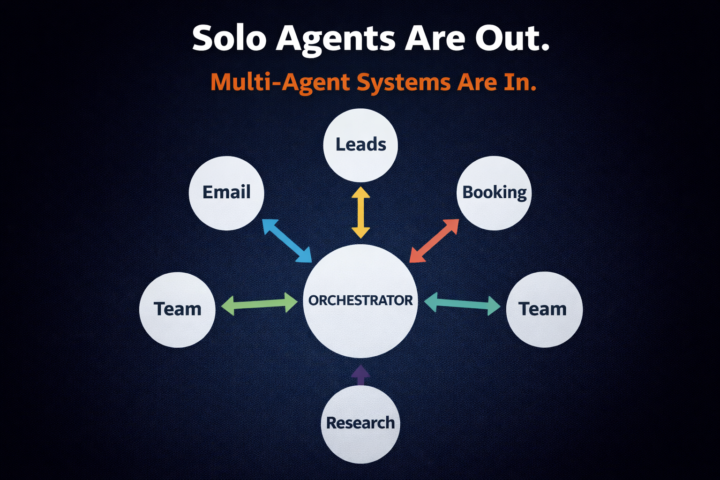
I think most builders are focused on building agents. But the real conversation in March 2026 is about what holds agents together. Solo agents are out. Multi-agent systems are in. Here's what that actually means for how we build: A single agent answering questions or writing emails is impressive. But a single agent can't run a business operation. What runs a business operation is orchestration, multiple agents working together, each owning a specific function, coordinated by a system that routes intent to the right place. Intelligence without coordination means decisions are made in isolation and can't reliably translate across complex business environments. 2026 is the year orchestration will be widely recognized as the connective tissue that makes AI useful at scale. This is exactly why I built Jake. Jake doesn't answer questions. Jake routes. He reads intent, decides which agent handles it, and passes the task. Polaris finds people. Lania handles leads. Hermes sends emails. Borealis books meetings. Five agents. One orchestrator. Zero manual coordination. AI is shifting from individual usage to team and workflow orchestration, coordinating entire workflows, connecting data across systems, and moving projects from idea to completion. That's the architecture that actually scales. If you're still building single agents start thinking about how they talk to each other. That's where the real power is. 🔥
1 like • Mar 22
Honestly @Steve Kotev , the hardest part right now is trust without proof. Most business owners I talk to understand the value immediately. But understanding and paying are two different things. When you have no case study, no testimonial, and no track record, the sale becomes about faith in you as a person, not confidence in a proven system. So the move I'm making right now is removing the risk entirely, offering the first implementation free in exchange for a case study. One working system, real results, documented. That becomes the proof that closes every conversation after it. The other challenge is getting in front of the right person at the right time. Not every business owner who needs this is actively looking for it. So content is doing a lot of the work, showing up consistently until the timing lines up. 🤝
0 likes • Mar 22
@Moloy Kundu On my way!
Mar 21 •
Most builders are still thinking about AI agents as tools
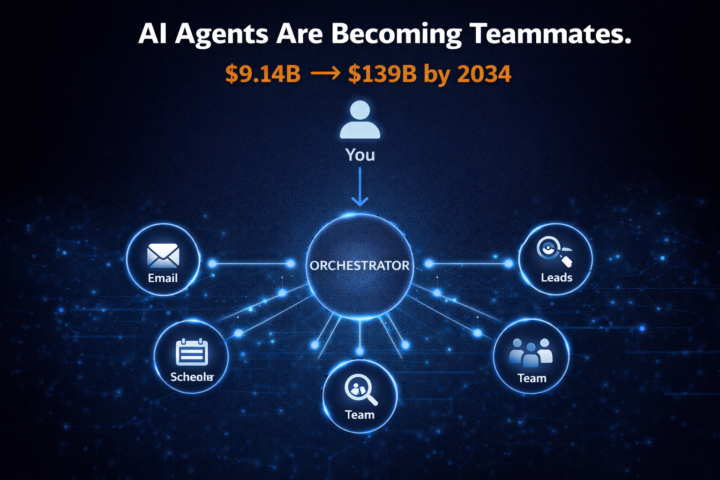
I think most builders are still thinking about AI agents as tools. In 2026, they're becoming teammates. We are moving from instruction-based computing, where we tell a computer how to do something, to intent-based computing, where we simply state the desired outcome and the agent determines how to deliver it. That's a fundamental shift in how systems are built. And the numbers back it up. The global agentic AI sector is projected to grow from $9.14 billion in early 2026 to over $139 billion by 2034, a CAGR of 40.5%. This isn't hype. This is infrastructure being built right now. Here's what that means practically for builders: What's emerging is not just smarter automation, but a new coordination layer, where different types of AI agents work together to run core business workflows at scale. Single agents are impressive. Multi-agent systems are transformative. The architecture that actually wins in 2026 looks like this: → One orchestrator reads intent and routes → Specialized agents each own one function → Every agent is isolated, independently testable, replaceable → The whole system runs on one trigger The era of simple prompts is over. We're witnessing the agent leap, where AI orchestrates complex, end-to-end workflows semi-autonomously. This is exactly what I built with Jake. One Telegram message. Five specialized agents. Full workflow executed. Zero manual work. The builders who understand coordination, not just automation, are the ones building systems that actually scale. That's the edge.
0 likes • Mar 21
Exactly @Dominik Kucharski. AI doesn't just automate work, it expands what's possible. The people using it to learn faster, build better, and connect more deeply are the ones moving at a completely different speed right now. The creative ceiling just got a lot higher.
0 likes • Mar 22
Appreciate the pushback @Frank van Bokhorst , genuinely. 🙏 You're right that understanding the business sense behind it is non-negotiable. Building systems without knowing the problem they solve, the ROI they generate, or the workflow they replace is just expensive experimentation. That's exactly why I don't lead with the technology. I lead with the business outcome, fewer missed leads, faster response times, lower operational costs. The system is just how we get there. Curious what you've seen go wrong when builders miss the business sense? Always learning. 👇
1-10 of 20

@nkong-joshua-2603
Software engineering student and a lover of AI
Active 4h ago
Joined Nov 25, 2025
Powered by