Activity
Mon
Wed
Fri
Sun
Jun
Jul
Aug
Sep
Oct
Nov
Dec
Jan
Feb
Mar
Apr
May
What is this?
Less
More
Memberships
Research Career Club
667 members • Free
9 contributions to Research Career Club

26d •
Burnout is not a badge of honour – it’s a warning light.
Most researchers are taught to “push through” exhaustion, guilt and Sunday panic as if they’re proof of commitment. But the real career impact comes from calm, consistent work you can sustain for years – not heroic all‑nighters that quietly destroy your motivation. In my 15 years of publishing 80+ papers and leading £9m+ in projects, the pattern is always the same: the most successful people are not the ones who suffer the most, but the ones who protect their energy the most. They set limits on the system before the system breaks them. Here’s the shift I wish I’d made earlier 👇 1. Treat your time like lab space. You wouldn’t let random people dump equipment on your bench; don’t let random tasks fill your calendar. Block 2–3 focused “research blocks” per day and protect them like an experiment booking. 2. Make expectations explicit, not assumed. Burnout loves ambiguity. Ask your supervisor or PI, “What does ‘good enough’ look like for this paper/experiment this month?” Then agree on concrete, realistic milestones instead of silently moving goalposts in your head. 3. Shrink the unit of progress. When you’re exhausted, “write the paper” is impossible. “Draft a rough Results paragraph” is doable. I still run my own work this way: embarrassingly small, clearly defined tasks that I can finish even on a low‑energy day. 4. Build one small, non‑academic routine. A 20‑minute walk, gym session, or coffee with a friend at the same time each day creates an anchor that reminds you you’re a human first, researcher second. My best ideas have come during these “non‑work” moments. 5. Ask for support early, not heroically late. Every time I’ve seen someone crash, they were “fine” right up until they weren’t. A short, honest conversation with your supervisor, GP, or counselling service now is far better than a forced break later. What is one small change you’ll make this week to protect your energy from burnout? Drop it in the comments 👇
0 likes • 25d
I love point no.4. But what does point no.3 means? Does it mean we still continue and should satisfy with even just a small progress on low-energy days?
Feb 24 •
Beware of predatory journals
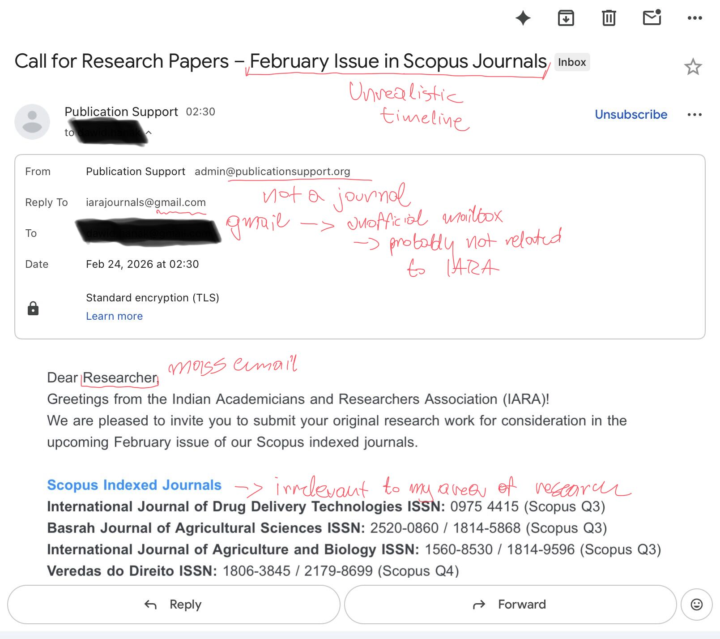
I got an email at 2:30 AM. "Dear Researcher, submit to our Scopus indexed journal." I deleted it this morning. Here's how I knew it was a trap: 1. The reply address was Gmail. Not a publisher domain. Not a journal domain. Gmail. Anyone can create one. 2. The greeting said "Dear Researcher." Not my name. Not my field. Not my work. 3. The "February issue" email arrived in late February. No real peer review happens in 48 hours. 4. And every journal listed? Drug delivery. Agriculture. Law. Nothing close to my research. These emails don't want your science. They want your submission fee. So before I submit anywhere, I run this check: → Verify indexing inside the database — not in their email → Check if the journal was discontinued → Look for real editorial board names and affiliations → Confirm peer review has an honest timeline → Make sure the scope matches my actual work If even one answer is "I'm not sure" — I don't submit. Your research took months or even years to produce. Don't let an email from predatory journal decide where it lives. P.S. Think. Check. Submit is a free checklist. Use it before every submission. It takes 10 minutes and protects your entire career.
3 likes • Feb 24
I almost fall into one of these traps before.
Feb 12 •
What’s your core research area?
Many of you are here to network but we don’t often know who is doing what - let’s change this: In a few words, please explain what is your core research area. Enjoy!
2 likes • Feb 12
procedural and distributive fairness in insolvency law
Jan 16 •
Mistakes I made when writing my early research papers
I spent 13 months writing my first research paper. And guess what? It was painful. I told myself: "I hate writing." "I'm not good enough." "I just need to get this done." I was making massive mistakes that were killing my productivity and leading to rejections. Here are the 5 biggest mistakes I made (and how to fix them): 1. I tried to write the Introduction first. I thought I had to write linearly. Start at the top, finish at the bottom. The Fix: Flip the script. Write your Methods first. Then Results. Then Discussion. Write the Introduction last—once you actually know what story your data tells. 2. I tried to be a "Perfectionist" during the draft. I would write a sentence. Delete it. Fix the grammar. Rewrite it. I was thinking and writing at the same time. The Fix: Separate the two. Draft as quickly as possible. Don't worry about English or grammar. Just get the ideas down. Remember: Done is better than perfect. You can edit later. 3. I wrote without a plan. I used to write 40-page drafts because I had no plan. I included everything I thought was relevant. The Fix: The Perfect Outline. Spend 1-2 days just on the outline. Define your key messages and flow before you write a single paragraph. Outlines prevent waffling. Less is more. 4. I used "Fancy Words" to sound smart. I thought complex language made me look like an expert. The Fix: Plain language. Your goal is to make learning easy for the reader. If you use words like "desirous" just to sound academic, you are hurting your impact. 5. I ignored the "Novelty" trap. I thought new data was enough. The Fix: Verify your novelty early. 70% of desk rejections happen because of a lack of novelty. If you have an "Old Solution" to an "Old Problem," you will get rejected.Frame your work as a New Solution + Old Problem, or an Old Solution + New Problem. Writing doesn't have to be a struggle. You just need the right framework. Which of these mistakes are you making right now? P.S. If you are stuck staring at a blank screen, ask yourself: "Why does this research matter to others?". It changes everything.

1 like • Jan 16
Items 1, 2 and 5 are the points I've to remember and keep reminding myself when writing ... Thanks Prof.
Dec '25 •
Happy New Year, everyone!
Wishing you all the best for the 2026! Hope your goals and aspirations will come true. I am truly grateful for your contributions to this community. Learning together and sharing expertise is the best way to grow as a person. Thank you - I’ve already learnt a lot from you. Looking forward to 2026 - let’s make it great!
1 like • Dec '25
Happy New Year 🎉
1-9 of 9
Active 2d ago
Joined Nov 2, 2025