Activity
Mon
Wed
Fri
Sun
Jul
Aug
Sep
Oct
Nov
Dec
Jan
Feb
Mar
Apr
May
Jun
What is this?
Less
More
Memberships
Entrepreneur Oasis MENA
44 members • Free
AI Automation Society
407.8k members • Free
88 contributions to AI Automation Society

17h •
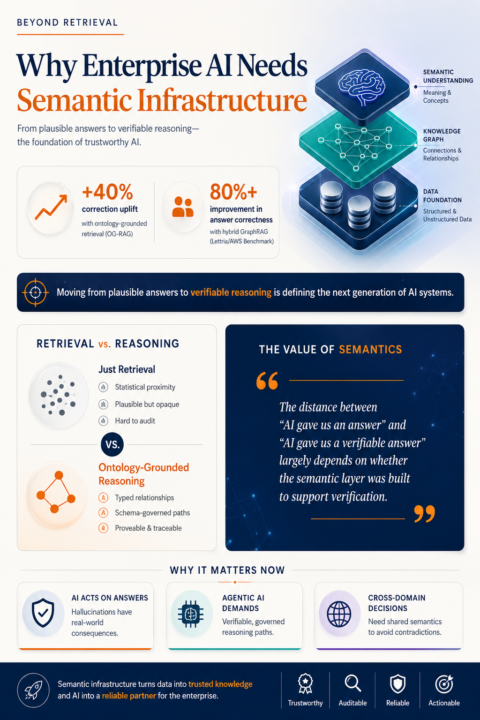
✨ From Plausible to Provable: The Next Era of Enterprise AI
Enterprise AI doesn’t fail because it lacks data it fails when answers can’t be trusted. The promising solution is semantic infrastructure: ontology-grounded reasoning that turns black-box responses into verifiable, auditable decisions. When AI understands meaning—not just similarity—it moves from sounding right to being right. 🚀 If you would like to know more or to build an optimal way of building trusted chatbot, DM me or you can submit your query through my website: MROQA
1
0

💎
⭐
2d •
Be in the room with the top AI voices this summer!
I'll be speaking at an event called Workless happening July 29-31 in Tivat, Montenegro. Liam Ottley, Jack Roberts, Dave Ebbelaar, Mark Kashef, and so many more AI experts building different businesses. If you saw the one in Cape Town back in February, this is the same thing. Same kind of people, same experience. Founders and operators actually building with AI, all in one room. If you're looking to talk directly to the people doing this and building businesses around it every day, this is the room you want to be in. And if you want to connect with hundreds of other operators doing the same, this is the room. Check it out here: https://workless.ai/ Huge bonus points if I see anyone from AIS pull up. And even more bonus points if you show up in some AIS merch.
4 likes • 2d
Very interesting, I’ll be there if my schedule allows.
3d •
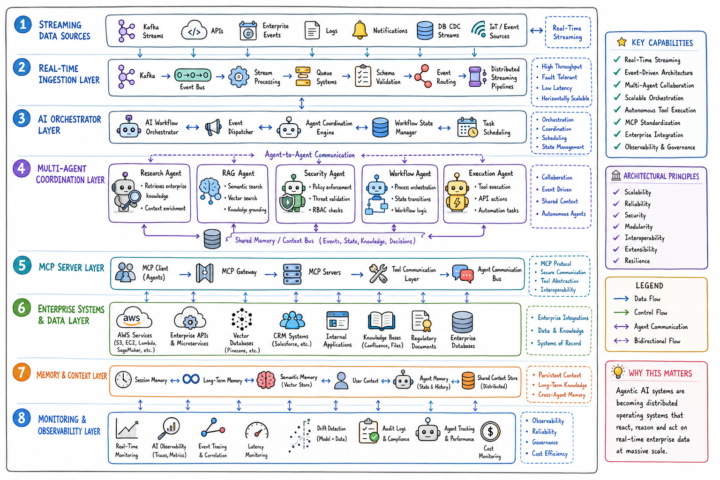
🚀 From AI Experiments to Enterprise-Grade Systems
This visual represents how agentic AI systems are built for the real world.👇 At the top, everything starts with real-time data(APIs, events, logs, streams, IoT).AI is only as good as the signals it receives. Next comes real-time ingestion. This layer ensures data flows fast, reliably, and at scale validating, routing, and preparing events as they happen. Then we reach the AI Orchestrator. This is where intelligence is coordinated: • Which agent should act? • In what order? • With what context?• And under which rules? The heart of the system is multi-agent collaboration 🤖🤖 Different agents specialize in different jobs: • Research & knowledge retrieval• RAG and semantic understanding • Security and policy enforcement• Workflow orchestration • Execution and automation They don’t work alone — they communicate, share memory, and make decisions together. Below that sits the MCP layer. This standardizes how agents safely interact with tools, APIs, and enterprise systems — turning AI actions into real outcomes. Then come enterprise systems & data CRMs, databases, knowledge bases, cloud services — where the actual business lives. To make AI reliable, we add memory & context. So systems remember past interactions, user intent, decisions, and long-term knowledge — not just the current prompt. Finally, everything is wrapped with monitoring & observability. Because production AI must be: • Traceable • Auditable• Secure • Cost-aware 🔑 Modern AI isn’t a model — it’s an operating system. The teams winning with AI are not asking “Which model should we use?” They’re asking “How do we design systems that can reason, act, and scale safely?” That’s the shift happening right now. 🎰 Join me in the Hermes Agent Accelerated Business Hackathon presented by Nvedia+Stripe+Nous Research. 🔥
6d •
Revolutionize Logistics: AI-Powered Resource Management System
Logistics has been revolutionized by automation transforming fragmented manual processes into intelligent, connected ecosystems where smart tools handle the complexity and people are freed to lead, decide, and innovate. Read the full story on Contra... Part of my participation in #configmakeathon by Figma! https://contra.com/community/2TSafp31-revolutionize-logistics-ai-powered-resource-management-system?r=mohammed_roqa&referralExperimentNid=DEFAULT_REFERRAL_PROGRAM

1 like • 6d
@Semih Asaroglu Logistics chosen by a friend. The stack by me, and the design by Figma. It is a demo. Two weeks.
1 like • 5d
@Mofedul Alam Joy Thanks! My idea is to connect tools with stakeholders iinteligently. I will discuss this further and I would love to get your feedback on the technical architecture. Thanks again!
💎
⭐
7d •
400,000 members.
When I started the AI Automation Society, I had no idea it would grow into this. Under two years later and we just crossed 400k. The largest AI automation community in the world. Yes, the space is exploding. But this community grew because you guys keep showing up, asking questions, dropping answers, sharing builds, and helping the person one step behind you. Huge thank you to the team that keeps this thing running, and to every single one of you who's posted, commented, or just been here. I feel lucky to get to do this. So excited to share with you guys what we've been quietly cooking up over here at AIS...👀 - Nate

0 likes • 7d
What a milestone!!! Congrats, and I think we are going to celebrate 1 million too.
1-10 of 88

@mohammed-roqa-7379
Systems Architect (15+ yrs) aligning tech with business growth. Expert in AI/automation, cloud, & enterprise scale. Seeking to connect with leaders.
Active 8h ago
Joined Jan 20, 2026
INTJ
Powered by