Activity
Mon
Wed
Fri
Sun
Dec
Jan
Feb
Mar
Apr
May
Jun
Jul
Aug
Sep
Oct
Nov
What is this?
Less
More
Ultra School | Ultrasound
128
$9/m
Vagus School
1.1k
Free
31 contributions to Vagus School

Mar 13 •
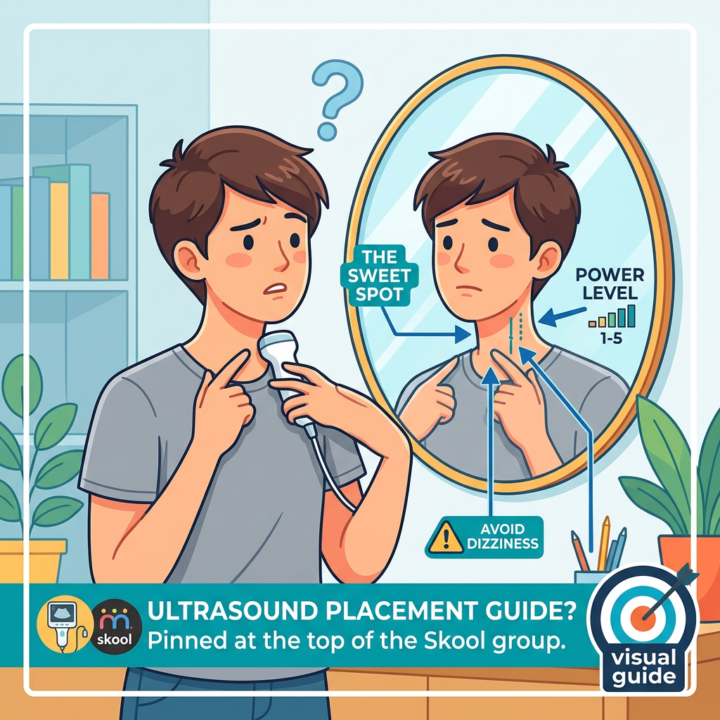
📸 The #2 Question: "Got Any Pictures of How to Use This Thing?" (Yes! Here is the Visual Guide + The Golden Rules)
You got your device (hopefully from the pinned post above! 👆), and now you're staring at it thinking, "Okay... but where does this thing actually go on my neck?" It is the second most common question I get, and the answer is critical. Slapping the ultrasound on the wrong spot is like trying to charge your phone with the wrong cable—it just won't work, and you might get a weird error message (dizziness, tingling, etc.). I have built a whole module dedicated to this, complete with diagrams and a video guide. It covers the exact anatomy, the "mirror trick," and how to avoid overstimulation. 👉 [CLICK HERE FOR MODULE 3: Ultrasound Setup & Neck Placement] The "Cheat Sheet" Before You Click: Since you are here asking for pictures, here is a quick preview of what is waiting for you inside that module so you can get it right the first time: 1. The Setup (Don't Skip This!) - Gel is Boss: Do not turn the device on without it. It is not lotion; it is the conductor. - Warm it Up: Cold gel is a shock to the system. Warm the bottle in your hands first for a spa-like vibe. 2. The "Sweet Spot" Placement - The Location: It is on the left side of your neck (you can do the right side ONLY when you're absolutely sure you can find the left side Vagus Nerve). - The Landmarks: You are aiming for the point between the crease behind your jawline, the bottom of your earlobe, and the big neck muscle (sternocleidomastoid). - The Mirror Trick: Use a mirror to watch the placement. If you feel a tingle or your voice wobbles, you are hitting a nerve—move slightly inward (towards your windpipe). 3. The 5-Minute Goldilocks Rule - Minute 0-1: Level 1 (Gentle introduction) - Minute 2-3: Level 2-3 (Building warmth) - Minute 4-5: Level 4 (The "Ahhh" zone) - Red Flag: Nausea or headache? Stop immediately and sip cold water. Bonus: When to Do It (Module 4 Sneak Peek) Timing matters! Most people love this before bed for deep sleep, but you can also do a low-intensity session in the morning for "alert calmness" without the jitters.

0 likes • 23d
For new users, when you have the unit properly lubricated with the gel, and placed in the proper location, you will know as the sound of the vibration will resonate. You will notice a distinct sound diffrence as your inner ear nervous system picks up the vibrations within.
Aug 13 •
How To Reset Your Nervous System In 90 Seconds Without Electronics
The internal geometry of a 3D-printed conduit, such as the Nemuri Pendant, modulates respiratory resistance to induce a parasympathetic shift without electronic intervention. By adding calibrated resistance to the airway, the device facilitates a reduction in respiratory rate to the 4–6 breaths per minute range. This specific frequency optimizes heart rate variability and maximizes vagal tone by extending the exhalation phase. The mechanism relies on fluid dynamics rather than firmware. As the user breathes through the tuned internal channel, the added load engages the diaphragm and throat muscles more deliberately. This engagement, combined with soft pressure feedback, triggers the diving reflex to lower the heart rate and suppress sympathetic arousal. Physical markers of this vagal activation typically manifest within 90 seconds. Users observe a softening of the periorbital muscles and a release of tension in the trapezius and levator scapulae. The shift is a direct result of lengthening the expiratory phase, which enhances the inhibitory influence of the vagal efferents on the sinoatrial node. A rhythm of 4-second inhalations and 6-second exhalations through this resistance provides a structured method for retraining baseline breathing patterns. Because the device requires no batteries or apps, it serves as a permanent analog interface for nervous system regulation. It is a tool for immediate recovery after high-cortisol events or for maintaining autonomic balance during daily transitions. https://www.frontiersin.org/articles/10.3389/fnhum.2018.00353/full https://pubmed.ncbi.nlm.nih.gov/21939457/ https://vagushub.com/nemuri

1 like • Aug 15
@Jeffrey Fantastic Whomever came up with that, has the entrepreneurial mind gift for sure. But a great idea with the copper inlay. I recently purchased a copper bracelet inlayed with high intensity magnets to help with the bodies electromagnetism.
Jul 5 •
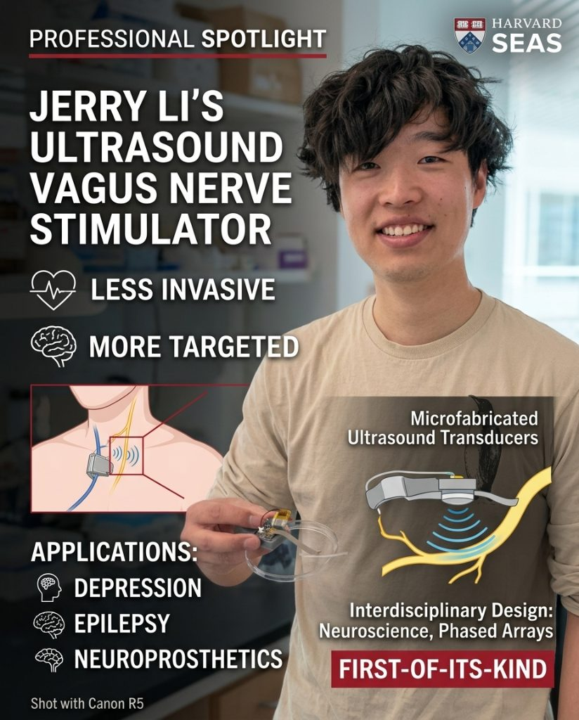
Revolutionizing Nerve Stimulation With The First Flexible Ultrasound Cuff
Jerry Li, an electrical engineering concentrator, developed a flexible cuff as his senior capstone project. The cuff uses ultrasound rather than electrical currents to stimulate the vagus nerve with precision. The approach is presented as having the potential to be less invasive and more targeted than prior methods. Applications noted include future treatment of depression, epilepsy, or support for neuroprosthetic control. Li stated that to his knowledge no one has used microfabricated ultrasound transducers for peripheral nerve stimulation before. Microfabrication work began in May 2025 and continued over the summer. Electronics design was the focus during the academic year. The microfabrication process itself was described as the most challenging element, characterized as a long and detailed procedure even with expert guidance. The project drew on multiple disciplines including neuroscience, phased array theory, wireless charging, and mechanical prototyping. Li noted that the interdisciplinary scope helped build his confidence as an engineer. The work was conducted under the Harvard John A. Paulson School of Engineering and Applied Sciences. https://www.facebook.com/hseas/posts/for-his-senior-capstone-project-electrical-engineering-concentrator-jerry-li-dev/1342732331285198/
1 like • Jul 7
Nice
Jun 27 •
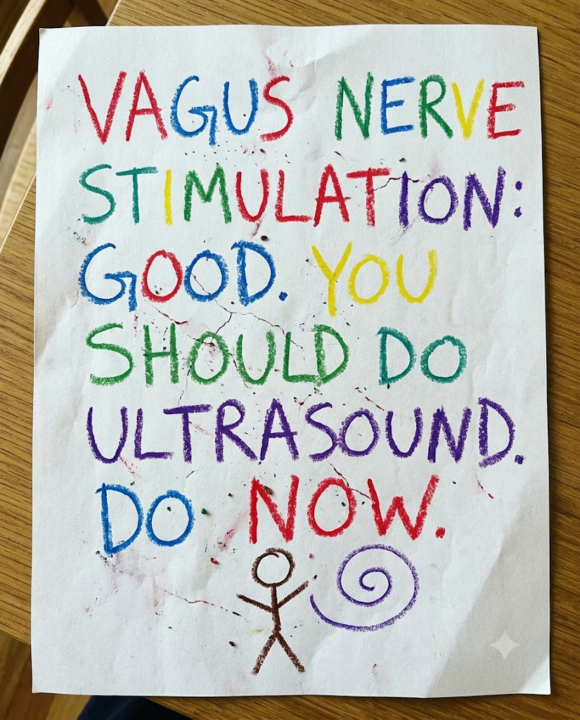
I Was Wrong About AI And I Am Sorry
OK, OK, I've seen the errors of my way and have now decided from now on I'm going to make pictures only by hand. The only pictures you're going to see from me from now on are ones that only I have made with my own hands and whatever drawing materials I have on hand. Apologies in advance for the superior drop in quality, but this is what people have asked for, and people don't like AI. While the consistency and quality of my posts may drop substantially and it really won't convey too much information, I decided to make this one very clear piece of media so people can really get a sense of what's important in life. I hope this helps, and you guys were totally right. I'm so sorry about using AI to make pictures. What was I thinking? Crazy, I know! I have innate artistic abilities that I should have been tapping into this whole time! I feel like such an idiot. Please accept this picture as a sign of my apology.
1 like • Jun 27
😆
Jun 15 •
Vagus Nerve Keeps You Asleep so Your Brain Can Glymphatically Cleanse
Sleep requires a precise shift from sympathetic activation to parasympathetic dominance, orchestrated by the vagus nerve. Low vagal tone causes a sluggish shift, leading to difficulty falling asleep, frequent waking, and poor sleep quality. Higher nighttime HRV correlates with more time in deep slow-wave sleep and REM sleep, where physical repair and memory consolidation occur. Sleep doctors use overnight HRV as a complementary marker to traditional sleep architecture. People with high vagal tone sleep less but feel more rested than those with low vagal tone, who spend more total hours in bed. During deep sleep, the vagus nerve increases its firing rate, slowing heart rate to its lowest resting point and reducing blood pressure. This parasympathetic dominance shifts resources to muscle growth, tissue regeneration, immune strengthening, and neural waste clearance via the glymphatic system. During REM sleep, vagal tone fluctuates dynamically, supporting the vivid dream state while maintaining physiological stability. Poor vagal function disrupts REM cycling, contributing to vivid nightmares, unrefreshing sleep, and daytime fatigue. The glymphatic system operates primarily during deep sleep. Inadequate parasympathetic dominance reduces glymphatic flow, causing inflammatory byproducts and metabolic waste to accumulate in brain tissue, contributing long-term to neurodegenerative disease risk. Low vagal tone disrupts sleep through elevated nighttime heart rate and sympathetic activity, reduced time in deep sleep and REM stages, increased sleep latency, more frequent nighttime awakenings (particularly 2am-4am), higher cortisol levels disrupting circadian rhythm, less recovery per hour of sleep, and greater sensitivity to light, sound, and temperature disturbances. Evening vagal activation practices improve sleep quality by shifting to parasympathetic dominance in the last 30-60 minutes before bed. Practices include 4-7-8 breathing (inhale 4s, hold 7s, exhale 8s), left nostril breathing for 5 minutes, humming or chanting to stimulate auricular vagus branch, cold face wash triggering dive reflex, progressive muscle relaxation, and body scan meditation.

1 like • Jun 21
Blue UV light from display screens are really bad as well. 📱 I have a 20% red filter setting on my screen display to cut down on the uvb exposure. They also sell glasses designed to block the blue light.
1-10 of 31

@michael-wagner-3311
🌐Advocate for the advancement of humanities collective consciousness via education and awareness.
Active 4d ago
Joined Feb 20, 2026
Florida
Powered by