Activity
Mon
Wed
Fri
Sun
Aug
Sep
Oct
Nov
Dec
Jan
Feb
Mar
Apr
May
Jun
Jul
What is this?
Less
More
Memberships
The Independent Authors Guild
244 members • Free
7 contributions to The Independent Authors Guild

16d •
Is it too off-the-wall to include an Arabic-styled English-language poem on a book jacket?
He is the Silk who endures the burning day, and she is the Iron who commands the cooling night; and the world breaks upon them like rain upon the earth, for they receive its fury without bending or fear. Their love is a treasure buried deeper than the wells of old, a truth concealed not by shadow, but by the Lie they wear in daylight— a truth no Elder can fathom, for none imagine her shield of the tent.

0 likes • 3h
Regarding your writing: I don’t think it is too off-the-wall. The poem creates an immediate mythic register, and the Silk/Iron, day/night contrasts give the relationship a clear internal architecture. I especially like the idea that their truth is concealed not by darkness, but by the identities they perform in daylight. That makes me curious about the world surrounding them and why their love must remain hidden. My only hesitation is the phrase “Arabic-styled,” since it is broad and may pull attention toward questions of cultural authenticity rather than the poem’s purpose on the jacket. I would let the language carry the influence unless the book itself grounds that description more specifically. The final image, “her shield of the tent,” is intriguing, though it is also the line I had to work hardest to understand. If that image has a clear meaning within the novel, the poem could work very well as jacket copy or an epigraph. On an inspirational note: Your feedback about interleaving fuller prose with the staccato rhythm helped me identify a genuine craft issue in the opener. I revised it with that in mind. Would you be open to exchanging email addresses and reading four revised paragraphs instead of the original two? I would value your reaction to whether the rhythm now feels clearer while preserving the photographic effect.
0 likes • 2h
Thank you, Blaze. I appreciate the perspective and the earlier feedback you gave me about interleaving fuller prose with the staccato rhythm. That observation proved useful during revision. Best wishes with When Silk & Iron Lie.

3d •
Plot Development Method
For the fiction writers here, how do you develop your plot? Off-the-cuff (i.e. spontaneously), systematically, or a hybrid method? Note, there was a post here about this subject but I can't seem to locate it.
1 like • 5h
I usually begin with a vision of how I want the story to end, whether it is an image, a conversation, or a physical cue. From there, I develop the characters and the pressures that could carry them toward that ending. The plot emerges through accumulation and attrition as their choices narrow the possible routes. So, for me, the process is a hybrid of vision and discovery.
2d •
Opening Excerpt — Would You Keep Reading?
I’m working on a literary institutional thriller and testing whether the opening creates tension, clarity, and voice. I’m mainly interested in whether you would keep reading. It’s open to all, so I’ll keep it brief and share only the opener and first two paragraphs. SUMMER 1974 I am ten when the bells begin at six, their toll rolling across the hills in uneven bursts while I lie still, listening for the spaces between them. Something tight forms with the first bell and settles into a rhythm beyond my control. The Pentax comes with me when I leave the house, its leather case striking my chest, the strap drawing across the back of my neck. Wet from the night, every blade of grass leans in the same direction. From the edge of the drive, bells diminish beyond trees. The church tower rises above the branches, its outline unchanged as daylight gathers. Stone fills the viewfinder as I bring the lens into place. Vertical lines converge. Click. Whirr. Again. Click. Whirr. A bird crosses the upper edge. I compensate. Click. Church shoes press into the gravel. “Good, Donald. You kept time.” My mother's attention passes from the camera to me and back to the camera. At the passenger door, her hand takes the strap. Leather draws across my shoulder. As the camera clears my chest, heat remains where it touched. “Today, abstain.”
0 likes • 5h
@Kimberly Kradel Thank you. That is a fair reading, and you identified the exact tension I am working with. The clipped rhythm is deliberate. The protagonist processes the scene almost photographically. Yes, through isolated details, physical cues, and controlled observations. Your “statement snap, observation snap, feeling snap” description captures the effect well. My concern is the same one you raised. If the fragmentation begins to interfere with clarity, the technique stops serving the story. I am revising the opener now to preserve the staccato where it creates pressure while allowing more connective prose between those sharper beats. The goal is controlled compression, not confusion. This feedback is useful because it confirms the rhythm is visible while also showing me where it may be overapplied.
1 like • 5h
@Melissa Jayne Thank you. Yes, this is close to what I intended. He wakes into immediate motion, but his attention keeps breaking toward visual detail because he processes the world through images even when the adults around him demand order and timeliness. His mother’s reaction is less about disapproving of art itself and more about what the picture taking interrupts. Church, schedule, presentation, and obedience take priority in that moment. I do want the reader to wonder whether she sees his artistic instinct as valuable or merely inconvenient, though I may need to ensure the scene gives enough context for that tension to feel deliberate. Your comment about asking for the literary reader’s patience is especially useful. That is the intended audience, but the prose still has to reward that patience with clarity and forward pressure. I appreciate you identifying both the visual strength and the possible demand the style places on the reader.

6d •
As a children's book author, I've been thinking about this today...
As a children's book author, I've been thinking about this today... If you could create one children's book that every child in the world would read, what would you want it to teach? For me, I'd want children to learn that being kind is never a weakness—it's one of the greatest strengths they can have. 💛 I'd love to hear your answer in the comments. Your ideas might inspire my next story!
0 likes • 1d
I really appreciate this explanation of your recurring trope. There is something powerful in the reversal you are working with: a society misreads kindness and gentleness as weakness, while the heroine recognizes those same qualities as courage. I also like that the alpha-female character is not simply “softened” by the male protagonist. Instead, she seems drawn to the fact that he is not threatened by her strength. That feels important. His vulnerability does not compete with her power; it gives her room to be fully herself. One thought: I wonder if the word “wimp” might be worth challenging inside the work itself. The world may call him that, but the story seems to be proving the opposite. A kind man who remains kind under pressure is not weak. He may actually be the bravest man in the room. I think the emotional heart of this idea is strong: tenderness as courage, gentleness as resistance, and love as recognition rather than conquest.

8d •
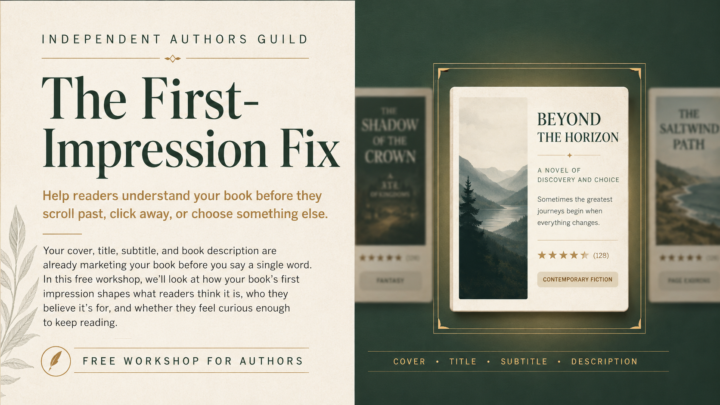
Free Workshop Tuesday, July 14: The First-Impression Fix
Your book is being judged before anyone reads a page. That may sound harsh, but it’s simply how readers make decisions. Before they know your story, your message, your expertise, or your heart, they see the cover. They read the title. They glance at the subtitle. They skim the description. And guess what...it's not just readers. Amazon's algorithm is doing the same thing. And in just a few seconds, readers and robots alike decide whether they understand the book well enough to click it, buy it, or share it across the platform. That’s what we’re going to talk about in this free workshop: The First-Impression Fix: The First Step to Getting Traction on Amazon This is our first workshop in the Guild, next Tuesday, July 14, 2026, at 6:30 PM CDT. We’ll look at how your book’s first impression shapes what readers think it is, who they believe it’s for, and whether they feel curious enough to keep reading. We’ll be looking at the full first-impression package: Cover Title Subtitle Book description And, perhaps most importantly of all, how to dial it in as a single branded package to get traction on Amazon. This workshop is for you if you’re preparing to publish, already published and wondering why readers aren’t responding, or even considering a relaunch of a book on your list that hasn't seen the light of day in years. Join me Tuesday, July 14th at 6:30 PM Central inside the Guild. Bring your book if you have one. Bring questions if you’re still working on one. And bring a willingness to look at your book the way a reader sees it. This is where we start making the book easier to love, easier to trust, and easier to buy.
0 likes • 6d
Looking forward to the workshop.
0 likes • 3d
I write stories about what happens when human beings collide with institutions that know how to protect themselves. My work follows pressure, records, access, silence, and the cost people carry when official versions of events begin to replace lived experience. The stories are personal, but the danger is structural. What stories do you write about?
1-7 of 7
@michael-hicks-6803
Michael Hicks is a U.S. Navy veteran and author of COMPROMISED, writing systemic thrillers shaped by truth, resilience, and consequence.
Active 2h ago
Joined Jun 26, 2026