Activity
Mon
Wed
Fri
Sun
Nov
Dec
Jan
Feb
Mar
Apr
May
Jun
Jul
Aug
Sep
What is this?
Less
More
✨The Galatic Awakening✨
116
Free
Self Organizing Organism
68
5.0
$7/m
The Divine Within
9
Free
Cosmic Crystals
137
Free
The Skool of Self Trust
13
Free
LoveNow988 ❤️ 11 11🐇
84
Free
Granny Wisdom, Hippie Vibes
290
5.0
Free
Crystal Appreciation Society
163
Free
3 contributions to Oasis Builders

🔥
6d •
Watching the Sun Move Through the Garden
One way to understand a garden’s sunlight is to stand in the same place and watch where the Sun sets. Around the autumn equinox, it sets close to due west. Mark that spot against something you can recognize, such as a tree or fence post. Watch again every few weeks. Through fall, the sunset point moves south along the horizon and the days grow shorter. After the winter solstice, it begins moving north again. For the Southern Hemisphere, this is reversed. By the spring equinox, the Sun follows nearly the same path across the sky that it does now. The difference is where the season is headed. In spring, daylight is increasing. In fall, it is decreasing. That small observation can help us understand why a bed that receives plenty of light in summer may fall into a tree’s or building’s shadow later in the year. It is worth recording what actually happens in our own gardens before deciding where a fall crop or a permanent planting should go. Have you noticed a part of your garden that changes more with the seasons than you expected?

🔥
4 likes • 5d
@Elizabeth O'Carroll it makes me sad too!!!
🔥
Aug 12 •
When Two Plants Share the Same Space
When two plants grow beside each other, their relationship depends largely on how much their needs overlap. Plants compete for light, water, nutrients, rooting space, and sometimes physical support. A tall plant may shade a shorter neighbor. Roots may draw from the same part of the soil or occupy different depths. A vine may use another plant for support, but eventually become dense enough to shade it. Timing is important too. A fast-growing annual may use resources early and disappear before a perennial reaches its strongest growth. Weather can also change the relationship. Plants that share space well during a wet spring may compete much more strongly during a dry summer. Plant compatibility is not simply a fixed list of good and bad companions. It develops from how plants use resources across space and time. When looking at neighboring plants, consider: - Light and canopy overlap. - Water use. - Rooting space. - Nutrient demand. - Physical support. - Seasonal timing This week, choose two plants growing beside each other and ask: Where are their needs overlapping, and where are they using the space differently? Which type of competition is easiest for you to notice?
Poll
5 members have voted
🔥
2 likes • Aug 12
I just wanted to throw this out there. My garden plans/layout this year went haywire. And I ended up planting a jalepeno plant in a bald patch of my strawberries and that jalapeño plants alone has probably given me 50 jalapeños so far, they just keep coming!!!
🔥
May 27 •
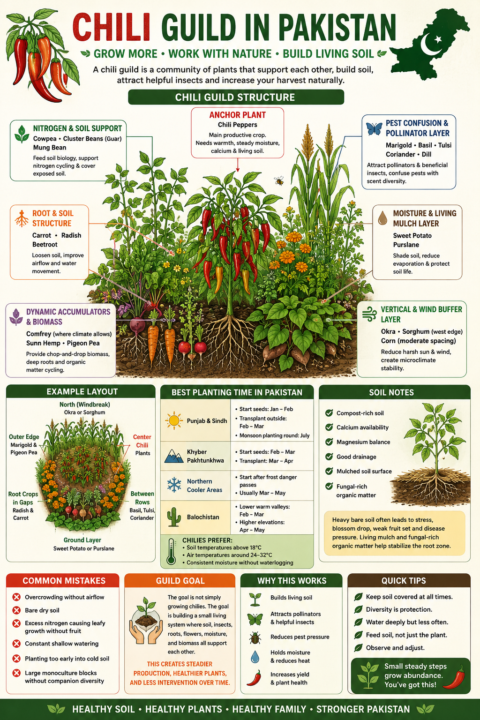
Chili Guild
This is made for warmer climates although the concept would work anywhere warm. @Mohammad Irtaza Tafheem @Oliver Wing
🔥
3 likes • May 28
What are your thoughts on using purslane for coverage in portions of the garden?
🔥
1 like • May 29
@Jim Flach thank you!!!
1-3 of 3

🔥
@melissa-watts-7143
Drawn to all things spiritual, and working to connect with my highest self. Love all things nature, reading, and my 2 daughters. 🌕🪴🔮💜🧙♀️🌳🧘♀️
Active 5h ago
Joined May 4, 2026
Michigan