Activity
Mon
Wed
Fri
Sun
Aug
Sep
Oct
Nov
Dec
Jan
Feb
Mar
Apr
May
Jun
Jul
What is this?
Less
More
Owned by Mathew
Memberships
The Transurfing Skool
4.2k members • Free
Ultra School
153 members • $9/month
Vagus School
939 members • Free
Temple of Selves
125 members • Free
Elastic Perception Free
6.4k members • Free
ReWild Breathwork | Free
1.6k members • Free
The Somatic Academy by Soma+IQ
15k members • Free
Earth 2.0 Community
1.8k members • Free
9D Breathwork Community
33.2k members • Free
8 contributions to Vagus School

16d •
New Research Reveals The True Primary Cause Of Alzheimer's Disease
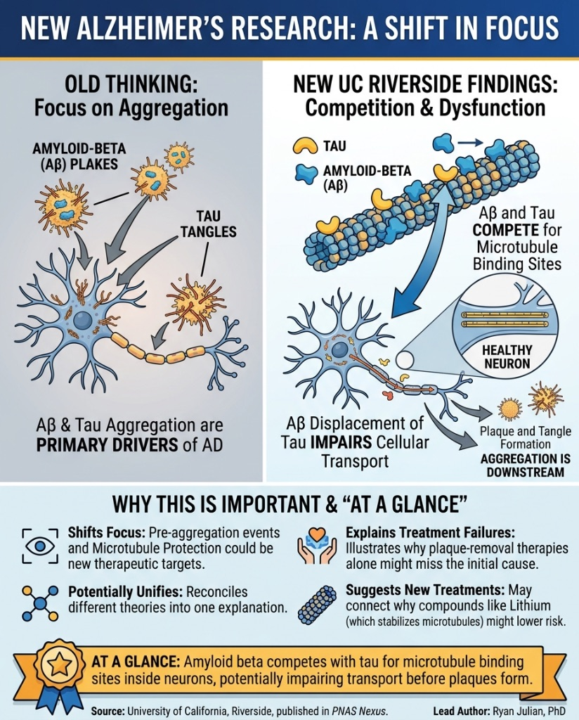
New research from investigators at University of California, Riverside suggests that amyloid beta (Aβ) and tau compete with each other for binding sites on microtubules inside neurons, disrupting cellular transport and possibly initiating disease development. The study, published in Proceedings of the National Academy of Sciences, Nexus, focuses on microtubules as a central point of interaction between the proteins and proposes that displacement of tau by Aβ may impair neuronal function before protein aggregation occurs. The new research runs counter to current thinking that has focused on amyloid beta aggregation as the primary driver of Alzheimer’s disease. Instead, the UC Riverside team found that amyloid beta binds to microtubules with similar affinity to tau, a protein responsible for stabilizing these structures. Using fluorescent labeling, the team tracked amyloid beta interactions and observed that it attaches to microtubules and can displace tau when present at sufficient levels. This displacement may compromise the microtubule network that neurons rely on for intracellular transport. “Our work shows amyloid beta and tau compete for the same binding sites on microtubules, and that a-beta can prevent tau from functioning correctly,” said first author Ryan Julian, PhD, a professor of chemistry at UC Riverside. Microtubules are a transport pathway within neurons that provide for the movement of essential molecules. Tau’s role in maintaining these structures has been well established, but the interaction between amyloid beta and microtubules has not been researched extensively. The researchers sought to better understand this relationship after they identified structural similarities between regions of tau that bind microtubules and Aβ peptides. To do this, the investigators labeled Aβ peptides and monitored them for changes in movement and light emission, indicating attachment to microtubules. Additional experiments demonstrated that amyloid beta and tau bind with comparable strength, which gave weight to the team’s hypothesis that Aβ accumulation could displace tau.

1 like • 16d
Microtubules are in the mix. Shocker!
Apr 2 •
Vagus Nerve Stimulation (80hz) Suppresses Inflammation Without Drugs
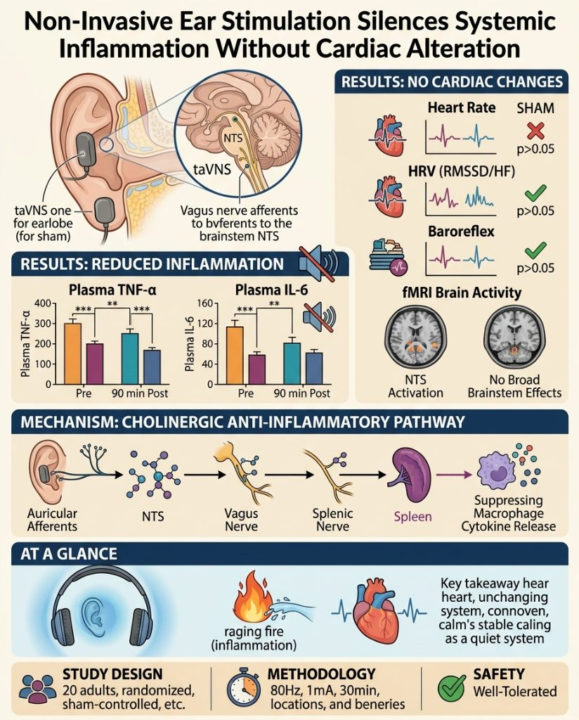
Neuromodulation is advancing toward precision physiological control. A randomized, double-blind, sham-controlled trial has confirmed the efficacy of transcutaneous auricular vagus nerve stimulation (taVNS) in suppressing systemic inflammation. By applying 80 Hz pulses to the cymba concha for 30 minutes, researchers observed a 22% reduction in TNF-α and a 15% reduction in IL-6. These results were achieved without pharmaceutical intervention. The data reveals a critical distinction: taVNS modulates the immune system without impacting heart rate variability or baroreflex sensitivity. This indicates the stimulation bypasses cardiac vagal tone entirely. Functional MRI confirms the mechanism involves the nucleus tractus solitarius (NTS). This activates a splenic nerve cholinergic pathway that inhibits macrophage cytokine release at the source. This non-invasive approach provides a blueprint for treating chronic conditions like rheumatoid arthritis and IBD. It represents a paradigm shift toward targeted bioelectronic medicine - even possible further applications in preventing Alzheimer's from developing in the first place. Very big news ! https://pmc.ncbi.nlm.nih.gov/articles/PMC12960021
4 likes • Apr 3
The paper you linked to is a very comprehensive theory of the use of vagus nerve stimulation for the treatment of disease. I could not find a reference for your graphic but the takeaway is the right one. I think the idea that if you provide different stimulations to the vagus nerve you can alter how the brain is effected and the organ systems. Only a small percentage of the total neurons in the vagus nerve are responsible for HRV, yet this is the typical way we try to measure vagus nerve activation. Which may be missing the mark. Inflammasense (https://inflammasense.com/) is developing a technology called autonomic neuorography to non-invasively measure cervical VNS signals in the neck. It has been able to see changes in neuronal activity when inflammation markers are present in the body.
Mar 25 •
Anyone try Zenbud?
Zenbud (https://zenbud.health/) is a low intensity focused ultrasound (LIFU) wearable that targets the auricular branch of the vagus nerve at the cymba concha (just above the ear canal opening). It uses a 5.3 MHz ultrasound frequency that pulses at 41 Hz. Sessions last for 5-30 minutes. They did a preliminary clinical trial (no control group) with 28 patients who have anxiety (https://pmc.ncbi.nlm.nih.gov/articles/PMC12671299/). Each day for 4 weeks they stimulated the ear for 5 minutes. 93% of the patients had decreased anxiety, 89% were less depressed, 82% had reduced PTSD symptoms and 65% had improved sleep quality. Interesting to note that a pulse rate of 40 Hz is one of the target pulse frequencies that @Sterling Cooley will be adding to his modified US-2000 Pro.
1 like • Mar 27
@Sterling Cooley That is so cool that you helped develop it. I can appreciate your reasoning for not continuing with the device. But I am still interested to know if you had any noticeable effect when you did use it. I know you prefer cVNS over taVNS, but I am still trying to understand the therapeutic landscape of these therapies (which would include any type of vagus nerve neuromodulation) including convenience, cost, dosage and effects.
Mar 13 •
📸 The #2 Question: "Got Any Pictures of How to Use This Thing?" (Yes! Here is the Visual Guide + The Golden Rules)
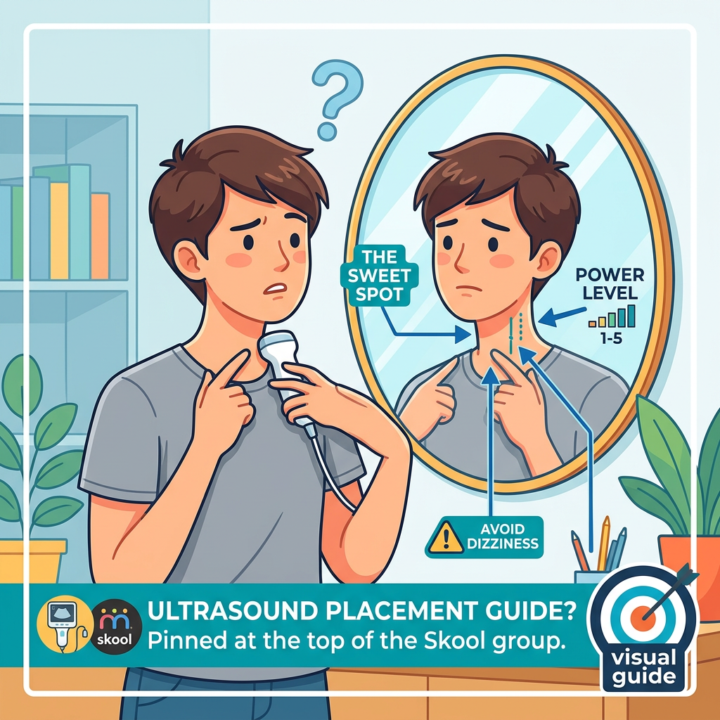
You got your device (hopefully from the pinned post above! 👆), and now you're staring at it thinking, "Okay... but where does this thing actually go on my neck?" It is the second most common question I get, and the answer is critical. Slapping the ultrasound on the wrong spot is like trying to charge your phone with the wrong cable—it just won't work, and you might get a weird error message (dizziness, tingling, etc.). I have built a whole module dedicated to this, complete with diagrams and a video guide. It covers the exact anatomy, the "mirror trick," and how to avoid overstimulation. 👉 [CLICK HERE FOR MODULE 3: Ultrasound Setup & Neck Placement] The "Cheat Sheet" Before You Click: Since you are here asking for pictures, here is a quick preview of what is waiting for you inside that module so you can get it right the first time: 1. The Setup (Don't Skip This!) - Gel is Boss: Do not turn the device on without it. It is not lotion; it is the conductor. - Warm it Up: Cold gel is a shock to the system. Warm the bottle in your hands first for a spa-like vibe. 2. The "Sweet Spot" Placement - The Location: It is on the left side of your neck (you can do the right side ONLY when you're absolutely sure you can find the left side Vagus Nerve). - The Landmarks: You are aiming for the point between the crease behind your jawline, the bottom of your earlobe, and the big neck muscle (sternocleidomastoid). - The Mirror Trick: Use a mirror to watch the placement. If you feel a tingle or your voice wobbles, you are hitting a nerve—move slightly inward (towards your windpipe). 3. The 5-Minute Goldilocks Rule - Minute 0-1: Level 1 (Gentle introduction) - Minute 2-3: Level 2-3 (Building warmth) - Minute 4-5: Level 4 (The "Ahhh" zone) - Red Flag: Nausea or headache? Stop immediately and sip cold water. Bonus: When to Do It (Module 4 Sneak Peek) Timing matters! Most people love this before bed for deep sleep, but you can also do a low-intensity session in the morning for "alert calmness" without the jitters.
1 like • Mar 13
In the provided picture I see you placing the ultrasound below the jaw and in your ultimate breath video you are holding it above the clavicle. Can I just use it anywhere on the neck I can feel the carotid artery pulse?
Mar 11 •
The Great Nerve
Has anyone read The Great Nerve: The New Science of the Vagus Nerve and How to Harness Its Healing Reflexes by Dr. Kevin Stacey? It is written by a pioneer in our understanding of the vagus nerve and in its therapeutic stimulation (through electrical stimulation). Chapter 7 focuses on ultrasound therapies. I found the book very informative. Seems very complementary and validating to the information provided in this Skool. Link to book: https://a.co/d/0f2OQPvr)
1 like • Mar 11
I just discovered that in the post yesterday about chronic inflammation he referenced a post from last year about "What actually *is* inflammation?" also suggests reading this book.
1-8 of 8
Active 12h ago
Joined Dec 16, 2025
Powered by