Activity
Mon
Wed
Fri
Sun
Nov
Dec
Jan
Feb
Mar
Apr
May
Jun
Jul
Aug
Sep
What is this?
Less
More
Owned by MaryBeth
Join a warm, supportive community where you’ll find practical tools to grow, feel better, strengthen relationships, and build a healthier life.
Poster Print on Demand
14.2k
Free
Minted Promo Suite
86
Free
Ask Lynne's Health Exchange
119
5.0
Free
Beginner Builders Academy
333
5.0
Free
Lazy Sales/AI Closing Code Hub
3k
5.0
Free
Skool Nexus
221
5.0
Free
Community GROWTH Library
247
5.0
Free
Skoolers
153.5k
Free
6 contributions to ChatGPT Users

Aug 29 •
Before you buy another tool, make ChatGPT build the decision pack
Before you buy another tool because a LinkedIn post made it look magical, give ChatGPT a proper research job. Pick the problem you need to solve, then give it your current process, the must-have features, budget range, and the three or four tools you are considering. Ask for a decision pack, not a verdict. For each option, have it show what it can do, what it cannot do, the likely setup effort, pricing source, integrations you actually need, and the questions you should ask before paying. Crucially, ask it to link every claim to its source and mark anything it could not verify. You could finish with: "Create a one-page decision pack with a comparison table, the gaps against our requirements, questions for each supplier, and a short recommendation only where the evidence supports it. Do not invent pricing, features or integrations." That gives you something far more useful than a pile of tabs and a vague feeling that one of them probably looked good. What purchase decision would you most like to make with a bit less tab chaos?


3 likes • Aug 29
This helps me to build with more clarity. I love less tabs. I lose things in the tabs and get frustrated (😡)!
Aug 26 •
Give ChatGPT Work a real business job: find the gaps in your offer
Most people already know ChatGPT can answer a question. ChatGPT Work gets more interesting when you give it a proper business job with a finished outcome. Try an offer-gap audit. Give it your main sales page, a few recent sales-call notes, and customer emails. Then ask it to compare what you say with what people actually ask, hesitate over, or value. "Create an offer-gap report. Show where our website message matches the customer evidence, where it is vague or missing, and where a claim needs proof. Quote the source behind each finding. Finish with a ranked page-change backlog, with the likely customer question each change should answer. Flag anything uncertain rather than filling gaps with guesses." That is not a clever prompt for the sake of it. It is a piece of work you can hand to whoever owns the page, the sales process, or the next campaign. The useful bit is the traceability: every suggested change should point back to something a customer actually said or did. Run it once a month, make the two most important changes, then compare the next report. That is how ChatGPT starts helping with the work around the work, not just producing another answer. Which recurring business job would you most like ChatGPT Work to take ownership of?

3 likes • Aug 27
I have actually enjoyed getting to understand how to use ChatGPT. It is a tool and has a purpose.
0 likes • Aug 29
@Jason West exactly!!
Jul 9 •
ChatGPT Voice just had its biggest upgrade yet: what GPT-Live actually changes
OpenAI has released GPT-Live, a new generation of voice models that now powers ChatGPT Voice. It started rolling out globally yesterday across iOS, Android and the web. The headline change: it can listen and speak at the same time. Every previous version of Voice worked in turns. You talked, it waited for silence, then it answered. That is why it kept butting in when you paused to think, and why the whole thing felt a bit like a walkie talkie. GPT-Live processes what you say continuously, so you can interrupt it mid-sentence, pause to gather your thoughts without it jumping in, or tell it to stay quiet and just listen. It even gives the small acknowledgements a real person does, the odd "mhmm" so you know it is following. The second change is the one I think matters most for business use. When you ask for something that needs real work, a web search, proper reasoning, digging through a file, it hands that job to GPT-5.5 in the background and keeps the conversation going while it runs. You can also pick a reasoning level: Instant for quick answers, Medium or High when you want it to think harder before it speaks. A few practical details worth knowing. GPT-Live-1 becomes the default for paid plans, with a mini version as the default for free users. It can now show visual cards while you talk, things like weather, stocks and sports. It is better at ignoring background noise. And at launch it does not support video or screen sharing, so if you use those, the older voice modes are still available. Here is my take on why this deserves your attention. Voice has been the feature most business owners try once and quietly abandon, because talking to a turn-based bot feels like effort. The interesting shift is that voice can now hold a natural conversation while real work happens underneath it. That starts to look less like a gimmick and more like thinking out loud with an assistant. The obvious first test: next time you are driving or walking, talk through a business problem with it for ten minutes and see what you come back with.
5 likes • Jul 9
I have not used voice. I'll be giving it a try now!
Jun 26 •
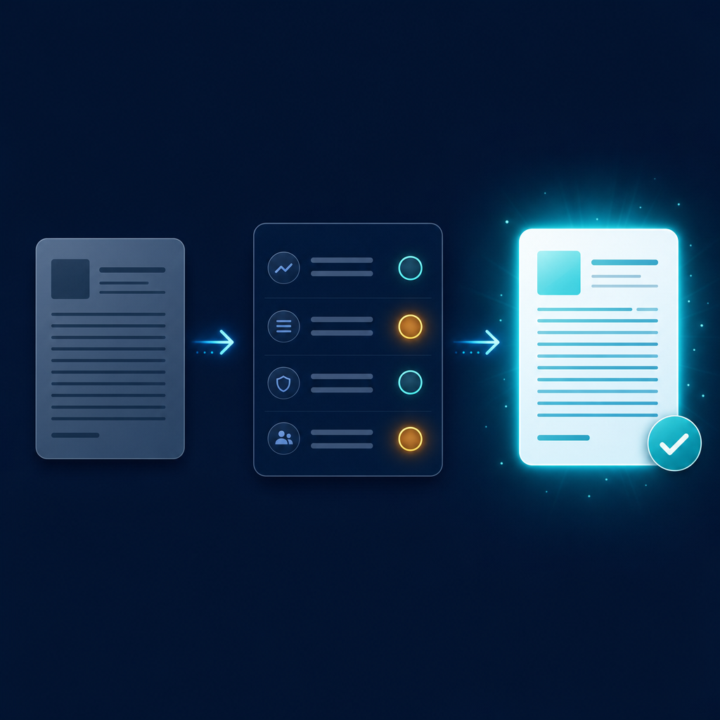
The rubric trick: how to make ChatGPT grade its own work and fix it
Most people accept ChatGPT's first answer, tweak it a bit, and move on. The single biggest upgrade you can make is to stop treating the first draft as the answer and start treating it as something to be marked. Here's the move. You give ChatGPT the task, then you hand it a rubric, the same criteria you'd use to judge the work yourself, and you make it score its own draft against that rubric before you ever see it. Then it rewrites to fix its lowest scores. Say you're writing a cold email. Most people prompt: "Write a cold email to a marketing director offering our service." You get something generic. Instead, try this: "Write a cold outreach email to a marketing director. Then score your own draft from 1 to 10 on each of these: 1) does the first line earn the second, 2) is it about them not us, 3) is there one clear ask, 4) would a busy person read it in under 15 seconds. Show the scores, then rewrite to fix anything under 8." Now you're not hoping for a good email. You've told it what good looks like and made it run the editing pass you'd normally do yourself. Two things make this work. First, the rubric is where your expertise goes. You know what a good email, landing page, or proposal needs, so you encode it once. The model is far better at applying a clear standard than inventing one. Second, asking for scores forces it to actually evaluate instead of just rephrasing, and it will usually catch its own weakest spot before you have to. Save your favourite rubrics and reuse them. A good-email rubric, a good blog-intro rubric, a sales-call-summary rubric. Over time that's a quiet quality system running on every task. What's a task you'd want a rubric for? Tell me the task in the comments and I'll help you build the criteria.
7 likes • Jun 26
I like this. I'll put this idea to use with other things I ask Chat for help with.

🔥
May 29 •
I am so excited
I just fell in love with AI, I created my very first Oracle Shuffler Artifact. All images created on CHATGPT and all coding with Claude. Tada. I hope I am allowed to share this here: https://sacredselflove.netlify.app/
4 likes • Jun 8
This is awesome!! Thank you for sharing.
1-6 of 6

@marybeth-mahan-3146
Private Practice in mental health and addictions.
Online now
Joined Sep 6, 2025
Powered by