Activity
Mon
Wed
Fri
Sun
Apr
May
Jun
Jul
Aug
Sep
Oct
Nov
Dec
Jan
Feb
Mar
What is this?
Less
More
Memberships
Royalty Guild. Amazon KDP
251 members • Free
Driven Publishers
4.1k members • Free
Publisher Mastery (KDP Course)
3.2k members • Free
The 1% KDP Publishing Club
1.2k members • Free
16 contributions to Royalty Guild. Amazon KDP

12d •
Interesting case study
I stumbled upon this YouTube channel by accident. Obviously, it's a fake AI sheikh spreading wisdom (this puts fake gurus on a whole other level. :D). Out of curiosity, I decided to check how many followers the creator has and what it is all about. To my surprise, it turns out it is about selling a book. The book is probably written by ChatGPT as well. I don't actually know and don't really care. But it is a great example of how each author finds their own unique way. This particular one has about 50,000 followers and is advertising to them for FREE. He is also selling his book directly via his own website. No commission for Amazon, no waiting two months to receive his royalties, not even bothering with reviews.I think it is an interesting case study. It is not my path, but I respect this guy's creativity and resourcefulness. Not only is the author not worried about the rise of AI, but he is utilizing it very well.What do you guys think? Do you know of other interesting and unorthodox ways to sell books? (Just to be clear, I am not promoting this author. I don't know him, don't really like his videos, and I haven't seen his book. I just find his strategy an interesting case study. Also, I am not even sure if it is working well and to what extent.) https://www.youtube.com/@TheSheikhTariq/shorts
1 like • 12d
@Thomas Juuls very interesting additional information. Is YT paying creators for shorts (when they are watched)? Can the guy actually be making money from his book ads? :)

27d •
The Uncomfortable Truth About KDP's Future (And What To Do About It)
I've been sitting on this post for a while because I wanted to make sure I wasn't just being dramatic. After months of watching the space closely, I'm convinced this isn't fear-mongering — it's pattern recognition. Here's my honest breakdown of where Amazon KDP is headed — for all of us. The Ground is Already Shifting Under Our Feet KDP is currently the frontline of AI disruption. The market isn't just "getting competitive" — it's being flooded with synthetic content at a scale we've never seen before. Amazon knows it. That's why they're actively rewriting the rules: algorithm changes, royalty structure tweaks, review policy updates. The A10 algorithm shift wasn't accidental. They're trying to manage a glut they didn't anticipate, and they're doing it in real time. If we've noticed our organic rankings slipping over the past year, we're not imagining it. The playbook that worked in 2022 is now actively working against us. The Next 1–2 Years: We're No Longer Authors. We're Media Buyers. Here's the hard pill: writing a well-structured, 30,000-word book is no longer a differentiator. We can produce it in a day. Execution — the thing we used to compete on — has been commoditized overnight. And before anyone says, "just write better, more human content," readers can't actually tell the difference anymore. That ship has sailed. Competing on the quality of the text itself is a losing game, regardless of how it's produced. So what actually wins now? External attention. Amazon's new algorithm heavily rewards books that arrive with an audience already attached. That means the winners over the next two years won't be the best writers. They'll be the best digital marketers — the ones building newsletters, growing YouTube followings, nurturing Skool communities, and then pointing that audience toward their books. Our identity in this business has to evolve. We need to think of ourselves less as authors and more as media brands that happen to publish books. The second piece of this is what I'm calling the trust premium. Readers are already experiencing AI fatigue, even if they can't name it. They can feel when a person is behind something — not because the writing is better, but because the marketing is authentic, the niche is specific, and the face behind the brand is real and present. Verifiable human presence and transparent, specific marketing will convert dramatically better than anonymous, optimized content. Our humanity isn't in the text anymore. It's in how we show up off the page.

3 likes • 26d
Thanks, @Igor O! Thoughtful and helpful post, as usual. Here’s an interesting article on the same subject, but with a broader perspective: not just about books and writing, but about any industry. https://x.com/mattshumer_/status/2021256989876109403
Feb 19 •
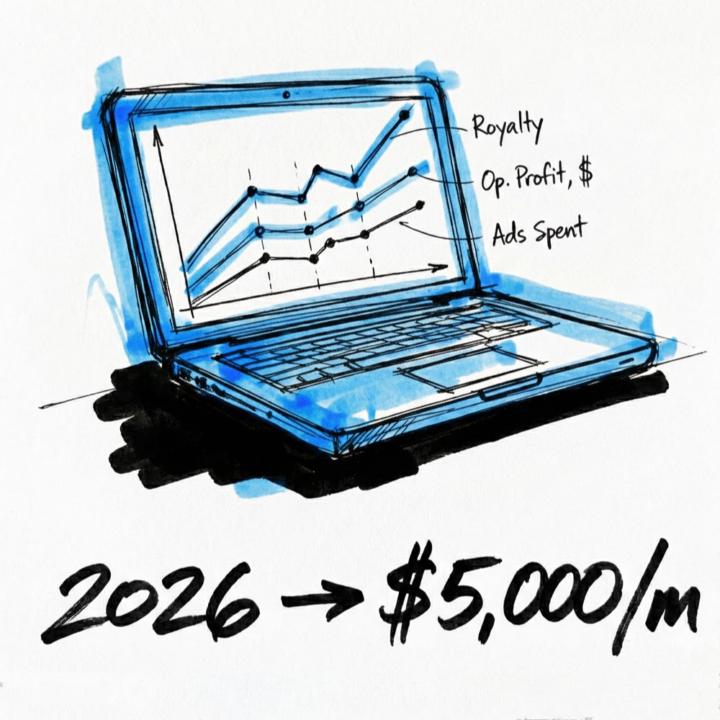
Join Me: $5,000/Month KDP Challenge in 2026
You saw the chart. Eight months, 22x royalty growth, 15x profit. Not magic – process. Now I'm setting the next target: $5,000/month by the end of 2026. And I'm doing it publicly, with full transparency on what works and what doesn't. Here's what changed in my thinking going into this year. Low-content got me to $50/month on autopilot. Switching to a quality-first mindset got me past $3,000. But scaling further requires something I spent the last few months building: a repeatable system that doesn't depend on my mood, my schedule, or lucky niche picks. I'm calling it the Guided Publishing System. It's not a course. It's not a prompt pack. It's a structured workflow — built around the idea that AI can do the heavy lifting in execution, while the decisions, creative direction, and judgment calls stay with us. That's what produces defensible, platform-compliant books that actually sell. And that's what separates publishers who plateau from publishers who compound. I'm not ready to open it up fully yet. But I'm looking for a group of serious publishers – people already making something on KDP, already past the "does this even work?" phase – who want to run this alongside me in 2026. What that looks like in practice: Real numbers shared. Real process documented. No cheerleading – just what's working, what broke, and how I'm adjusting. If you're plateaued somewhere between $50 and $1,000/month and you're done waiting to figure out what the next level actually requires, this is worth paying attention to. If $5,000/month is a thing of the past for you, it's amazing! Let's target 5x growth, for example. More details on the Premium tier upgrades will be available soon. Watch this space. --- The chart shows my trajectory from Jan-25 through Dec-25. Your numbers will be different. I hope you will crash it.
4 likes • Feb 20
Hey Igor. This sounds interesting. What is required to join the challenge?
Feb 9 •
Reviews for Paperback via Facebook
Gathering feedback from Facebook groups and through Facebook ads, compensating readers for your book purchase, and, hopefully, converting that into Amazon reviews is a good strategy. But even the previous sentence sounds a bit complicated. Not to mention actually building a system for corresponding with potential readers, tracking who is at what stage, and tracking compensation (both to prove to Amazon that the reader received only compensation and not a reward, and for tax accounting purposes). What are your thoughts on the topic? Do you use such a system? If yes, how do you organize it?

4 likes • Feb 11
@Igor O that's just one function. There are many more. Like replying to Facebook comments for example. There are tutorials on YouTube.
3 likes • Feb 13
@Laura Diaz I only use Meta ads. So far they've worked pretty well. My ROI for December was 240%. January however was bad: 40%. Maybe because I published some new books with ROI around 0%. So, ask me again in a few months. 😄
Feb 7 •
❓Are We at a Turning Point with Reviews?
Last month, I saw increasing evidence that the November and December review sweep could be more than just a campaign. In very simple words, probably every book has gathered reviews in a non-organic manner in the crosshairs of Amazon's bots. Obviously, Amazon is prioritizing marketplace integrity and authentic reader feedback. This has led to increased scrutiny of practices like certain ARC teams, bulk review solicitation, and "book pulsing," as these may deviate from "organic" review rates. If you were a member of Amazon's marketplace integrity team and you saw a book, published two weeks ago, with 50 reviews. It's not J. K. Rowling's book, nor even Alex Hormozi's. Can you believe they're genuine, unsolicited reviews? How PROBABLE is it that it's just a regular, but lucky book? So, it seems every book with an atypical number or velocity of reviews could now be a target. We know that on Amazon, 1-2% of sales result in reviews. This means that for every 100 books sold, you could get 1-2 reviews. If a book has 20 sales and 17 reviews, is it really probable? I remember times when we could stuff keywords in white text on a white background, and it worked. After some time, Google penalized it. Okay, let's add the right proportion of keywords to the text, but don't worry about text flow for human readers. After some time, Google penalized it. Amazon: add major keywords to the title, subtitle, and seven keyword fields whenever possible. It worked until it didn't. "If your book has fewer than 50 reviews, do not even try to promote it." Maybe it still works, but maybe tomorrow you will read the "Account Suspended for Review Manipulation" email. What are your thoughts on this?

7 likes • Feb 7
I see this as a positive development. It levels the playing field, filters out many bad actors, and gives customers a more realistic understanding of what they’re buying.
1-10 of 16

Active 1d ago
Joined Nov 11, 2025
Powered by