Activity
Mon
Wed
Fri
Sun
Aug
Sep
Oct
Nov
Dec
Jan
Feb
Mar
Apr
May
Jun
What is this?
Less
More
Memberships
Mastering.com Members Club
36.8k members • $8/month
Backstage Tech Skool
101 members • Free
Sound Guy 101
232 members • Free
12 contributions to Sound Guy 101

May 1 •
Do you make money with music?
Hey everybody! I want to get a conversation going here. It’s been a little quiet, and we have people all across the globe here who are interested in Audio Engineering!! Let’s learn from each other and get to know one another! My question is this: Do you make money with music? If so, what’s the biggest part of your income?; Weddings? Sports? Conferences? Festivals? Bar gigs? Studio work? Mixing or mastering? Myself, I make most of my living by doing live sound at weddings, corporate events, and playing in bands on festivals, weddings, and in bars. I have other smaller income streams through lessons, mixing/mastering, and consultation. What do you do??? What’s been the most profitable area of your business? And if you’re not making money yet, what’s in the way? What would need to happen for you to make this a full time job? Can’t wait to hear from you all. I hope you’re having a great day! ~Jon

0 likes • May 3
I’m not making as much money from audio as I’d like yet, or as consistently as I’d want, but I’m actively working on changing that. Most of the opportunities I’ve had so far have been more about experience than actual pay (sometimes literally just food haha), and I’ve reached a point where I don’t want to stay in that phase anymore. I’ve learned a lot, but I’ve also realized that the time and effort I’ve invested should be valued. Because of that, I’m being more intentional with how I move forward. I’ve been learning video editing to offer services to audio-focused content creators, and I’m starting to charge more consciously for my knowledge (in Pro Tools and music theory when collaborating) I’m also realizing that sometimes it’s not just about improving skills, but about learning how to set boundaries and work with people who actually respect what you bring to the table. That part has honestly been just as important as anything technical. I do believe you can learn something from every experience, but I also think a lot of people stay stuck in the “experience phase” longer than they should. I’m trying to move past that now, and build something more sustainable. And when I’m in a position to do so, I’d like to support others in the way I wish I had experienced earlier.
0 likes • May 5
@Bruno Destefanis I feel this a lot. It’s wild how much money there is in the entertainment industry haha. It took me time to learn to value my work, and it’s not an easy or very structured path. I do feel lucky to find people like Jon who create community and make the process less isolating. Really appreciate you sharing this. Always open to learning how others are navigating this space (:
May 3 •
Sound Guy 101 course
I finished the course and honestly, it was really helpful!! If you’re just starting, it gives you a clear foundation and helps things make sense much faster. But even if you already have some experience, I feel like it helps you connect what you already know with the right terminology and concepts. That’s been a big one for me, going back to the basics. If you have that solid foundation, it’s much easier to move forward, which is where I’m at right now. I’ve been around audio for a while, but I didn’t always have the vocabulary to explain what I was hearing or doing, and this helped fill that gap. Honestly, I thought I knew some things… turns out I didn’t fully 😅 (I even missed a couple of quiz questions haha) For me at least, it’s not just about learning new things, but about understanding better what you already kind of know. If you’re on the fence, whether you’re a beginner or already have some hands-on experience, I’d say it’s worth checking out (: Thanks, Jon!! -Ponce
1
0

0 likes • May 3
I see studio and live sound as two completely different skill sets. Studio work is controlled, which forces you to focus on detail, quality, and precision. There’s nowhere to hide, if something’s off, it shows. Live sound is the opposite. You don’t have full control, so it becomes about reacting in real time and solving problems on the fly. It’s more unpredictable, but that’s also what makes it exciting. To me, they complement each other. Studio teaches you critical listening and attention to detail, while live teaches you adaptability and decision making under pressure. If anything, I think doing at least a bit of both makes you a better engineer overall(:
Feb 3 •
Analog or Digital?
Hey Sound Guys and Gals, I’m curious to know if you have any experience using a mixer. And if so, do you use an Analog or Digital mixer? Let me know what you guys are working with!
0 likes • May 3
I’ve had some exposure to both analog and digital setups, mostly in educational environments and small conference style gigs. From my experience, analog felt more focused, transparent and direct. The signal flow is very clear and easy to follow visually, and that helped me understand the fundamentals much faster. With digital consoles, I feel like there’s a bigger learning curve. I had to spend time figuring out menus, routing, matrices, FX, groups, and especially how to recall scenes or configurations for recurring events with small adjustments. It’s powerful, but it definitely takes more intentional learning. I briefly worked with a Soundcraft Ui24R and even though it wasn’t for long, getting into the wireless workflow with a router and an iPad was really interesting. The band was also using in-ear monitoring. I wasn’t very involved in that part, but it gave me a glimpse into a different way of handling monitoring. Most of the gigs I was around were more conference oriented, like mic setups, quick changeovers between speakers, and some Zoom integrations, so my role was pretty basic. Still, being around those setups helped me start connecting the dots. Right now I think of analog vs digital like manual vs automatic cars. Same destination, just a different way of getting there. One makes you understand every step, the other lets you move faster once you know your way around.
Apr 24 •
Do you do video?
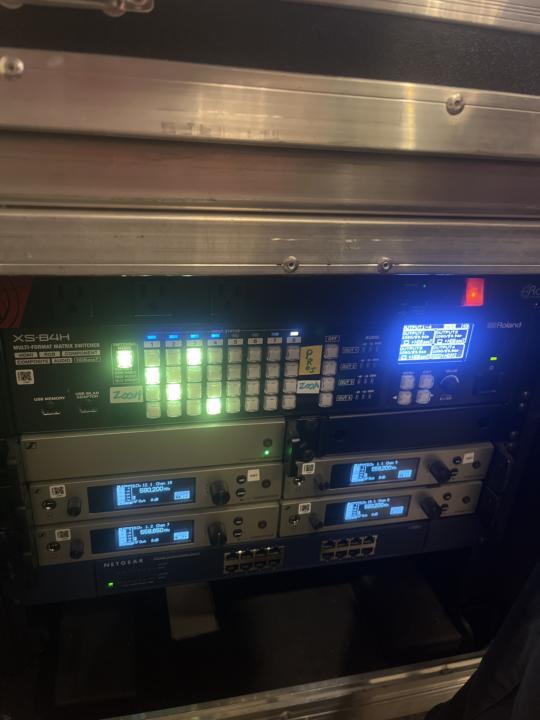
I’ve been having to do video a lot lately with my AV work. Multi ins and outs, it’s pretty cool. I still have a lot to learn about resolution, EDID, and bandwidth protocols. But so far so good, I’m loving it. Sometimes the videos these doctors are playing aren’t really what I want to see at 7am in the morning…. But hey, it’s work! Wondering if you do a lot of video in your work, and what was the most helpful thing for you in acquiring video skills?
1 like • Apr 24
I’ve been getting into video a bit lately, mostly from the editing side, so I’m still pretty new to the technical side of things It’s been interesting to see how some concepts overlap with audio, but things like EDID and bandwidth definitely feel like a whole different world haha So far, what’s helped me the most is just experimenting and trying to understand what’s actually happening rather than just making things work And yeah… I can imagine 7am content in that setting is not always ideal haha
1-10 of 12
Active 25d ago
Joined Feb 3, 2026