Activity
Mon
Wed
Fri
Sun
Aug
Sep
Oct
Nov
Dec
Jan
Feb
Mar
Apr
May
Jun
What is this?
Less
More
Memberships
Copywriting Launchpad
5.4k members • $5/month
Unboring University
1.7k members • Free
Daily Email House
497 members • Free
26 contributions to Daily Email House

8d •
Look what I found in a sales page.
- Bejakovic’s Crooked Line: There’s a strange type of proof which conventional sales pages never include. But when you use this strange proof the way Sam does, you build massive respect and trust. When you're methods are quoted as a bullet point you've really made an impact.

3 likes • 6d
Looking forward to the day that Bejakovic turns up as one of the 'greats' in an actual book haha. These days copywriting has been watered down to 'creative strategist'...which is actually marketing with extra steps. A far cry from the old-school Mad Men era. If only we could get back copywriting's old prestige...

21d •
What random ideas from courses have been valuable?
In another thread, @Susan Moore writes: === I've taken courses that I didn't finish. But the amount of studying I did do, combined with related unfinished courses, and my own work and life experiences has all added up to this cumulative knowledge and insight I simply would not have without my messy inclinations and unfinished courses. === In that thread, I had an example of a course I didn't finish or implement when I got it, but which still gave me an idea that ended up being useful to me years later. This got me wondering, have you had experiences like that? I mean, have you ever found... A valuable idea or tactic or strategy that you got from a course that you never never finished? Or an idea or tactic or strategy that you got from a course, which you didn't use at the time, but which you used and profited from years later? Or a a tangential idea that somebody dropped in a course or training, which you ended up using, even though it was almost irrelevant to the main thing being taught?
3 likes • 21d
Recently a client asked me to put together webinar slides from scratch, for a partner speaker in the financial loans niche. The speaker did give us an outline and main pain-point to center the webinar around. But for him to put together the slides himself...that would take longer than we'd need. I remembered some past Chris Orz trainings. How I actually enjoyed his minimalistic slides (1-2 colours only, 1-2 visuals per slides, 1-2 points per slide...very straightforward). And how for every subtopic, it was like Problem, to Past Solutions, to Key Gaps, to Better Solution, to Case Studies. Orderly. So I modelled after Chris Orz's approach into the loans slides. Wrapped it up in a few hours. The webinar speaker liked them. Didn't have much revisions to make. And the webinar on that very date went well without a hitch. I think this is why we need to have good online courses, made with care, value and proper design. Because the students watching or reading them up-- could become future trainers and experts, in their own right. If we want more quality folks and work to spread throughout the business world...instead of the snake-oil rubbish or AI drivel we get too many a time...it starts with the right trainers, authors and coaches pushing out quality material.
24d •
High percentage of failures
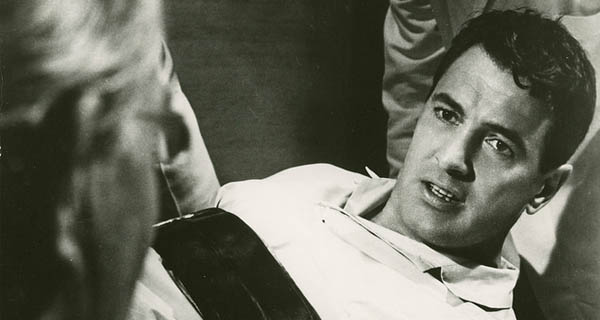
I recently rewatched an old movie called Seconds. Uncomfortable, but also very interesting. I won't give away the plot here, in case you ever want to go see it yourself. I'll just share a quote I wrote down, because it was relevant to what we all do: "You know son, when I began this business, I was a young man with an idea. I wasn't aiming to make a lot of money. Helping others, help them to find a little happiness. Oh heck, not just the rich. You see, I got tremendous comfort in the thought that in my small way I was waging a battle against human misery. And I was, too! Except we do have a high percentage of failures. I guess that's to be expected, but it hurts me." If you are in the information selling business... I reckon you got into it at least in part to wage a battle against human misery, in your own small way. I also reckon that you have a high percentage of failures. Regardless of how good your information is. Regardless of how accessible you try to make it. Regardless of how hard you try to motivate people. People just don't get the results that you know are possible, or any results at all. Does this hurt you? Do you just shrug it off and say, "That's to be expected"? I'm curious about your experiences, what you think about this, and what if anything you do about it. Let me know. And if you like I can share what my experiences are and what I think and do.
2 likes • 23d
I feel we shouldn't be worried about 'failure rates'. Because even though we might do all the good practices out there, it might still not work out too. For a whole lotta reasons (due to season, market saturation, etc) The least we can do, I believe, is to ensure the mistakes we make along the way don't kill us right away.
1 like • 22d
@John Bejakovic I'll give a quick example, since it's happening to me and a few of my clients: Recently ALL, not just one of the social media platforms out there are screwing up with shadowbans, tech hiccups and more. If you were spread out across multiple channels to keep up traffic and business going, the hits wouldn't be so bad. Maybe those platform issues were caused by some kind of rule break...but you can settle them. But if let's say you were 100% reliant on Tiktok for traffic and suddenly your content gets caged into the 0 views shadowban...you are in hot soup. Your business traffic is good as dead, because all your traffic has been taken out.
May 28 •
Do you have a welcome sequence?
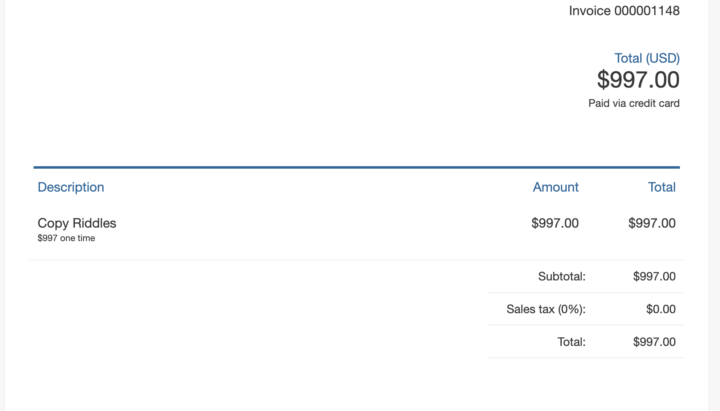
This morning I woke up and saw that i have a new ThriveCart order notification. I'm not promoting anything new, I have no current deadlines, and this was not simply a rebill notification for a Daily Email Habit subscriber. What could this order be? I opened up the email to see: DESCRIPTION: Copy Riddles AMOUNT: $997.00 I started to pat myself on the back. For one thing, it's always nice to get a $997 course sale. For another, I figured that this emails an email I wrote a few days ago, in which I promoted Copy Riddles, can now go into my "Emails that did well" file. And sure enough, the dude bought thorugh that email ("A new episode about clever product names"). Only one problem though... The dude got onto my list on May 18. He bought today, May 28. I haven't reached out yet to this guy. I don't know what he knows about me, how presold he was, or whether this email really did do magic. I suspect that ANY decent email promoting Copy Riddles might have gotten this guy to click through, at which point, maybe the sales page is what really sold him. On the flip side, had I not sent this email a few days ago, promoting Copy Riddles, odds are excellent I would NOT have made this sale. That's an argument for regularly promoting offers from your back catalog in your daily emails. It's also an argument for having a welcome sequence, in which you gradually guide new people along through the offers you have. I don't have a welcome sequence. I'm apparently losing money. Do you have a welcome sequence? Why or why not?
1 like • Jun 3
Yeah I always get my clients to do welcome sequences, especially if they got some free course or webinar to start off clients with. I've noticed that it does go a long way to keep folks 'loyal', judging from the follow-up click-thrus (as shallow as this metric may be) and sales. Sometimes I wonder if the welcome sequence could be adapted for a paid product though, like some email-delivered 10-20 Day Challenge kinda thing. So I try not to give all the goodies out right there and then.
May 11 •
Money Mondays: How much of it is there?
In another thread, @Katie James writes: "The unbroken rule in every group I'm in but this one is 'Don't talk about money' Which sort of sucks because earning money is a necessary part of life." Even in this group, we don't talk money all that much. Let's change that. I don't even know where to start. But in the interest of getting money talk off the ground, I'll take a stab at a first money topic, one that's not too intimate but that can still be enlightening (we can build up to intimate). So here's my question for you. Answer it based on your gut feeling, not logic: ====>>>> How much money is there in the world? In other words: Is money a finite quantity, like real estate or diamonds, so that if you get some, somebody else has to be denied? Or is money effectively infinite, where we can all have as much as we are comfortable with, like air or sunlight or ideas? Let's talk money. If you're game, write in the comments below how much money you think there is in the world, because getting clear on this can help you make more money. And like Katie says above, that's a necessary part of life.
1 like • May 12
I like what Kiyosaki said in his earliest books: 'Money is an idea' And how MJ DeMarco in UNSCRIPTED talked about how money has always changed from trinkets, to barters, to British pounds, US dollar, and even Fallout bottle caps (in future??)...the only thing that never really changes is that it facilitates better relative value to reach people. So yes, it is effectively infinite. Central banks put a numerical figure so that folks stay within the set order of things haha.
1-10 of 26

Active 6d ago
Joined Oct 27, 2025
Powered by